



by Bruce Keith, on September 12, 2026
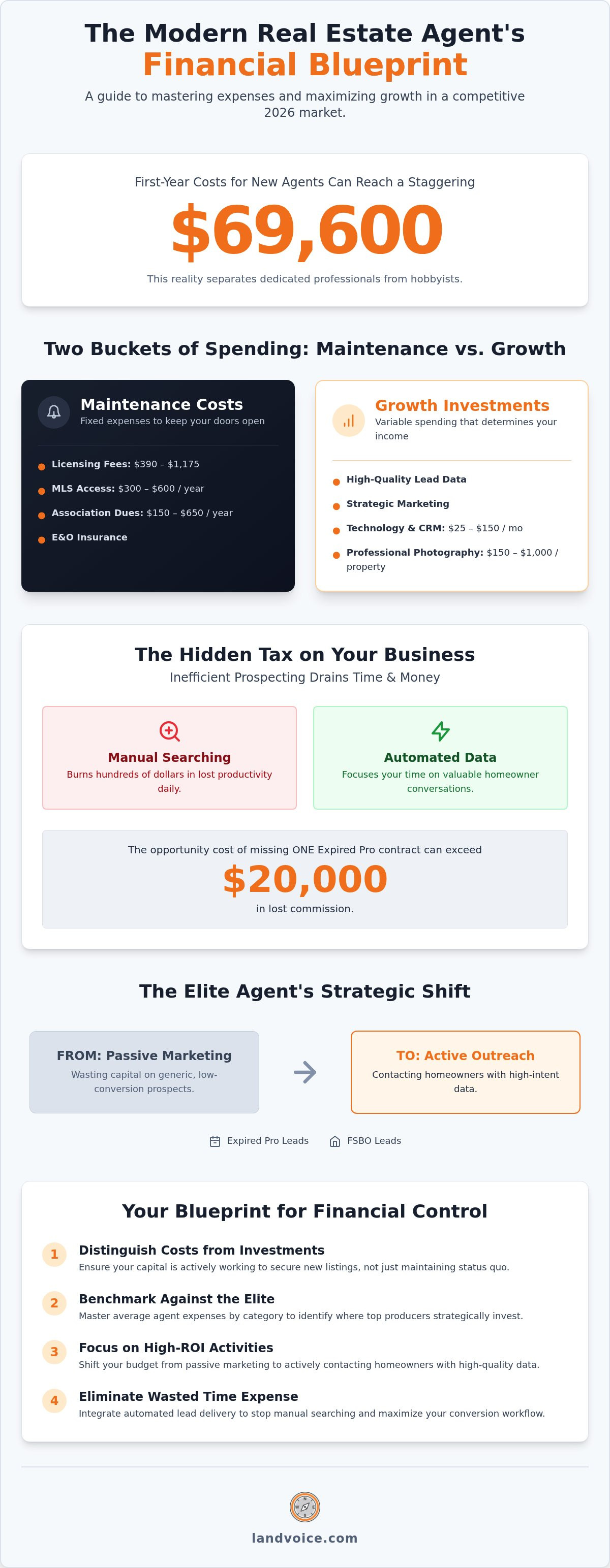
New real estate agents in 2026 often face a staggering reality where first-year costs can hit $69,600. It's a brutal figure that separates those who treat this as a hobby from those who build a legacy. You've likely felt the anxiety of market shifts tightening your budget while your overhead remains high. Mastering the average real estate agent expenses by category is no longer optional; it's your survival manual for a competitive industry.
We agree that the confusion over which tech tools are actually essential is exhausting. You want a clear benchmark for your spending and a strategy to eliminate the wasted time expense of manual lead searching. This guide promises to transform your business finances by showing you exactly where elite agents invest to secure more listings. We will provide a roadmap for scaling through smarter investments in high-quality data from Landvoice.
You'll learn how to pivot from passive marketing to active results. We'll analyze everything from licensing fees and brokerage splits to the specific technology that makes contacting homeowners a predictable science. It's time to stop guessing and start executing with a budget built for growth. Follow this guide to cut low-ROI expenses and reclaim control of your professional future.
Key Takeaways
- Distinguish between maintenance costs and growth investments to ensure your capital is actively working to secure new listings.
- Master the average real estate agent expenses by category to benchmark your spending against the industry's top-producing elite.
- Stop losing money on passive marketing and shift your focus to high-ROI activities like contacting homeowners using Landvoice data.
- Execute a 30-day financial audit to identify low-yield expenses and clear the path for high-precision tools like Expired Pro.
- Eliminate the wasted time expense of manual lead searching by integrating automated lead delivery directly into your daily conversion workflow.
The Reality of Real Estate Agent Expenses in 2026
Success in 2026 demands a more aggressive approach to your budget than ever before. The industry has shifted. Transparency is higher; competition is sharper. You can't rely on the same old numbers from five years ago. To win, you must view your budget as a tactical weapon. Top-tier agents don't see costs as money lost. They see them as capital deployed to secure listings. This mindset separates elite performers from those who simply struggle to survive.
Fixed vs. Variable Costs: Defining Your Baseline
Your baseline includes the non-negotiables. These are the fixed costs like licensing, REALTOR association dues, and E&O insurance. While necessary, these don't grow your business. This Real estate agent overview highlights the foundational requirements of the profession, but your real income happens in the variable bucket. When you analyze the average real estate agent expenses by category, it's clear that the biggest differentiator is where agents choose to spend their variable dollars.
- Fixed Costs: Licensing fees, MLS access, and mandatory insurance. These keep your doors open.
- Variable Costs: Marketing, lead data, and technology. These determine how much you earn.
Most agents fail because they starve their growth bucket. They treat their business like a liability rather than an investment. Elite performers over-invest in lead acquisition to guarantee a steady pipeline. They move from a scarcity budget to a scaling budget, knowing that every dollar spent on high-quality data is fuel for their listing engine.
The Hidden Cost of Inefficient Prospecting
Efficiency is the ultimate currency. Many agents think they're saving money by manually searching for homeowner information. They're wrong. If your goal is to earn a high six-figure income, your time is worth over $100 an hour. Spending half your morning hunting for phone numbers means you're burning hundreds of dollars in lost productivity every single day. Low-quality data acts as a silent tax on your business, draining your energy and killing your conversion rates.
High-performing professionals eliminate this wasted time expense by partnering with Landvoice. It provides the technical superiority needed to start making more contacts immediately. The opportunity cost of missing just one Expired Pro contract due to poor data can exceed $20,000 in lost commission.
Breaking Down Real Estate Business Costs by Category
Dominate your market by dissecting your budget with surgical precision. Analyzing the average real estate agent expenses by category reveals a clear divide between those who simply maintain a business and those who scale an empire. You must stop leaking cash on low-ROI activities and start fueling your growth engine with intentional spending. Every dollar you allocate should be a calculated move toward securing your next listing.
Administrative and operational costs are your table stakes. Initial licensing costs typically range from $390 to $1,175, while annual MLS access adds another $300 to $600 to your ledger. According to the NAR Member Profile, professional association dues usually cost between $150 and $650 annually. These are fixed requirements, but they don't generate revenue. To drive income, you must look toward professional development, such as expert-led coaching, and high-impact marketing. Professional listing photography alone can cost between $150 and $1,000 per property, making it a significant but necessary variable expense.
Lead Generation and Data Acquisition
High-intent data is the lifeblood of a top producer's pipeline. You shouldn't waste capital on generic pay-per-lead services that offer diluted, low-conversion prospects. Instead, focus your budget on specialized feeds like Expired Pro and FSBO leads. These sources represent homeowners who have already signaled their intent to sell. Choosing an annual SaaS subscription with Landvoice provides the most effective rate for long-term growth. It ensures you have a consistent, high-quality stream of contacts without the volatility of third-party lead platforms.
Technology Stack and Prospecting Tools
Your technology stack must be built for execution, not just organization. While a CRM is essential and usually costs between $25 and $150 monthly, it only works if you're feeding it quality data. Tools like Neighborhood Search allow you to build local dominance by targeting specific high-value areas. Integrating call capture technology further optimizes your spend by tracking which marketing channels actually drive engagement. You can see how these tools integrate into a high-performance workflow to maximize your daily outreach. Focus your tech investments on making more contacts; everything else is just noise.
ROI Analysis: High-Yield Lead Data vs. Passive Marketing
Stop throwing money at passive branding that offers no immediate return. Passive marketing is a gamble; active homeowner outreach is a strategy. When you evaluate the average real estate agent expenses by category, it's clear that top producers prioritize high-intent data over broad-spectrum awareness. You need results today, not "brand recognition" six months from now. Direct outreach puts you in the driver’s seat of your own income.
The math of a listing is simple. One Expired Pro contract doesn't just pay for itself. It justifies your entire data budget for the year. Contacting homeowners directly provides a predictable path to revenue stability that passive ads cannot match. Most agents suffer from expense leaks where they waste thousands on low-intent traffic from social media. These platforms are often a sinkhole for seller acquisition because they target users who aren't ready to act. You need to focus your capital where the motivation is already high.
The Power of Niche Lead Sources
Generic leads are expensive and competitive. High-intent FSBO leads represent sellers who are already active in the market; they have a problem you can solve. While generic Facebook leads might cost less per click, the cost-per-listing is significantly higher due to low conversion rates. According to the Occupational Outlook Handbook, agents must be proactive and persistent in their work environment to succeed. This means moving toward sources that other agents ignore.
Using pre-foreclosure leads offers a tactical advantage. This niche provides a unique entry point with far less competition than traditional listings. You aren't just another agent; you're a solution provider. For a deep dive into converting these specific opportunities, refer to our FSBO Leads for Real Estate Agents guide. It maps out the exact conversion strategies needed to turn data into commissions.
Investing in Professional Coaching
Coaching isn't a bill. It's an investment in your most valuable asset: yourself. When you analyze the average real estate agent expenses by category, you'll see that the highest ROI often comes from professional development. High-performance coaching helps you master scripts and objection handling for elite-level prospecting. It eliminates the hesitation that keeps average agents from making more contacts. When you have the confidence of a veteran, your conversion rates skyrocket. Landvoice provides the data, but coaching provides the skill to close. Don't let your budget be a list of costs; make it a roadmap for your inevitable growth.
How to Audit and Optimize Your Agent Budget
Stop letting your profits leak through unmonitored subscriptions and dead-end marketing. You must audit your financial output to ensure every cent is an investment in your future. Auditing the average real estate agent expenses by category reveals exactly where your capital is working and where it is being wasted. This isn't just about saving money; it's about reallocating resources to the activities that actually put you in front of sellers.
Follow this five-step framework to reclaim your profitability. First, track every single dollar for 30 days to identify subscription fatigue. Second, categorize each expense as either 'Maintenance' or 'Growth.' Third, eliminate any marketing channel that hasn't produced a lead in 90 days. Fourth, reallocate those saved funds into high-intent data sources. Finally, set a specific 'Contact Goal' that justifies your new investment. If you aren't making more contacts with your data, the investment is being wasted.
Trimming the Fat without Cutting the Muscle
You need to distinguish between vanity metrics and actual listing appointments. Likes and shares don't pay the bills; signed contracts do. Consolidate your tech stack to remove redundant tools that serve the same purpose. For example, teams can leverage LicenseIQ to discover and recover wasted spend on Microsoft 365 licenses, keeping overhead lean. Most importantly, you should never cut your lead data budget during a market slowdown. This is the muscle of your business. Cutting your data source when the market tightens is like a runner stopping their hydration during the hardest part of the race; it guarantees a total collapse.
Top-tier agents understand that growth is a perpetual cost. Maintaining a competitive edge requires a deep understanding of the average real estate agent expenses by category and a willingness to pivot when ROI drops. You must reinvest at least 20% of every commission back into prospecting to maintain momentum. Create a dedicated 'Growth Fund' specifically for niche data and Landvoice tools. Consistent reinvestment in high-quality prospecting data creates a recession-proof pipeline that keeps your business stable regardless of market shifts.
Scaling Your Business with High-Precision Lead Data
Scaling your operation requires a fundamental shift from tracking the average real estate agent expenses by category to optimizing your conversion workflow. You've audited your budget. You've trimmed the fat. Now, you must deploy your capital where it creates the highest leverage. Landvoice provides the technical superiority you need to separate yourself from the pack. It's the difference between guessing where your next deal is and knowing exactly who to contact every morning.
Efficiency is the bridge between a struggling agent and a market leader. Having Expired Pro and FSBO data delivered directly to your dashboard eliminates the friction of manual lead research. You stop being a researcher and start being a closer. This transition moves you out of survival mode and into a position of dominance. Disciplined outreach, fueled by precision data, ensures your calendar stays full of listing appointments. You are no longer at the mercy of the market; you are the one driving the results.
Your Competitive Edge in a Crowded Market
Professional stability starts with a steady flow of high-quality leads. You cannot build a legacy on shaky data. With 30 plus years of industry experience, Landvoice treats data as a proprietary gold standard. You gain an immediate advantage by using tools like Inked to identify and win more listings before your competitors even know they exist. These proprietary assets provide the technical superiority required to establish yourself as the gatekeeper of your local market. When you master the average real estate agent expenses by category, you realize that high-precision data is the only investment that guarantees a competitive edge.
Take Action: Your Next Listing is One Contact Away
The time for research is over. The time for execution has begun. Your next listing isn't a matter of luck; it's a matter of making more contacts. You have the roadmap for your 2026 budget. You know which categories to fund and which to cut. Now, you must secure the data that makes success inevitable. Visit the Landvoice pricing page to choose between monthly and annual plans that fit your growth strategy. Annual subscriptions offer the best effective rate for agents committed to long-term market leadership. Stop guessing. Start winning. Visit the Landvoice homepage today and take control of your pipeline.
Own Your Market in 2026
You now have the definitive blueprint for financial dominance. Understanding the average real estate agent expenses by category is just the first step toward professional stability. You've learned how to audit your budget, trim the fat, and reallocate your capital into high-ROI growth buckets. The time for research is over. It's time to execute.
Shifting your capital from passive branding to active outreach is the only way to secure more listings in this competitive landscape. By partnering with Landvoice, you gain access to 30 plus years of industry-leading data precision. You get specialized leads for Expired Pro, FSBOs, and Pre-Foreclosures delivered directly to your dashboard. When you combine this proprietary data with motivational coaching from high-performance experts, your professional growth becomes inevitable. You're no longer just an agent; you are a market leader with a recession-proof pipeline.
Stop guessing where your next listing is coming from. Start making more contacts and take control of your pipeline today. The competitive edge you need is within reach, and your next listing is just one contact away. You have the tools and the strategy. Go out and win.
Frequently Asked Questions
What is the biggest expense for most real estate agents?
Marketing and lead acquisition typically represent the largest portion of the average real estate agent expenses by category. While fixed costs like licensing and MLS fees are mandatory, top producers often allocate over 30% of their gross income toward active prospecting. This includes high-precision data subscriptions and CRM tools. Investing in lead sources that provide direct contact information for motivated sellers is the most efficient way to ensure these expenditures translate into closed commissions.
How much should a new real estate agent spend on marketing per month?
New agents should expect to spend between $300 and $3,000 per month on marketing depending on their growth goals. It's critical to have a financial runway of at least six months before starting. Instead of broad branding, focus your limited budget on niche data that allows for making more contacts immediately. Prioritizing high-intent leads over expensive social media ads ensures your early marketing dollars generate a faster return on investment and stabilize your pipeline.
Is paying for lead generation data like Landvoice worth the cost?
Yes, because high-quality data from Landvoice eliminates the wasted time expense of manual lead searching. When you calculate your hourly rate, spending hours hunting for phone numbers is far more expensive than a subscription. One single contract from a source like Expired Pro can justify your entire annual data budget. Precise contact information allows you to spend your time contacting homeowners instead of performing administrative research, which is the fastest path to scaling.
What percentage of my commission should I reinvest in my business?
Established agents typically reinvest about 10% to 20% of their gross commission income back into their business. Top-tier professionals often lean toward the higher end of that range to maintain a competitive edge. This reinvestment should be split between maintaining your baseline operations and fueling growth through high-precision lead data. Consistent reinvestment ensures you have a recession-proof pipeline that continues to produce listings regardless of shifts in the broader real estate market.
How can I reduce my real estate business expenses without losing leads?
You can reduce expenses by performing a 30-day audit and cutting vanity marketing tools that don't produce listing appointments. Switch from monthly to annual SaaS subscriptions with Landvoice to secure the best effective rate for long-term growth. Consolidating your tech stack around tools that facilitate making more contacts allows you to eliminate redundant software. Focus your spending on high-intent data sources like FSBOs and Expireds where the conversion rates are naturally higher.
What are the most common 'hidden costs' of being a real estate agent?
Self-employment taxes and health insurance premiums are the most significant hidden costs that agents often overlook. Other invisible expenses include transaction coordination fees, closing gifts, and desk fees that can reach $500 monthly. When calculating the average real estate agent expenses by category, you must also account for vehicle maintenance and fuel costs. Managing these hidden figures requires a disciplined budgeting approach to ensure your take-home pay remains profitable after all operational outflows.
Should I prioritize branding or direct lead generation in my budget?
You must prioritize direct lead generation if you want immediate revenue stability. Branding is a long-term play that rarely produces the instant listing appointments required to sustain a growing business. Direct outreach to high-intent homeowners provides a predictable return on your capital. While a professional website is necessary—and you can check out Erstelle deinen perfekten Online Auftritt mit Litefyr – schnell und einfach!—your budget should favor proprietary data assets that put you in direct communication with sellers who are ready to act right now.
Professional coaching is a high-yield investment that saves money by increasing your conversion efficiency. Mastering objection handling and advanced prospecting scripts means you need fewer leads to close a deal, which lowers your cost-per-acquisition. Expert-led training from Landvoice helps you eliminate the hesitation associated with contacting homeowners. By improving your skills, you stop wasting expensive lead data and start maximizing the financial return on every contact you make.
