



by Bruce Keith, on October 5, 2026
You don’t need to control a difficult client to keep a conversation moving. Dealing with difficult real estate clients without stress starts with focusing on what you can control: your response, your expectations, and the next clear step. A tense call or last-minute demand can disrupt your schedule, especially when the source of friction hasn’t been discussed openly.
It’s understandable to worry that setting a firm boundary could damage the relationship. But avoiding the conversation often creates more confusion, repeated requests, and pressure on your other client work. You can be respectful and direct at the same time.
This guide will help you stay composed under pressure, communicate expectations early, and move challenging conversations toward practical next steps. You’ll learn how to pause before responding, clarify what happens next, and protect time for the rest of your business. You’ll also see when to reset expectations, document key decisions, or recognize that a working relationship may no longer be productive. The goal isn’t to make every client easy. It’s to handle the hard moments with a clear process, so one difficult interaction doesn’t take over your day.
Key Takeaways
- Focus on the communication issue behind a tense interaction instead of labeling the client. That shift helps you choose a productive response.
- Use a simple sequence to de-escalate: pause, listen, clarify the concern, respond, and agree on a next step.
- Set clear expectations for communication and availability so clients know what to expect without feeling dismissed.
- For dealing with difficult real estate clients without stress, identify recurring friction, reset expectations, document agreements, and review whether the relationship is improving.
- Protect focused work time with a planned workflow and consistent prospecting, while recognizing that no process can control a client’s behavior.
Why difficult real estate client relationships become stressful, and what you can control
Repeated tension, urgent messages, and expectations that keep shifting can wear down even a committed agent. The strain often comes from trying to solve several problems at once: a client’s concern, your own reaction, and a decision that still needs to be made. Separate them. First identify what the client is worried about. Then choose how you’ll respond. Finally, clarify the next decision or action.
A difficult interaction isn’t proof that a client is inherently difficult. It’s often a communication or expectation problem that becomes more intense under pressure. Treating it as a specific issue gives you room to respond professionally instead of reacting to a label. This is the foundation of dealing with difficult real estate clients without stress: manage the conversation process, not the person.
Which client behaviors commonly create friction?
Friction can arise when a client changes priorities repeatedly, delays a decision, sends the same question through several channels, or expects a response on a timeline you haven’t agreed on. These behaviors don’t reveal why a client is acting that way. They do show where expectations may be unclear and need discussion.
Uncertainty around a transaction can make ordinary disagreements feel bigger. A delayed update or a change in plans may raise new questions, while pressure to make a decision can sharpen the tone of a conversation. Understanding the source of the concern doesn’t mean you must agree with every request. It helps you respond to the actual issue.
What can an agent control in a tense exchange?
You can control your tone, when and how you respond, how carefully you listen, and whether you define a clear next step. You can’t control market conditions, a client’s choices, or external delays. Keep your attention on the part you can move forward: explain what’s known, identify what remains uncertain, and agree on what happens next.
If emotions are running high, pause before replying. A short break can help you avoid sending a defensive message and return with a measured answer. Listen for the specific concern, then reflect it back to check your understanding. You can draw on practical conflict resolution methods such as identifying the issue and looking for a constructive next step, without conceding a point you dispute.
Empathy means taking a client’s concern seriously; it doesn’t mean accepting unreasonable or undefined expectations. You can acknowledge frustration while still explaining your availability, what you can address, and what decision is needed. Calm clarity protects the working relationship and keeps the conversation focused.
How to de-escalate a difficult real estate client conversation
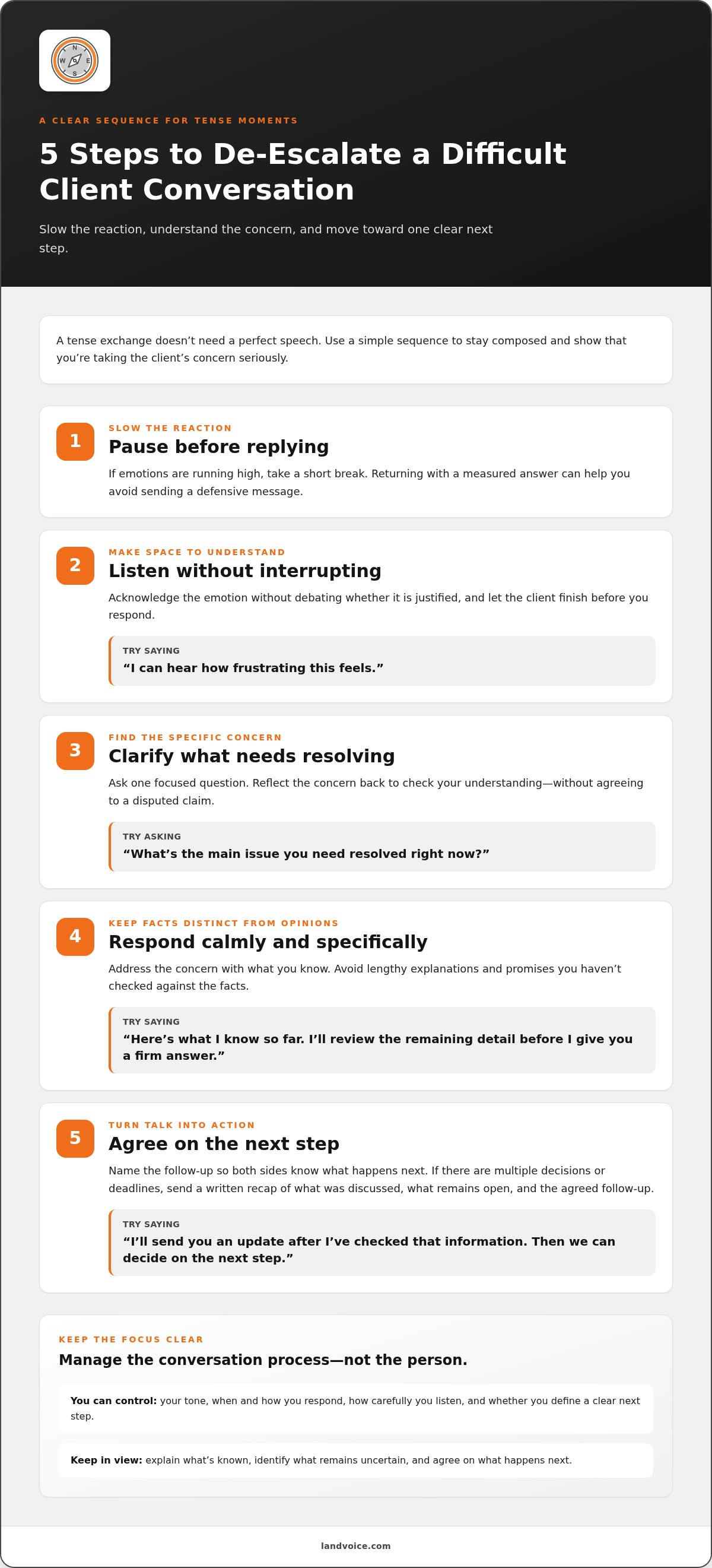
A tense exchange doesn’t need a perfect speech. It needs a clear sequence that slows the reaction and moves the issue forward: pause, listen, clarify, respond, and agree on a next step. That structure helps you stay composed while showing the client you’re taking their concern seriously.
How can you respond when a client is upset?
Start by acknowledging the emotion without debating whether it’s justified. Try, “I can hear how frustrating this feels.” Then ask one focused question: “What’s the main issue you need resolved right now?” Let the client finish before you respond. Avoid interrupting, lengthy explanations, or promises you haven’t checked against the facts.
Reflective listening helps you verify the concern without agreeing to a disputed claim. For example: “So you’re concerned that the change in timing leaves you with less room to decide. Have I understood that correctly?” If the client corrects you, listen again. If they confirm, you can address the concern while keeping facts and opinions distinct.
What language keeps the conversation productive?
Use concise, specific phrases that recognize the concern and create a path forward. Guidance on de-escalation techniques also emphasizes communication choices that can help lower tension. In a client conversation, keep your language calm and avoid sounding dismissive or defensive.
- Summarize: “It sounds like the lack of an update is the part causing the most concern. Is that right?”
- Clarify: “When you say you need this handled today, which decision are you hoping to make?”
- Respond with facts: “Here’s what I know so far. I’ll review the remaining detail before I give you a firm answer.”
- Propose action: “I’ll send you an update after I’ve checked that information. Then we can decide on the next step.”
Keep the focus on the immediate issue. If several questions come up, name them and take them one at a time. When the conversation includes multiple decisions or deadlines, send a written recap of what was discussed, what remains open, and the agreed follow-up. That gives both of you a clear reference point.
Naming the next step restores clarity because it turns a tense exchange into a specific action both sides can understand. That’s a practical foundation for dealing with difficult real estate clients without stress. For a steadier routine around prospecting and client conversations, explore a prospecting workflow.
How to set client boundaries without sounding dismissive
Boundaries make service more predictable. They tell clients how to reach you, what kind of response to expect, and how you’ll handle urgent concerns. That isn’t a rejection. It’s a clear working agreement that helps you stay responsive without implying you’re available every moment.
How do you reset expectations about response times?
Discuss communication preferences early, then revisit them if the working relationship changes. Agree on the best channel for routine updates, a realistic response window, and what qualifies as urgent. Keep the plan consistent with your actual schedule and brokerage practices. Don’t promise an immediate reply or apply the same availability rules to every client.
Make the explanation client-centered: “I want to make sure your questions get the attention they need. I usually review messages during my workday and will reply as soon as I can within that window. If something time-sensitive comes up, please call so I can understand the urgency.” Adjust the wording to match what you can reliably deliver.
Compare vague availability with specific, respectful language:
| May sound dismissive | Sets a clear expectation |
|---|---|
| “I can’t answer whenever you text.” | “For routine questions, message me here and I’ll respond during my usual workday.” |
| “Stop calling about every little thing.” | “Let’s use a call for time-sensitive issues and keep routine updates in our agreed channel.” |
| “I’m busy. You’ll have to wait.” | “I’m tied up at the moment. I’ll get back to you when I’m available to give this my attention.” |
When should a concern move from conversation to documentation?
Use a written recap when a conversation results in decisions, assigned responsibilities, or agreed follow-up. Keep it factual and neutral: record what was decided, who will take each action, and any relevant timing. Avoid labels or emotional commentary. Good notes make the plan easier to follow and reduce the chance that either person remembers the agreement differently.
If a concern involves a process or repeated disagreement, follow your brokerage’s established procedures. Documentation isn’t a threat or a substitute for a direct conversation. It’s a professional record of what was discussed and what comes next.
Clear expectations are central to dealing with difficult real estate clients without stress. Set boundaries with warmth, make only commitments you can keep, and explain the plan before frustration builds. Consistency protects your time while giving clients a dependable picture of how you work.
A five-step reset for handling recurring client tension
One stressful exchange may be a response to an unusual moment. A repeated pattern is different. If the same confusion, missed expectations, or communication breakdown keeps returning after you’ve discussed it, reset the working agreement instead of treating every flare-up as a separate incident.
Use this five-step process to get specific and decide what needs to change:
- Pause. Don’t start the reset while you’re reacting. Choose a time and channel that allow both of you to focus.
- Identify the pattern. Note what has happened more than once, without guessing at the client’s motives.
- Discuss expectations. Explain what’s creating friction and invite the client to clarify what they need. Agree on a workable approach.
- Document the agreement. Recap decisions, responsibilities, and follow-up in neutral, factual language.
- Review progress. Check whether the new approach is working. If the same issue persists, decide what support or next steps are appropriate.
How can you prepare before a difficult follow-up?
Before reaching out, write down observable facts, the unresolved issue, and the outcome you need from the conversation. For example: “We’ve changed the preferred update channel twice. Let’s agree on one channel for routine updates.” Keep your opening concise and focused on solving the issue, not assigning blame. If the discussion involves a For Sale By Owner seller, the FSBO guide can provide relevant context for that prospecting conversation.
What if the relationship remains unworkable?
Look for whether agreed communication practices are being followed and whether recurring concerns can be discussed productively. If expectations still clash or the same problems continue despite a clear reset, involve your broker and follow established brokerage procedures. Don’t make a unilateral decision about ending the relationship without understanding the appropriate process.
If a transition becomes necessary, keep the discussion professional and factual. Focus on the client’s next steps and any relevant handoff details, rather than relitigating the conflict. A structured reset gives you a fair way to assess whether the working relationship can improve. It also helps you approach dealing with difficult real estate clients without stress by replacing repeated reaction with a deliberate process.
Build a steadier real estate workflow so one difficult client does not dominate your day
No workflow can control how a client behaves. A planned workday can, however, reduce the pressure to react to every message the moment it arrives. When follow-up, prospecting, transaction tasks, and breaks each have a place in your schedule, one tense interaction is less likely to consume time set aside for everything else.
How can you protect time for client work and prospecting?
Block time for specific types of work, then capture commitments in one reliable system instead of relying on memory. For example, reserve a focused period for client follow-up, another for prospecting, and a separate block for transaction tasks. Build in breaks, too. At the start or end of each workday, review priorities and adjust for genuine deadlines without letting every new message reset your plan.
Consistency matters more than a perfect schedule. If a client needs attention, decide what must be handled now and what can wait for your next planned follow-up window. This creates a practical rhythm: clients receive deliberate attention, and you preserve time to maintain the rest of your business.
How can seller lead tools support a more consistent routine?
Planned prospecting is one part of a broader pipeline, not a promise of easier clients or specific business results. Organized seller lead information can help you prepare for homeowner outreach and make prospecting a regular part of the workweek. Agents building a seller-prospecting routine can explore expired listing leads; FSBO leads may also suit a workflow focused on connecting with homeowners selling independently.
Landvoice provides real estate prospecting tools and coaching resources. These can support prospecting skills and a more consistent routine, but they don’t resolve client conflict. Use them alongside clear communication practices and a schedule that reflects your priorities. That’s a more sustainable approach to dealing with difficult real estate clients without stress: protect your attention, keep prospecting on the calendar, and address client concerns through a clear process.
Take control of the next client conversation
Strong client relationships don’t depend on avoiding every difficult moment. They depend on how you respond. Pause, listen for the concern beneath the complaint, and make the next step clear. Set realistic communication expectations, document key agreements, and reset the approach when tension becomes a pattern.
That process helps you stay focused on what you can control, while a planned work routine protects time for other clients and prospecting. Landvoice has served the real estate industry for over 30 years. Its seller lead data and prospecting progress tools can support a steadier workflow, though they can’t control client behavior or resolve every conflict.
Use a clear process, hold respectful boundaries, and keep moving forward. You can handle challenging conversations without letting them define your day.
Frequently Asked Questions
How do you deal with a difficult real estate client professionally?
Handle the issue, not the person. Pause before replying, listen to identify the client’s actual concern, and separate what you know from what still needs clarification. Then respond with a concise explanation and agree on a specific next step. If the same misunderstanding keeps recurring, reset communication expectations and summarize key decisions in writing. This approach supports dealing with difficult real estate clients without stress by giving each tense exchange a clear structure.
What should you say to a demanding real estate client?
Use calm, direct language that acknowledges the concern and defines what you can do next. For example: “I understand this feels urgent. I’ll review the details and update you when I have a clear answer.” Avoid arguing, overexplaining, or promising an outcome before checking the facts. If a request is outside your agreed process, explain the boundary respectfully and offer a realistic next step rather than a flat refusal.
How do you set boundaries with real estate clients without losing them?
Set expectations early and explain how they help you serve the client consistently. Agree on a preferred channel for routine communication, a realistic response window, and how to flag time-sensitive concerns. Keep the plan aligned with your schedule and brokerage practices. A client is more likely to understand a boundary when you pair it with reassurance, such as, “I’ll give this my full attention during my next follow-up block.”
How can real estate agents stay calm when a client is angry?
Slow the exchange down. Take a breath, let the client finish, and avoid matching their volume or urgency. Acknowledge the emotion without debating it, then ask one focused question to uncover the main concern. Before responding, check the relevant facts and decide what you can clarify now. If you need time to investigate, say so plainly and give a realistic expectation for when you’ll follow up.
When should a real estate agent stop working with a difficult client?
Consider whether the working relationship can continue when clear expectations have been discussed but communication problems or mismatched expectations persist. Before making a decision, review the situation with your broker and follow your brokerage’s established procedures. If a transition is appropriate, keep the conversation factual and professional. Focus on the client’s next steps and any necessary handoff, rather than assigning blame or reopening old disagreements.
How do you avoid burnout from demanding real estate clients?
Protect your attention with planned work blocks for client follow-up, transaction tasks, prospecting, and breaks. Use one reliable system to record commitments so you’re not carrying every open task in your head. Set realistic communication expectations and review priorities at the start or end of the day. If stress continues to affect your well-being or work, talk with a trusted support person or your broker about practical changes.
Can a more consistent prospecting routine reduce stress for real estate agents?
A consistent prospecting routine can add structure to your workweek and help you build a broader pipeline, but it can’t guarantee business results or easier client relationships. Planned blocks for contacting homeowners help you balance prospecting with current client work. Landvoice provides seller lead data and tools for managing prospecting progress, which can support a more organized routine alongside clear communication and time boundaries.
