



by Bruce Keith, on October 16, 2026
What if your next listing conversation starts before a property ever reaches the MLS? If you’re learning how to find off-market real estate deals for listings, the challenge isn’t simply finding names. It’s recognizing the seller signal behind each lead and choosing a practical way to start a conversation.
You already know that prospecting takes time. Stale records and poorly matched leads can drain that time without moving your pipeline forward. A more focused approach starts with understanding what each source can tell you, from expired listings and FSBOs to pre-foreclosure prospects and homeowners in your target areas.
This guide will help you compare off-market seller lead sources, prioritize the ones that fit your market and prospecting capacity, and build a repeatable process for contacting homeowners. You’ll also see how organized notes, tags, and follow-up can keep conversations on track. The goal is a sharper workflow that helps you create more meaningful listing conversations, without treating every lead as the same opportunity.
Key Takeaways
- Learn how to find off-market real estate deals for listings by matching distinct seller signals with a focused prospecting approach.
- Understand what expired listings, FSBOs, pre-foreclosures, and neighborhood research may indicate without assuming a homeowner is ready to sell.
- Compare lead sources by relevance, geographic scope, contact data, and the follow-up each one requires.
- Build a repeatable workflow for defining a target, reviewing records, contacting homeowners, and tracking outcomes.
- See how organized research and consistent follow-up can help turn seller data into a more manageable listing pipeline.
What off-market real estate deals mean for listing agents
That distinction matters because the same term often appears in investor searches for properties to acquire. For an agent, the opportunity is a potential client conversation. You’re looking for a reason to make a relevant, respectful introduction, then listening to the homeowner’s goals. The role of a real estate broker includes representing clients in real estate transactions, but a lead is only an opening to explore whether a professional relationship makes sense.
Off-market seller leads are signals that may support a listing conversation, not publicly marketed inventory or proof that a homeowner is ready to sell.
Understanding this difference is the first step in how to find off-market real estate deals for listings. It keeps your prospecting focused on potential seller relationships rather than treating every record as a property available for purchase. It also helps set the right expectation: data can point you toward a conversation, but the homeowner decides whether to have one and what happens next.
How off-market seller opportunities differ from investment deals
An investor typically evaluates whether a property fits an acquisition plan. A listing agent looks for an opportunity to understand an owner’s plans and, if appropriate, discuss representation. For example, a home that’s no longer being marketed publicly might lead an investor to assess its purchase potential. An agent might instead ask whether the owner still hopes to sell and what support would be useful. The signal starts a conversation; it doesn’t establish an agreement to list.
What seller signals can point to a potential listing conversation?
Signals can reflect marketing choices or changed circumstances, but they don’t reveal motivation on their own. An expired listing, a FSBO advertisement, a pre-foreclosure record, or a homeowner identified through neighborhood research each points to a different source of information. None proves the owner wants to list now. Treat the record as context, not a conclusion. Approach homeowners respectfully, ask relevant questions, and tailor the conversation to what they share.
That mindset makes your outreach more disciplined. Start with what you can observe, then give the homeowner room to explain what matters to them. A useful prospecting process isn’t about assigning a story to every address. It’s about identifying a possible opening, making a thoughtful contact, and letting the owner’s response guide your next step.
Where to find off-market seller leads and homeowner signals
Off-market prospecting works best when you match the source to the signal it can actually provide. An expired listing, a for-sale-by-owner advertisement, a pre-foreclosure record, and neighborhood research are not interchangeable. Each gives you a different starting point for learning whether an owner might welcome a real estate conversation. None confirms readiness to sell.
These sources can help you focus your research instead of treating every homeowner record as the same kind of lead. As you consider strategies to find off-market properties, keep your objective clear: as a listing agent, you’re looking for potential seller relationships, not assuming a property is available to buy.
Use expired listings and FSBOs as distinct seller signals
An expired listing is a property whose prior listing period ended without a sale. That may create an opening to ask about the owner’s plans, but it doesn’t tell you why the property didn’t sell or what the homeowner wants next. Expired listing leads help you focus on this specific signal rather than treating it as equivalent to a different seller source.
FSBOs are homeowners marketing their property without an agent. They aren’t a uniform seller profile: some owners may prefer to manage the sale themselves, while others may be open to a conversation about representation. FSBO data is collected from 1,700+ sources daily and covers two areas. Use FSBO lead data to identify this distinct source, then tailor your approach to the homeowner’s current marketing choice. For more context, an FSBO leads guide can help you think through this prospecting category in more depth.
Add pre-foreclosure and neighborhood research selectively
Pre-foreclosure records are a separate signal, not a conclusion about an owner’s circumstances or intentions. Available record types can include Notice of Default, Lis Pendens, Notice of Trustee Sale, and Bank Owned Data. Pre-Foreclosure data covers two counties. Because these records can relate to sensitive situations, approach homeowners with care, avoid assumptions, and let them decide what they’re comfortable discussing.
Neighborhood research offers a different route. Instead of starting from a specific listing event, you can focus on homeowners in an area relevant to your prospecting plan. Neighborhood Search supports up to 3,000 monthly map-based homeowner lookups. Use the map to define a manageable focus, then treat each record as a research starting point, not evidence that the owner plans to move.
To make how to find off-market real estate deals for listings a practical process, choose one source that fits your capacity, learn what its signal means, and keep your opening conversation relevant. If you’re ready to explore seller data and prospecting tools for these categories, see how the workflow can support your prospecting.
How to compare off-market lead sources before investing prospecting time
A large lead list isn’t automatically a productive one. Compare each source by the signal it represents, its stated coverage, the contact information available, and the follow-up you’ll need to provide. Then weigh that against your own prospecting focus: a smaller, better-matched group may be more useful to your workflow than a high-volume list that doesn’t fit your goals.
Use this framework to make the differences visible. Geographic limits and data details should reflect what the provider states, not assumptions or benchmarks you’ve heard elsewhere.
| Source type | Signal | Geographic limit | Contact data | Follow-up needs |
|---|---|---|---|---|
| Expired listings | A prior listing period ended without a sale | Expired Pro includes one MLS | Up to 95% phone numbers, including cell phones | Ask about the owner’s current plans; don’t assume they still want to sell |
| FSBOs | An owner is marketing without an agent | Coverage is defined by the selected areas | Review the contact details provided with the leads | Respect the owner’s decision to manage the sale and tailor your approach |
| Pre-foreclosures | A record associated with a pre-foreclosure signal | County-based coverage | Review the contact details provided with the records | Use a sensitive, measured approach and avoid assumptions about circumstances |
| Neighborhood research | Homeowners identified through map-based research | Selected map area; lookup limits apply | Review the homeowner information available for the lookup | Keep the target focused and track the context of each conversation |
Evaluate freshness, coverage, and fit without overpromising
Freshness matters, but don’t invent a benchmark for how often a source should update. Compare update information only when the provider states it, and keep any stated coverage limit beside the lead type. Then assess fit: does the signal align with the kind of homeowner conversation you can handle consistently? For instance, expired listings and FSBOs reflect different marketing circumstances, so the same opening and follow-up plan may not suit both.
Data coverage shows what information is available; you’re responsible for qualifying the lead, contacting the homeowner thoughtfully, and following up. Phone availability can support your outreach, but it doesn’t ensure a response, establish seller intent, or promise a listing.
Assess contactability and organize follow-up responsibly
When reviewing phone numbers, check how the provider presents contact data and what supporting tools help you manage it. Landvoice Data Management includes notes, filters, search, tags, and maps; phone numbers appearing on the National Do Not Call Registry are indicated. Those tools can help you group records by source, capture conversation context, and distinguish a future follow-up from a lead that no longer fits your focus.
Compare sources against your available time, not just their volume. A focused prospecting plan gives you room to review records, make relevant contacts, and log outcomes. That’s a stronger basis for choosing where to invest your next prospecting block.
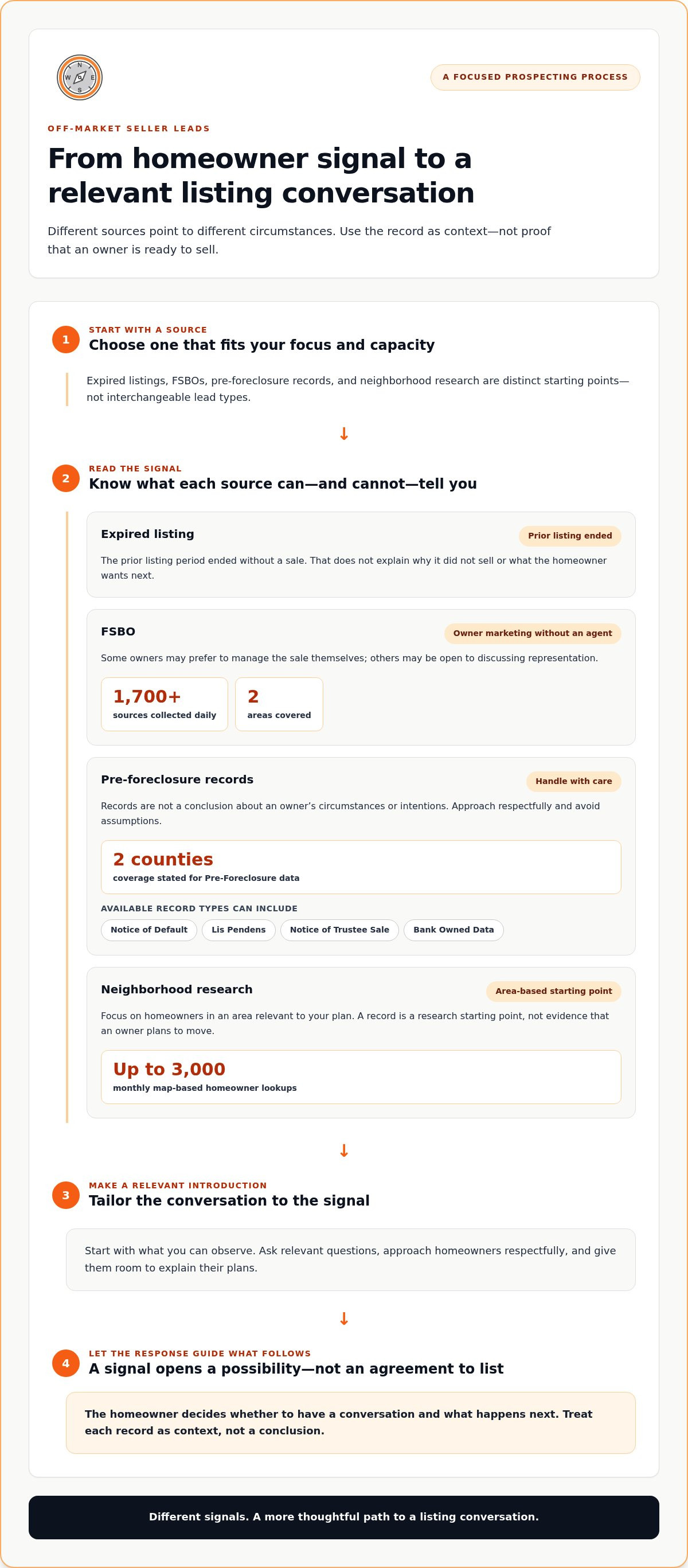
Build a repeatable workflow for finding and contacting off-market sellers
A consistent process keeps prospecting focused and gives you a clear way to learn from each conversation. Choose a seller signal, set a manageable target, review the records, contact homeowners with a relevant opening, and log what happens. This turns research into a routine you can refine instead of a scattered list of names and addresses.
Set a focused prospecting target and select a source
Start with one seller signal that matches your listing goals and the time you can commit. If you want to work with homeowners connected to a pre-foreclosure signal, for example, begin with pre-foreclosure lead data and keep your target within the source’s stated coverage. Define the audience and geographic scope before reviewing records. A precise focus makes it easier to assess whether the source supports the conversations you want to have.
- Choose the signal. Pick one source, such as expired listings, FSBOs, pre-foreclosures, or neighborhood research. Avoid combining categories before you understand the different context each one provides.
- Define the target. Specify the type of homeowner you want to reach and the geographic scope that fits your prospecting capacity. Keep the target realistic enough that you can follow through consistently.
- Review the records. Check each record for useful context and fit with your selected focus. Separate records that warrant a conversation from those that need more review, and don’t treat a signal as proof of intent.
- Contact homeowners. Open with a professional, relevant introduction that reflects the source without presuming the owner’s plans. For instance, an expired listing may give you a reason to ask whether the homeowner is still considering a move, rather than assuming they are.
- Log the outcome. Record the date and context of the contact, the homeowner’s preferences, any response, and agreed next steps. If there’s no conversation, note that too so your next action is based on the record, not memory.
Contact homeowners, document context, and refine the process
Useful tracking captures more than whether someone answered. Add notes that preserve what the homeowner shared, tags that group records by source or follow-up status, and a clear next step when one has been agreed. Keep the record factual and easy to scan. That way, when you return to it, you can pick up the conversation without relying on guesswork or repeating questions the owner has already answered.
Review your results regularly. Look for patterns in which sources lead to relevant conversations, which opening approaches feel appropriate, and where follow-up is getting delayed. Use those observations to adjust your focus, not to assume that a short stretch of results guarantees future listings. This is how to find off-market real estate deals for listings with a disciplined process: make a focused choice, track the response, and refine your next round of prospecting.
Turn off-market research into a more organized listing pipeline
Seller data can help you identify who to contact, but it’s only one part of a productive listing pipeline. You still need to review the signal, make a relevant homeowner contact, capture the context, and follow up consistently. Treat each lead as the start of a relationship-building process, not a promised listing. That distinction keeps your expectations grounded and your pipeline useful.
Landvoice provides seller data and prospecting tools that can support this agent-led workflow. The goal isn’t to replace your judgment. It’s to give you a more organized way to focus on specific seller signals, manage homeowner conversations, and maintain clear next steps as your prospecting progresses.
Match seller data tools to the prospecting job
Choose a source that fits the work you want to do. Expired Pro supports expired-listing research and uses elite databases to help provide nearly every phone number, with coverage of up to 95%, including cell phones. It includes one MLS. FSBO data supports outreach to owners marketing their properties themselves and covers two areas. Each source reflects a distinct seller signal, so keep your targeting and conversation approach aligned with the category.
Organization matters just as much as source selection. Data Management includes notes, filters, search, tags, and maps to help you sort records, preserve homeowner context, and structure follow-up. Phone numbers appearing on the National Do Not Call Registry are indicated. Use notes to capture what the homeowner shared, tags to group records by source or status, and filters and search to return to relevant prospects. Maps can help you organize your research geographically.
Build a simple pipeline that reflects your actual process. For example, separate records awaiting review from homeowners you’ve contacted, conversations that need follow-up, and contacts with no next step currently agreed. Keep the record factual: note preferences and agreed actions, but don’t interpret silence or a single conversation as a commitment to list. The information helps you manage your work; your professional judgment guides what happens next.
Take the next step without treating leads as guaranteed listings
Trusted for over 30 years, Landvoice can help you explore seller data and prospecting tools as inputs to your own relationship-building process. A demo gives you a way to see the platform and consider how its tools could fit your workflow, from reviewing a seller signal to tracking follow-up. The outcome still depends on the homeowner’s plans and the relationship you build.
Take the next step. See the tools, then shape a focused prospecting process that works for you.
Make your next prospecting move with purpose
Your next step doesn’t need to be complicated. Choose one seller signal, set a prospecting target you can maintain, and make room in your routine to follow through. As you apply what you’ve learned about how to find off-market real estate deals for listings, focus on the quality of the conversations you’re building, not just the number of records in front of you.
A repeatable process gives you something valuable beyond a list of potential sellers: a clearer view of what you’re learning from your market and where your time is best spent. Let Landvoice support your research and organization while you lead each homeowner relationship with care and professional judgment.
Start with one focused action, stay consistent, and keep improving your process. Your next meaningful listing conversation can begin with the steps you take today.
Frequently Asked Questions
Can off-market leads turn into listings?
Yes, off-market leads can open the door to a seller conversation, but they aren’t listing agreements or guaranteed results. A homeowner’s plans, timing, fit, and willingness to work with an agent all influence what happens next. Treat each record as a starting point. Learn the context, make a relevant introduction, and follow up in line with the homeowner’s preferences. If they aren’t interested, respect that and update your notes.
How can agents prioritize off-market leads when they have limited prospecting time?
Choose the source that best matches your current listing focus, then set a manageable batch of records to review and contact. Track each lead’s source, context, contact attempts, and outcome in one system. After a consistent review period, compare which sources produced relevant conversations and adjust your focus. A longer list isn’t automatically a better fit. Prioritize records you can review thoughtfully and follow up on consistently.
Is an expired listing automatically an off-market listing opportunity?
No. An expired listing identifies a prior listing period that ended, but it doesn’t show whether the homeowner still wants to sell or would consider working with you. They may have changed plans or chosen another path. Use the record as a prompt to learn more, not as evidence of current intent. For example, ask whether selling is still a goal before discussing how you might help.
What should an agent record after contacting a homeowner?
Record the lead source, contact date, useful context the homeowner shared, their preferred next step, and any follow-up timing you agreed on. Keep notes factual and professional. These details help you continue the conversation without asking the same questions again and help you assess which sources are leading to relevant discussions. When using phone data in Data Management, remember that numbers appearing on the National Do Not Call Registry are indicated.
Can agents combine FSBO and expired listing leads in one prospecting plan?
Yes, you can include both in a broader plan, but track them as distinct sources. A homeowner marketing a property without an agent has a different context from one whose previous listing period ended. Keep separate source tags and tailor your opening to what each record indicates. Then compare the relevance of the resulting conversations. Don’t assume one script, follow-up pattern, or prospecting approach will work equally well for both groups.
How often should agents review their off-market lead pipeline?
Review your pipeline on a regular rhythm that fits the time you’ve set aside for prospecting, and keep that rhythm consistent. Update records after conversations, identify leads with an agreed next step, and note which sources are prompting useful homeowner responses. For example, a brief review at the start of a prospecting session can help you prioritize follow-ups. Let your capacity and homeowners’ stated preferences guide the timing.
