



by Bruce Keith, on August 25, 2026
Why are you spending thousands of dollars on high-gloss postcards that end up in the recycling bin before the homeowner even reads your name? Most strategies for geographic farming for real estate agents are built on hope rather than data; they rely on passive branding while your competition is out there actually taking the listings. You've felt the sting of a high marketing spend with zero ROI. You're tired of guessing which doors to knock on and frustrated by the lack of accurate homeowner contact information. It's time to stop playing defense and start taking control of your local market.
You know that consistency is the only path to market dominance, yet the fear of entering a neighborhood controlled by another agent often keeps you sidelined. We agree that the old way of farming is broken. This guide will show you how to leverage high-precision data to identify high-turnover areas and use proactive outreach to secure consistent listings. You'll learn how to select the right farm, use Landvoice tools like Neighborhood Search to find the right people, and master the art of contacting homeowners to build a predictable, scalable business. We're moving from initial selection to final result, giving you the technical edge needed to outpace every elite performer in your zip code.
Key Takeaways
- Stop guessing and start measuring by learning how to calculate turnover rates to ensure you're investing in a neighborhood with actual listing potential.
- Master a multi-channel strategy for geographic farming for real estate agents that uses mailers as a warm-up for high-impact personal outreach.
- Shift your mindset from passive marketing to active relationship building by mastering the art of contacting homeowners without feeling pushy.
- Discover how Landvoice tools like Neighborhood Search provide the high-precision data you need to dominate your market.
- Turn your farm into a predictable listing machine by layering high-intent leads like Expireds and FSBOs over your geographic foundation.
The Mechanics of Geographic Farming in a Digital-First Era
Geographic farming isn't just a mailing list. It's a strategic siege of a specific market where you provide consistent value until you're the only choice. For a modern real estate agent, listings are the only currency that matters. They represent inventory, control, and future market share. Geographic farming for real estate agents secures this currency by building a fortress around a neighborhood. You aren't just looking for a deal; you're building an asset.
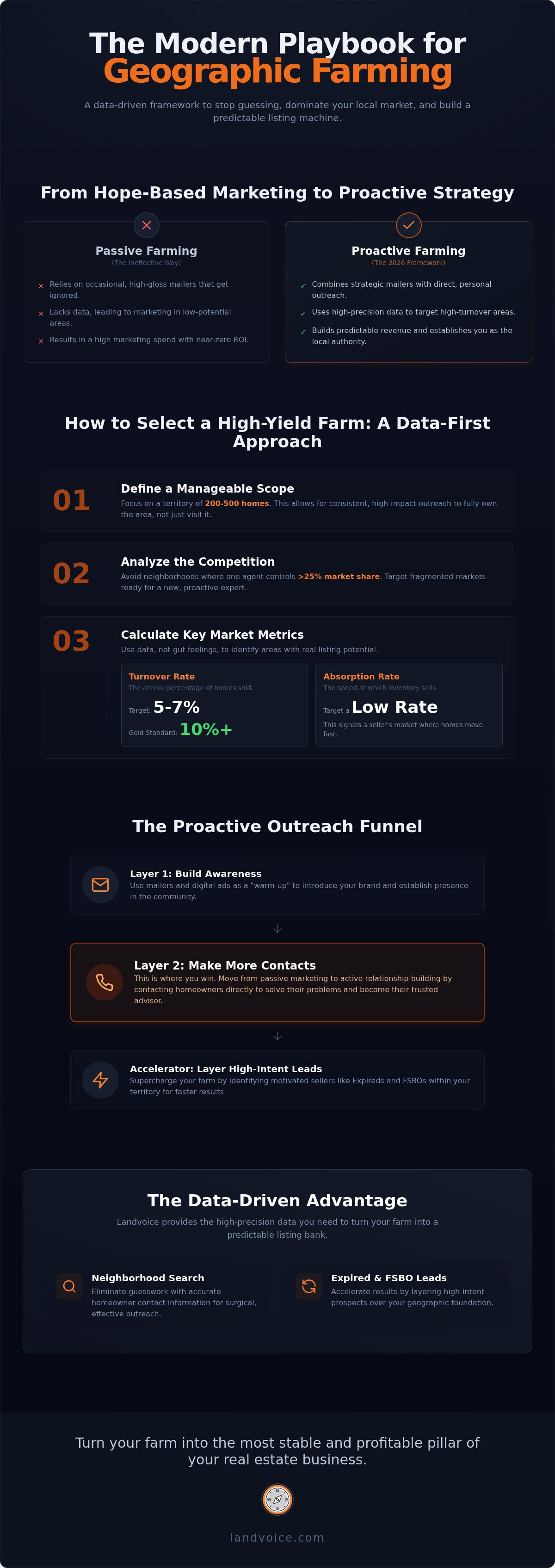
Most agents fail because they play it safe. They send a postcard once a quarter and wait for the phone to ring. That's passive farming. It's expensive, slow, and usually results in zero ROI. Proactive farming combines these mailers with direct action. You aren't just a name on a fridge; you're a face and a voice in the community. By making more contacts, you transform a cold zip code into a predictable revenue stream. You move from being an outsider to being the local authority.
Stability vs. Volatility: Why Farming Wins
Real estate is notoriously volatile. You close three deals one month and zero the next. This feast or famine cycle kills careers and creates constant anxiety. Geographic farming breaks this cycle by creating a baseline of business. When you dominate a farm, you're the "Go-To Expert." Your name becomes synonymous with local real estate. Referrals start to happen automatically because neighbors talk. This compounding effect of name recognition ensures that even when the broader market dips, your local pipeline stays full and your business remains stable.
The 2026 Farming Framework: Data + Action
The days of the phone book are dead. In 2026, geographic farming for real estate agents requires a multi-channel approach. You need mail to build awareness and digital ads to stay top-of-mind. But the real wins come from contacting homeowners directly to solve their problems. You can even layer in high-intent prospects like Expired Pro and FSBO leads within your farm to accelerate your results.
High-precision tools like Neighborhood Search from Landvoice allow you to skip the guesswork. You get accurate data so your outreach is surgical, not random. This eliminates the hesitation associated with outbound communication because you know exactly who you are calling. Geographic farming is a data-driven investment in community authority that turns a neighborhood into your personal listing bank.
Selecting Your High-Yield Farm: Data Over Guesswork
Choosing your territory based on gut feeling is a recipe for a drained bank account. You need a surgical approach to geographic farming for real estate agents to ensure every dollar spent returns a profit. Start by defining a manageable scope. For a solo agent, the sweet spot is usually between 200 and 500 homes. This range allows you to maintain high-frequency outreach without diluting your message or your budget. You want to own this territory, not just visit it.
Before you commit, analyze the competition. Is there a dominant agent who already controls more than 25% of the market share? If so, you're fighting an uphill battle against established loyalty. Look for neighborhoods where the market is fragmented. You want an area where homeowners are looking for a fresh perspective. This is your opening to establish yourself as the primary ally for the community through Landvoice precision data.
Don't ignore the absorption rate. This metric tells you how many months it would take to sell the current inventory at the current pace of sales. In a high-yield farm, you want a low absorption rate, signaling a seller's market where homes move fast. When you combine high turnover with low absorption, you've found a neighborhood ready for dominance.
Calculating Turnover Rate for Maximum ROI
ROI lives and dies by the turnover rate. Use this simple formula: divide the number of homes sold in the last 12 months by the total number of homes in the area, then multiply by 100. You're looking for a turnover rate of at least 5% to 7% to justify your time and marketing spend. If you find a neighborhood with a 10% turnover rate, you've found the gold standard. This level of activity ensures a steady stream of listing opportunities for any agent willing to do the work.
Identifying High-Intent Segments within Your Farm
Market dominance requires more than just high-level branding. You need to identify high-intent segments within your farm to see immediate returns. This is called layered farming. While you build long-term authority, you can simultaneously target homeowners who are ready to sell right now. This strategy eliminates the wait time typically associated with new farms.
- Use Expired Pro leads to find homeowners whose previous agents failed them. These are people who are ready to move but need a proven professional.
- Integrating FSBO leads within your farm allows you to offer professional value to those trying to go it alone.
- Utilizing Pre-foreclosure data gives you the chance to provide ethical, proactive solutions to distressed homeowners before their situation worsens.
This multi-layered approach ensures you aren't just waiting for the market; you're driving it. If you're ready to see how high-precision data can transform your selection process, explore our Neighborhood Search tool to find your next high-yield farm today.
Beyond Postcards: A Multi-Channel Outreach Strategy
Stop thinking of postcards as your primary lead source. In the world of geographic farming for real estate agents, mailers are merely the warm-up act. They soften the beachhead and build brand recognition; however, they rarely close the deal. The real work happens when you move from passive marketing to active engagement. You need a multi-channel approach to truly own a neighborhood. This means your face is in their mailbox, your ads are on their social feeds, and your voice is on their phone.
A successful 12-month "Touch Campaign" balances these elements to create a sense of omnipresence. You aren't just another agent; you're the local expert who is everywhere. Use "Circle Prospecting" to accelerate this process. Whenever a home in your farm goes under contract or sells, use that event as a catalyst for outreach. This gives you a reason to reach out that provides immediate value to the neighbors. They want to know how the sale affects their home value. You are the one with the answers.
Execution depends on precision. You cannot dominate a farm if you don't have the data to reach the people inside it. You need accurate homeowner names and phone numbers for every single property in your target area. Without this, your "multi-channel" strategy is just a expensive guessing game. High-quality data turns a list of addresses into a list of opportunities.
The Power of Proactive Contact
Professional success in real estate is a numbers game. Making more contacts directly correlates with more listing appointments. Landvoice eliminates the "search" phase of your day, allowing you to spend your time where it matters: on the phone. Using Neighborhood Search, you can pull up-to-date contact information for an entire street in seconds. This speed allows you to respond to market changes instantly. When you stop searching for numbers and start contacting homeowners, your productivity sky-rockets. You become a proactive force in the neighborhood rather than a passive observer.
Integrating Direct Mail with Digital Outreach
Your mailers must serve a purpose. Avoid the "Generic Agent" mailer that homeowners toss instantly. Instead, send a "Community Update" that features local market stats, recent sales, and neighborhood news. Aim for a monthly cadence to keep your face in front of the community. To amplify this, use social media geo-fencing. Set up digital ads that target the exact boundaries of your physical farm. When a homeowner sees your ad on Facebook and then receives your mailer the next day, your credibility doubles. This multi-layered approach ensures that when they think of real estate, they think of you.
Mastering the Art of Contacting Homeowners in Your Farm
Market dominance is won in the trenches of daily communication. Success in geographic farming for real estate agents depends entirely on your willingness to engage with the community. You aren't just an agent; you're a neighborhood advocate. Shift your focus to making more contacts every single day. Every conversation is a brick in your market-dominance fortress. You aren't hunting for a quick commission; you're cultivating a lifelong referral source. Your mindset must be one of service and authority.
Start with a neighbor-to-neighbor mindset to eliminate friction. You aren't calling to ask for a listing; you're calling to provide a localized service. Use Landvoice data to ensure you have the correct names and numbers, which removes the hesitation of the unknown. When contacting homeowners, your goal is to be the most helpful person they talk to all day. Provide a quick market snapshot or mention a local community event. This establishes you as a resource before you ever ask for business. Trust is the foundation of every listing you'll ever take in this farm, and trust is built through consistency.
Building Trust Without a 'Cold' Start
The key to a successful introduction is relevance. If you've been sending mailers, your name should already be familiar. Use that momentum. Mention a recent community update or a local market shift that affects their specific street. By leading with value, you eliminate the "salesy" vibe that homeowners despise. You aren't an intruder; you're a consultant providing high-quality information that helps them protect their largest financial asset. This proactive approach separates elite performers from those waiting for the phone to ring.
Scripts for Circle Prospecting and Neighborhood Updates
Circle prospecting is the fastest way to build authority after a local win. Use a script like: "Hi, I'm [Name], your neighborhood specialist. I'm calling because the home at 123 Maple Street just sold for a record price in just four days. I wanted to make sure you knew how this sale specifically impacts your own home's equity." It's direct, urgent, and value-heavy. It shows you're active and getting results for people just like them.
For a general update, try a "Specialist Introduction" script: "I'm reaching out to introduce myself as the dedicated real estate resource for our neighborhood. I've recently analyzed the latest property tax assessment shifts and how they might affect your bottom line. Would you like me to email you a copy of that report?" This positions you as an expert who understands the technical side of homeownership, not just a salesperson looking for a sign in a yard.
If they say, "We aren't planning on moving right now," don't view it as a rejection. It's an opportunity. Use a long-term follow-up script: "That's great to hear. Most people I talk to in this area love their homes. My goal is simply to be your go-to resource for whenever you do have questions in the future. Can I add you to my monthly neighborhood update so you can see what homes on your street are actually selling for?" You've just turned an objection into a permission-based relationship. This is how you win the long game.
Scaling Your Farm with Landvoice Prospecting Tools
Scale is a choice. You've selected your territory and mastered your scripts; now you need the engine to power your market dominance. Geographic farming for real estate agents is a high-speed game that rewards the efficient. You can't afford to waste hours manually searching for phone numbers or scrubbing outdated spreadsheets. Landvoice provides the technical superiority you need to separate yourself from the pack. It's the difference between a manual, slow-moving process and an automated listing machine that delivers results.
The goal is to move from initial action to final result with minimal friction. This requires tools that provide professional stability while acknowledging the difficulties of lead acquisition. By leveraging high-precision data, you eliminate the hesitation associated with outbound communication. You become the gatekeeper to a competitive edge that your rivals simply cannot match. It's time to stop researching and start executing with the right technology in your corner.
Automating the Search with Neighborhood Search
Neighborhood Search is your primary weapon for rapid expansion. While mailers provide passive awareness, this tool gives you the high-precision data required for direct action. You can pull an entire neighborhood's contact list in seconds. This speed allows you to react to market shifts before your competitors even know they happened. The "Data Genie" feature ensures your pipeline stays clean by updating old contact information and removing duplicates. Most importantly, it maintains precision in avoiding Do Not Call list violations, keeping your outreach professional and compliant.
Professional Coaching for Market Dominance
Data is only half the battle; you also need the mindset to execute. Landvoice Pro Coaching provides the professional stability you need to stay consistent. These sessions eliminate the fear of the phone by providing frameworks that feel natural and authoritative. You aren't just learning to sell; you're learning from industry veterans who have already mastered geographic farming for real estate agents. They provide the confidence to handle any objection and turn every contact into a potential client. This coaching transforms you into a high-performance professional who knows exactly what works.
To maximize your time, the Landvoice Dialer integrates directly with your lead lists. It allows you to focus on making more contacts instead of manually dialing numbers. This efficiency drives your ROI by ensuring you spend your working hours in high-value conversations. You are the center of your success story, and these tools are your primary allies in building a predictable, scalable business.
Own Your Market with Precision and Action
Market dominance is a choice, not a coincidence. You now have the blueprint for successful geographic farming for real estate agents. It requires moving past passive mailers and embracing proactive outreach. By focusing on high-turnover neighborhoods and layering in high-intent leads like Expireds and FSBOs, you create a listing machine that runs on data rather than hope. You've seen how the right framework turns a neighborhood into a predictable asset for your business.
Landvoice provides the technical superiority you need to execute this strategy at scale. With over 30 years of real estate data expertise and proprietary contact-finding technology, we offer nationwide coverage for professionals across the US and Canada. We eliminate the guesswork of prospecting by providing the high-precision information that makes success inevitable. You are the center of this success story, and it's time to claim your territory.
Start dominating your neighborhood with Landvoice Neighborhood Search
Your path to professional stability starts with a single decision. Stop the hesitation and start building your listing fortress today. You have the tools, the strategy, and the support to become the undisputed expert in your market. It's time to take control and win.
Frequently Asked Questions
What is the best turnover rate for a real estate geographic farm?
A turnover rate of 10% is the gold standard for high-yield geographic farming. You want an area where at least 5% to 7% of homes sell annually to ensure consistent opportunities. To calculate this, divide the number of homes sold in the last 12 months by the total number of homes in the area. High turnover ensures you aren't fighting for a single listing each year but are instead entering a liquid market with frequent inventory.
How many homes should I have in my real estate farm?
Solo agents should target a farm size between 200 and 500 homes. This range is small enough to maintain a high frequency of outreach but large enough to produce a steady stream of listings. If you go too large, your budget and time will be spread too thin to achieve market dominance. If you go too small, the total volume of sales won't support your income goals. Focus on depth rather than width.
How long does it take to see results from geographic farming?
Most agents see a significant return on investment within 12 to 24 months of consistent outreach. However, you can accelerate this timeline by layering in high-intent leads like Expired Pro or FSBO segments. Geographic farming for real estate agents is a long-term strategy that builds compound authority over time. While the first few months are about planting seeds, the second year is typically when referrals and automatic listings begin to materialize for the professional.
Is geographic farming better than buying leads from Zillow?
Geographic farming allows you to own a market rather than renting leads from a third party. When you buy leads, you're competing with multiple agents for a single contact. When you farm, you build a relationship with an entire community. This creates professional stability and a lower cost per lead over time. Farming turns you into the local authority, making your business more resilient to market shifts and platform algorithm changes.
How often should I be contacting homeowners in my farm area?
Aim for at least one physical touch per month and one direct conversation per quarter. Consistency is more important than the total marketing budget. You want to stay top of mind without becoming a nuisance. Use a mix of community updates, market reports, and personal check-ins. Regular contact ensures that when a homeowner finally decides to sell, you're the first person they think of because you've been a constant, reliable resource.
What is the difference between circle prospecting and geographic farming?
Circle prospecting is a tactical outreach strategy centered around a specific event, like a just-listed or just-sold property. It's designed for immediate results and making more contacts around a recent win. Geographic farming is the broader, long-term strategy of dominating an entire neighborhood over time. While circle prospecting is a tool used within a farm, the farm itself is the strategic asset you are building through multi-channel marketing and consistent community involvement.
Can I farm a neighborhood where another agent is already dominant?
You can absolutely enter a neighborhood with an established agent as long as their market share is below 25%. Most dominant agents rely on passive branding and become complacent over time. You can disrupt their hold by using high-precision data from Landvoice and providing more proactive, personalized service. Homeowners often appreciate a fresh perspective and a more modern, data-driven approach to selling their homes in today's digital-first market.
What tools do I need to start geographic farming effectively?
To start geographic farming for real estate agents effectively, you need a high-quality data source like Neighborhood Search to find homeowner contact information. You also need a reliable dialer to maximize your time when contacting homeowners and a CRM to track your follow-up schedule. Adding a professional coaching program helps you master the scripts and mindset needed to convert these contacts into listings. These tools provide the technical edge required to outpace competitors.
