



by Bruce Keith, on August 18, 2026
Stop burning your commission on "brand awareness" that doesn't ring the phone. In 2026, elite agents aren't just spending more; they're spending smarter by shifting dollars from cold branding to high-intent prospecting data. If you're wondering how to budget for real estate marketing to survive current market shifts, you need a plan that prioritizes verified leads over vanity metrics. With average Google Ads costs hitting $42 per lead, you can't afford to guess where your money goes.
You know the frustration of a high marketing spend that produces an inconsistent lead flow. You've felt the anxiety of wondering which tools are essential and which are just expensive fluff. We're going to fix that right now. This blueprint masters your marketing spend with a high-performance framework designed to maximize ROI and eliminate every wasted dollar. We'll break down exactly how to allocate 7% to 12% of your Gross Commission Income to build a predictable lead pipeline. You'll learn to use verified data and proven prospecting tools to turn Expireds and FSBOs into closed deals with total confidence.
Key Takeaways
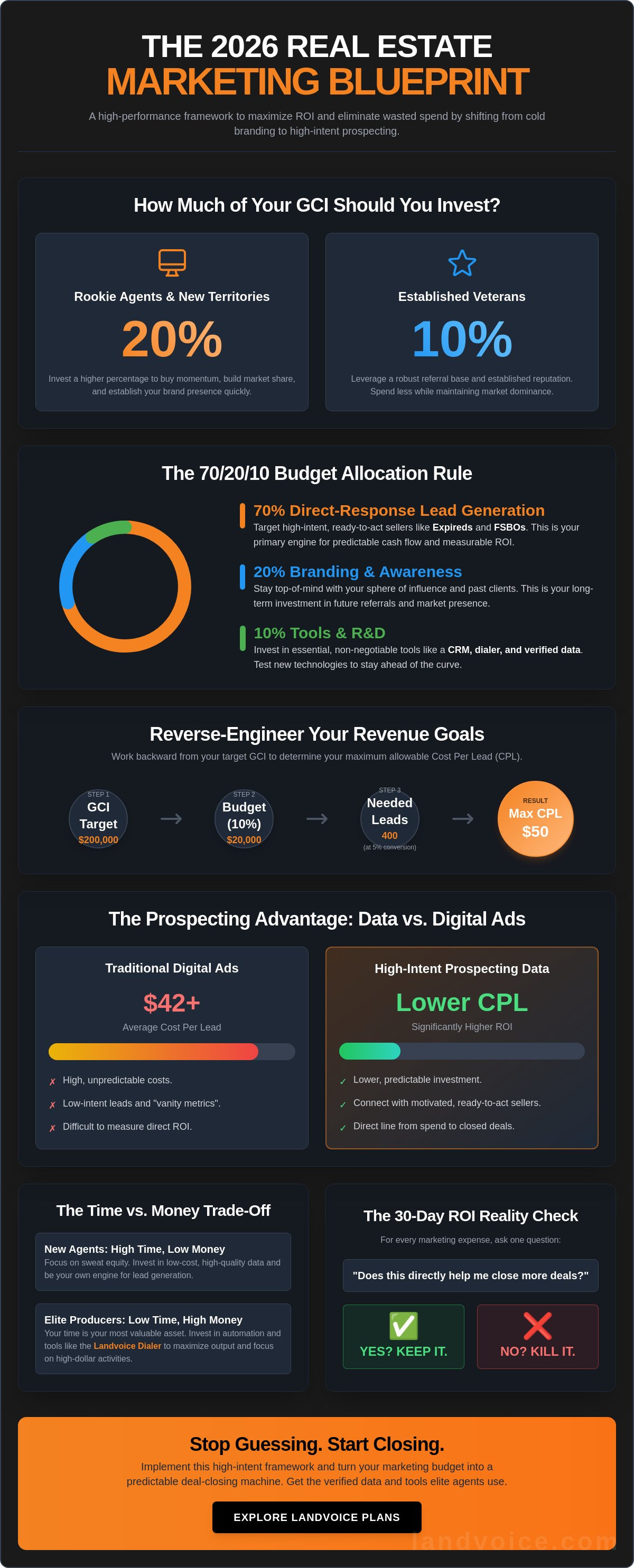
- Learn why rookies should invest 20% of their GCI while seasoned veterans can dominate their market on just 10%.
- Discover the 70/20/10 allocation rule that prioritizes direct-response prospecting over slow-burn brand awareness.
- Master how to budget for real estate marketing by reverse-engineering your revenue goals into a predictable daily lead target.
- Compare the high cost of digital ads against the superior ROI of high-intent data like Expireds and FSBOs.
- Implement a "Kill or Keep" 30-day audit to eliminate wasted dollars and maximize your return on every marketing investment.
The Foundation: Setting Your 2026 Marketing North Star
Your success in 2026 won't happen by accident. It starts with a number. Before you spend a single dime, you must define your Gross Commission Income (GCI) target. This isn't a "hopeful" figure; it's the specific revenue goal that dictates your entire strategy. Once you have that North Star, you can reverse-engineer how to budget for real estate marketing to ensure your business remains profitable regardless of market shifts. You set the target, you fund the engine, and you reap the rewards.
The industry standard follows the 10-20% rule. If you're a rookie agent or launching a new territory, plan to invest 20% of your GCI into marketing. You're buying momentum and market share. Established veterans with a robust referral base can often thrive on 10% because their past clients do the heavy lifting. However, you must be careful about budget leakage. You need to distinguish between your fixed business operations and your variable marketing investments. Understanding what marketing spending includes is critical for your P&L. Don't let office rent or desk fees masquerade as marketing spend. Every dollar in your marketing budget must be an active soldier sent out to capture new business.
The 2026 Market Reality Check
The 2026 landscape demands a leaner, more aggressive approach. You don't have room for "vanity metrics" like social media likes or impressions that don't convert into listing appointments. These are silent killers of your bank account. To win, you must shift toward high-intent data that puts you in front of ready-to-act sellers. A profit-first marketing budget for real estate is a strategic allocation where every dollar is pre-assigned to lead acquisition channels that guarantee a measurable return before any discretionary spending occurs. You stop guessing and start executing.
Calculating Your Maximum Cost Per Lead (CPL)
Stop looking at marketing as a cost and start seeing it as an investment. To find your ideal budget, work backward from your closed deal goal. If you want 20 closings and your conversion rate is 5%, you need 400 leads. If your average commission is $10,000, your total GCI is $200,000. Using the 10% rule, you have $20,000 to spend. This means your maximum CPL is $50. If you're spending $100 per lead on Facebook, you're over budget and under-performing. You must identify the "Conversion Gap" in your funnel. If your leads aren't turning into appointments, your problem might not be the budget; it's the data quality. High-performing agents use Expired Listing Leads because the CPL is significantly lower than digital ads, allowing you to dominate your market without overextending your finances.
Allocating Your Dollars: Lead Gen vs. Branding vs. Tools
Distribution is where most agents fail. They spend thousands on "brand awareness" and hope the phone rings. Hope isn't a strategy. To win in 2026, you must follow the 70/20/10 rule. Allocate 70% of your funds to direct-response lead generation. This is where you target high-intent sellers like FSBOs and Expireds. Dedicate 20% to branding to stay top-of-mind with your sphere; using high-quality custom wall art or photobooks from Photobook Press as premium closing gifts is a proven way to maintain long-term relationships. Use the final 10% for research and development on new tools. This aggressive split ensures your cash flow stays healthy while you build for the future.
Direct-response prospecting beats long-term awareness every time because it's measurable. You can't pay your mortgage with "likes" or "impressions." When you're figuring out how to budget for real estate marketing, you must prioritize the non-negotiables: a robust CRM, a high-speed dialer, and verified data. These aren't just costs; they're the engine of your business. Avoid "Shiny Object Syndrome" by vetting every software subscription against one metric: does this directly help me close more deals? If the answer isn't a definitive yes, cut it.
The Time vs. Money Trade-off
Your stage in the industry dictates your spending. New agents typically have high time but low money. If that's you, focus your budget on low-cost, high-quality data and put in the sweat equity. You are the engine. As you scale into a top producer, your time becomes your most valuable asset. This is when you invest in automation to protect your schedule. Many elite agents transition to using the Landvoice Dialer to maximize their hourly output. You stop dialing manually and start having more meaningful conversations. It's about buying your time back so you can focus on high-dollar activities like listing presentations and negotiations. You can always check our plans to see which tools fit your current growth phase.
Traditional vs. Digital Spend in 2026
The 2026 market has no room for outdated tactics. While 89% of realtors use digital marketing, you need a balanced real estate marketing plan that actually converts. Direct mail still works, but only if it's hyper-local and personalized. Don't waste money on mass postcards. Social media is now a "pay-to-play" environment. Organic reach is dying. If you want results on social, you have to fund it. Most importantly, stop treating your website like a digital brochure. It must be a conversion tool that captures leads and feeds your CRM. You build the system, you feed the data, and you dominate the neighborhood.
The Prospecting Advantage: Why Data Is Your Most Scalable Expense
Scalability is the difference between a job and a business. When you analyze how to budget for real estate marketing, you'll see that data is the only expense that gets cheaper as you get better. Compare the costs. A single lead from Facebook or Google Ads can cost you between $20 and $50; the average CPL for real estate in 2026 sits at approximately $42. In contrast, Expired Listing Leads cost pennies per lead. You aren't paying for "clicks" from people who might buy a home in six months. You're paying for the contact information of people who already tried to sell. This is high-intent data. It leads to shorter sales cycles and a massive spike in your ROI because the motivation is already there.
You can also find a "Hidden Goldmine" in Old Expireds. Most agents only chase the new listings from this morning. By targeting properties that fell off the market six to twelve months ago, you access a low-competition pool of sellers who are often ready to try again. This strategy provides a significant budget boost because you aren't fighting ten other agents for the same appointment. You're using budget-friendly marketing strategies to lower your Customer Acquisition Cost (CAC) while others overspend on cold traffic.
Dominating FSBOs and Pre-Foreclosures
Niche markets offer the highest margins. You should allocate specific funds for FSBO leads and Pre-Foreclosure data to diversify your pipeline. If you want to own a specific area, use Neighborhood Search to circle prospect around your new listings or recent sales. This allows you to generate high-quality leads without a massive ad spend. Real-time "Inked" leads ensure you're the first one through the door, leaving the agents with stale lists in the dust.
The Power of Verified Data
Inaccurate data is the silent killer of your marketing budget. Every time you dial a wrong number or reach a disconnected line, you're burning your most valuable asset: your time. If your hourly rate is $100, spending two hours a day on bad data costs you $1,000 a week in lost opportunity. You can't afford that leak. Landvoice verified numbers accelerate your prospecting ROI by ensuring you spend your time talking to real homeowners instead of chasing ghosts. You get the best cell phone numbers in the industry, you make the connections, and you close the deals. This technical superiority is your unfair advantage in a crowded 2026 market.
Auditing Your Spend: The 30-Day ROI Reality Check
You can't manage what you don't measure. Every 30 days, you must subject your marketing plan to a "Kill or Keep" audit. This isn't about being "nice" to your vendors; it's about business survival. If a lead source isn't generating a Return on Ad Spend (ROAS) that meets your GCI goals, it's dead weight. When you are learning how to budget for real estate marketing, you have to be ruthless. You track the data, you cut the waste, and you keep the profit. Cut the fluff. Keep the producers.
Stop obsessing over Cost Per Lead (CPL). A $5 lead that never answers the phone is more expensive than a $50 lead that signs a listing agreement. You must track your "Cost Per Appointment." This metric reveals the true health of your pipeline. If your digital marketing spend is part of the 58% of real estate companies spending between $1,000 and $10,000 per month, you need to know exactly which of those dollars are converting. Don't fall for the "Sunk Cost Fallacy." Just because you've spent three years paying for a lead portal doesn't mean you should spend another dime if the data has gone stale. Walk away and reallocate that capital to high-intent data.
The Quarterly Budget Pivot
Real estate is seasonal. You don't spend the same in December as you do in May. You should increase your spend when inventory is high and competition is fierce. When you close a big deal, don't just spend the commission on a vacation. Reinvest a portion back into your marketing "War Chest." This protects you during market downturns and allows you to accelerate when others are retreating. With the average annual marketing spend for real estate professionals rising to over $14,200 in 2026, you can't afford to be reactive. You plan the pivot, you fund the growth, and you dominate the market.
Tools for Tracking
You need a system that connects your bank account to your CRM. Simple spreadsheets work for beginners, but top producers use advanced ROI trackers to see the full "Lead-to-Close" journey. Lead attribution is everything. You need to know if that $10,000 check came from a FSBO lead or a neighborhood circle prospecting campaign. This clarity allows you to double down on what works and ditch what doesn't. If you're ready to stop guessing and start scaling, see our plans to find the data that fuels a high-ROI budget.
Scaling to Elite Status with Landvoice Pro
You've mastered the foundation and audited your expenses. Now it's time to accelerate. Elite agents don't just maintain their position; they dominate their market by knowing exactly when to pivot from a defensive budget to an aggressive one. When you understand how to budget for real estate marketing for total market capture, you might temporarily push your investment to 30% of your GCI. This isn't reckless spending. It's a calculated strike to seize market share while your competitors are shrinking their footprints. You're not just buying leads; you're buying the future of your business.
The secret to making a high-growth budget work is "Skills ROI." Landvoice Pro Coaching provides the tactical training that ensures your marketing dollars don't go to waste. You can have the best data in the world, but if you don't know how to handle an objection from a frustrated Expired or a stubborn FSBO, you're leaving money on the table. Coaching turns your marketing spend into a high-yield investment by sharpening your conversion skills. You get the leads, you make the calls, and you close the deals with total confidence.
To maximize your inbound flow without breaking the bank, leverage Call Capture. This tool generates low-cost inbound leads from your existing sign riders, giving you a 24/7 lead generation engine that works while you sleep. We've been the industry leader for over 30 years, and that legacy matters. In a market full of "here today, gone tomorrow" software, Landvoice is the safest bet for your hard-earned commission dollars. We provide the stability you need to scale with certainty.
The Elite Agent Stack
Success at the highest level requires a synchronized system. Combine Expired Pro with our high-speed dialer to triple your daily outreach. Use "Data Genie" to fill the gaps in your database and uncover contact information your competitors can't find. This isn't just about tools; it's about developing a "Dominance Mindset." When you have the best cell phone numbers in the industry and a coach in your corner, the fear of prospecting disappears. You stop being a solicitor and start being a solution provider.
Your Next Steps
Don't try to change everything overnight. Start small, prove your ROI on a single niche like FSBOs, and then accelerate your spend as the closings roll in. You need to stop "buying" leads from third-party portals that sell the same data to five other agents. It's time to start "owning" your market data and your destiny. The blueprint is in your hands. The data is ready. The only thing missing is your decision to act. View Landvoice Pricing and Pick Your Growth Plan to start your journey to elite status today.
Take Command of Your 2026 Profitability
You now have the blueprint to stop guessing and start growing. By applying the 70/20/10 allocation rule and conducting ruthless 30-day audits, you've mastered how to budget for real estate marketing for maximum impact. You've seen why shifting your spend toward high-intent data like Expireds and FSBOs provides a superior ROI compared to expensive digital ads. This is the shift that separates elite producers from those just trying to survive.
Don't leave your success to chance or stale data. Landvoice has been the industry leader for over 30 years, providing agents with the best cell phone numbers in the industry to ensure every minute spent prospecting is a minute spent making money. Our high-impact coaching from seasoned veterans ensures you have the skills to convert that data into closed deals. You have the framework. You have the tools. It's time to execute.
Dominate your market with the best data—See Landvoice Plans
Your future is built on the decisions you make today. You have the plan. Now, get out there and claim the market share you deserve. Your most profitable year is waiting for you to take the first step.
Frequently Asked Questions
How much should a new real estate agent spend on marketing?
New agents should invest 20% of their target Gross Commission Income (GCI) into marketing to build momentum. This higher percentage is necessary because you don't yet have a referral base to generate passive leads. For an agent aiming for $100,000 in GCI, this means a $20,000 annual investment. You're buying the market share that veteran agents have spent years establishing.
What is a good ROI for real estate marketing?
A strong return on investment (ROI) in real estate is generally considered to be 5:1 or higher. For every dollar you spend, you should aim to generate five dollars in commission. High-intent data channels like Expireds often produce even higher returns because the cost per lead is significantly lower than digital advertising platforms. You track your conversion rates to ensure your spend stays profitable.
Should I spend money on Zillow leads or prospecting data?
You should prioritize high-quality prospecting data over expensive portal leads. While platforms like Zillow offer leads, the cost per lead is often high and the competition is fierce. Prospecting data for FSBOs and Expireds costs pennies per lead and puts you in the driver's seat. You make the calls, you set the appointments, and you keep your margins high.
How do I calculate my real estate marketing budget if I have no GCI yet?
If you have no GCI yet, reverse engineer your budget from your first-year income goal. If you want to earn $80,000, use the 20% rule to set a $16,000 budget. This helps you understand how to budget for real estate marketing before your first closing. You must treat this as a startup cost for your business. You fund the engine to get the results.
Is it better to spend on branding or lead generation?
Lead generation must be your priority, especially when building your business. Follow the 70/20/10 rule where 70% of your budget goes to direct lead acquisition, 20% to branding, and 10% to new tools. Branding is important for long-term growth, but direct lead generation pays your bills today. You focus on the activities that lead to signed listing agreements immediately.
How often should I review my marketing expenses?
You should perform a deep dive into your marketing expenses every 30 days. This monthly audit ensures you aren't wasting money on tools or campaigns that don't convert. Quarterly reviews are also essential for adjusting your spend based on seasonal inventory shifts. You stay agile, you monitor your return on spend, and you move your money to where it performs best.
What are the most common hidden costs in an agent budget?
Unused software subscriptions and inaccurate data are the most common hidden costs. Many agents pay for tools they don't use or spend hours calling wrong numbers from low-quality lists. When you're figuring out how to budget for real estate marketing, you must account for the value of your time. Verified data prevents the "time tax" that bad contact information imposes on your business.
Can I do real estate marketing with a zero-dollar budget?
You can start with a zero-dollar budget by using sweat equity, but it's the slowest path to success. Manual tasks like door knocking or searching for FSBOs on public sites take hours that could be spent on listing presentations. Investing in verified data and a dialer accelerates your growth by automating the search. You trade a small amount of money for a massive amount of time.
