



by Bruce Keith, on October 18, 2026
What if your team could handle recurring work the same way, even when a different agent owns the next transaction? Learning how to build a real estate team operations manual starts with that goal. Without clear workflows, responsibilities shift from person to person, handoffs get missed, and the next hire has to piece together how things work.
You already know a template alone won’t solve the problem. Your manual needs to fit your team’s size, tools, and actual way of working. It should make the right next step clear, not add another document nobody opens.
This guide shows you how to document repeatable tasks, assign an accountable owner to each step, and spell out where work passes from one person to another. You’ll also learn how to make the manual useful for onboarding and easier to update as your team and processes change. The result is a practical operating resource that replaces guesswork with consistent workflows your team can follow and improve.
Key Takeaways
- Learn how to build a real estate team operations manual around clear owners, responsibilities, and handoffs, not a one-size-fits-all template.
- Map recurring work from lead intake through transaction completion, and define the trigger, owner, next action, and completion signal for each workflow.
- Choose a checklist, step-by-step procedure, role guide, or policy reference based on the task’s complexity and risk.
- Build a usable first version by inventorying workflows, prioritizing, drafting, testing with teammates, and approving the manual.
- Make the manual part of daily operations with team walkthroughs, role-based onboarding, and reviews prompted by process changes, recurring errors, or teammate feedback.
Why a Real Estate Team Operations Manual Needs Clear Ownership
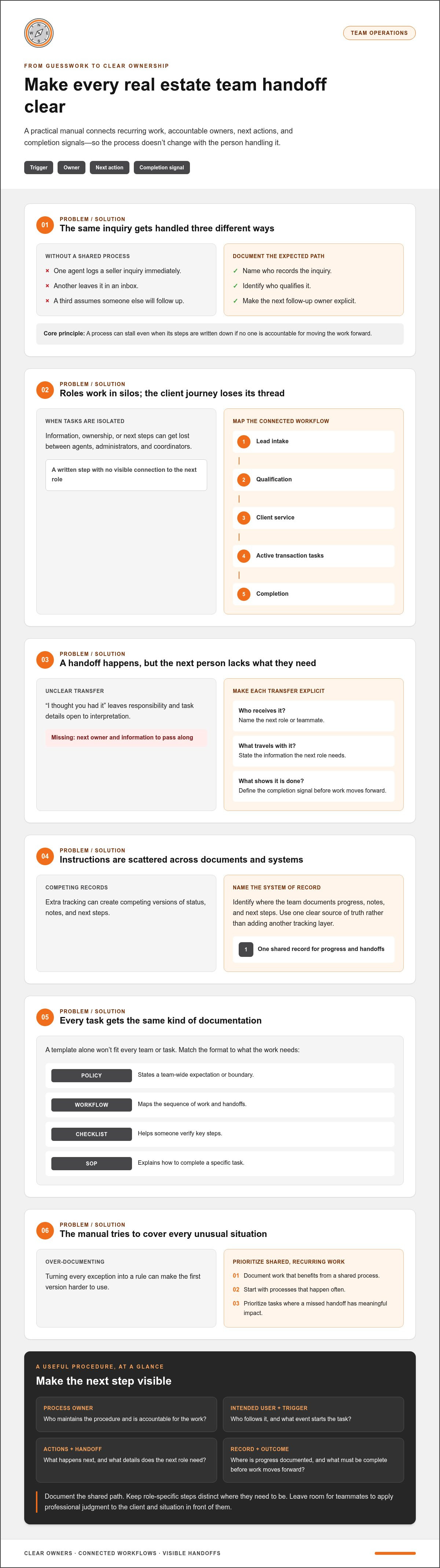
One agent logs a new seller inquiry immediately. Another leaves it in an inbox. A third assumes someone else will follow up. The task is the same, but the process changes with the person handling it. That inconsistency creates avoidable gaps, especially when a lead needs qualification, follow-up, or a clear next owner.
A real estate operations manual is the team’s documented guide to recurring processes, responsibilities, and handoffs. Its job is to make the expected path visible: who starts the work, what they do, and who takes over. Clear ownership matters because a process without an accountable owner can stall even when every step is written down.
Keep four terms distinct. A policy states a team-wide expectation or boundary. A workflow maps the sequence of work and handoffs. A checklist helps someone verify key steps. A standard operating procedure (SOP) explains how to complete a specific task. For example, a workflow may show how an inquiry moves from intake to follow-up, while an SOP gives the responsible teammate the steps for recording it.
This is practical Business Process Management (BPM): making work visible so the team can understand and improve it. Documentation supports consistency, but it doesn’t guarantee a transaction or replace professional judgment. The manual provides a shared starting point. Teammates still need to apply their expertise to the client and situation in front of them.
What belongs in a real estate operations manual?
Document recurring work that benefits from a shared process, not every one-off decision. Separate team-wide expectations from role-specific procedures and transaction-stage checklists. For each SOP, identify:
- Process owner: who maintains the procedure and is accountable for the work.
- Intended user and trigger: who follows it and what event starts the task.
- Expected outcome: what must be complete before the work can move forward.
How a manual helps a team work consistently
Written handoffs replace “I thought you had it” with a clear next step. They also make onboarding more practical: new teammates can follow the process, while experienced agents can provide coverage without relying on informal explanations.
For example, when a new seller inquiry arrives, the manual can identify who records it, who qualifies it, and which role owns the next follow-up. The exact steps can vary by team, but naming the owner and handoff point keeps the inquiry from being stranded between responsibilities. That clarity strengthens collaboration without turning the manual into a script for every conversation.
Design the Manual Around Real Estate Team Workflows
A manual works best when it follows the work as your team actually handles it. Map the connected path from lead intake through qualification, client service, active transaction tasks, and completion. That view helps you spot where information, ownership, or next steps can get lost between roles. It also keeps procedures from becoming isolated instructions that don’t connect to the rest of the client experience.
As you map each workflow, capture the same core details: what triggers the work, who owns it, what actions they take, where responsibility passes next, which system holds the record, and what signals completion. Guidance from Real Estate Office Policy Manuals from NAR can help you think through how written policies and procedures support consistent office operations.
Map the core workflows before drafting
Start with the teammates who perform the work. Ask them to walk through a recent example, and observe how tasks move between agents, administrators, and coordinators. Capture recurring exceptions and bottlenecks, but don’t turn every unusual situation into a rule. For the first version, prioritize processes that happen often or have a meaningful impact if a handoff is missed.
Connect the stages instead of documenting each role in isolation. For example, a new inquiry may move from intake to qualification, then to an agent for follow-up. Later, a client’s next steps may involve an administrator or coordinator before transaction completion. Show where each stage starts and ends so teammates can see how their work affects the next person.
Specify roles, handoffs, and records
Assign one accountable owner to maintain each procedure, even if several people perform its steps. At every handoff, state who receives the task and what information must travel with it. Identify the team’s existing system of record for status, notes, and next steps. The goal is one clear source of truth, not extra tracking that creates competing versions.
- Trigger and owner: What event starts the workflow, and who is accountable for moving it forward?
- Actions and handoff: What must happen, and what details does the next role need?
- Record and completion signal: Where is progress documented, and how does the team know the task is done?
Keep shared procedures separate from specialized tasks. A team-wide intake process may establish how every inquiry is recorded, while qualification or follow-up steps can differ by lead source or role. For instance, an expired-listing workflow may need distinct qualification and follow-up steps from another source. Use expired listing data as a practical example when mapping that path. If the workflow uses phone numbers, document the team’s handling process; numbers shown are indicated if they appear on the National Do Not Call Registry.
Build the map around the tools your team already uses. The manual should explain how those tools fit into the workflow, not assume they replace ownership or procedure. That connection between lead handling, client service, and transaction work is what makes the manual usable as one operating system.
Choose the Right Level of Detail for Each Team Procedure
The right format makes a procedure easy to use without burying the next action in unnecessary detail. A familiar, low-risk task may need only a checklist. A process with several handoffs or judgment calls needs more guidance. As you decide how to build a real estate team operations manual, match the detail to the work, not to a preference for long documents.
Checklist: Best for routine tasks with a predictable sequence and few decisions. Maintenance effort is low when the steps rarely change.
Step-by-step SOP: Best for complex processes with multiple owners, decisions, or handoffs. Maintenance effort is higher because updates may affect several roles.
Role guide: Best for clarifying a position’s recurring responsibilities, boundaries, and coordination points. Review it when responsibilities shift.
Policy reference: Best for documenting team-wide expectations that apply across workflows. Keep it concise and revise it when the underlying expectation changes.
Checklist or full SOP: which format fits?
Use a checklist when the teammate already knows the task and needs a reliable prompt, such as confirming that a file contains required internal notes before a handoff. Choose a fuller SOP when someone must understand why steps occur, how to make a decision, or what to do next if the process branches. Keep examples focused on quality standards. Show what a complete record looks like, for instance, without scripting every client conversation word for word.
A decision tree or escalation path often beats a long narrative when the next step depends on a clear condition. If an inquiry is ready for agent follow-up, route it to the assigned agent; if key information is missing, direct it back to the role responsible for completing intake. State who decides, what information they need, and where unresolved cases go. This keeps exceptions manageable without turning every possibility into a page of instructions.
Set useful standards and measures
Replace vague directions such as “follow up promptly” with observable criteria your team can apply consistently. Define the next action, where it’s recorded, who owns it, and what status shows the task is complete. Choose a small set of process measures the team can reliably capture, such as inquiries assigned, handoffs completed, or records missing a next step. These measures show how work is moving, not whether a transaction or listing is guaranteed.
Keep activity measures separate from business outcomes and individual performance promises. A manual should clarify the process, not imply that following a procedure guarantees a particular result. Make measures useful for spotting friction: if handoffs regularly lack necessary context, improve the handoff instructions or intake fields. Don’t add metrics simply because a dashboard can display them. Every measure should help the team make a practical decision or improve a step.
Before publishing a procedure, ask a teammate in the intended role to use it without extra explanation. If they can complete the task and identify the right next owner, you’ve likely captured enough detail. If they need repeated clarification, strengthen the decision points or handoff guidance. Keep the shortest format that supports consistent execution, then expand only when real use reveals a gap.
Build the Manual in Five Practical Steps
To learn how to build a real estate team operations manual, focus on a first version your team can use now, then improve it through real work. You don’t need to document every unusual scenario before publishing. Build the core, test it, and make ownership clear from the start.
- Inventory recurring workflows. List the work that repeats across lead intake, client service, and transaction coordination. Ask each role what starts the task, what they do, and where work passes next. Include workflows that depend on lead source, such as FSBO lead handling, when qualification or follow-up steps differ.
- Prioritize the first procedures. Select processes that happen often, involve several roles, or create confusion when steps are missed. Capture the essential path first. Record unusual exceptions separately rather than letting rare scenarios make every procedure harder to use.
- Draft in direct, active language. Have the process owner write the steps with input from the teammates who perform them. Use clear action verbs and name the person responsible. Number actions when sequence matters, such as “Record the inquiry,” “Assign the next owner,” and “Document the next step.” Link to a relevant FSBO lead guide when it supports a procedure about handling that source. Keep instructions practical and specific, without scripting every client conversation.
- Test with users. Ask a teammate unfamiliar with the draft to follow it without coaching. Have them flag missing actions, unnecessary detail, unclear ownership, and vague completion points. Revise the procedure based on what they couldn’t confidently do. A test exposes gaps that a quick proofread can miss.
- Approve and publish the first version. Name the owner, version date, and review date on each procedure. Store the manual in one accessible source of truth and organize it by workflow or role, so teammates can locate the right instructions quickly. Make clear which version is current, then approve the core manual and put it into use.
Draft, test, and publish for actual use
Keep the language lean. A teammate should be able to scan a procedure and identify the trigger, next action, owner, and completion signal. If a step depends on a decision, state the decision point and where each path leads. During testing, note questions and revise the document before approval. After publishing, direct the team to the shared source rather than circulating competing copies.
Start small and keep moving. The approved first version gives your team a consistent foundation, while later updates can address genuine process gaps as they surface.
Roll Out, Maintain, and Improve the Operations Manual
A manual only creates value when your team uses it during real work. Introduce it with a walkthrough, assign procedures by role, and make the current version easy to find. Then practice the workflows as they happen. That’s how you turn documentation into a working part of the team’s routine, not a file people remember only during orientation.
Make the manual part of onboarding and daily work
During onboarding, assign each new teammate the procedures tied to their responsibilities. Walk through key handoffs and let them use the instructions while completing real tasks. For existing teammates, use the manual during team reviews or when a process changes. If a procedure doesn’t cover a situation, define who answers the question and how the team should flag the gap for review. That gives people a clear path forward without encouraging everyone to invent a separate process.
For prospecting, make the procedure specific about who receives each lead, where contact attempts and notes are recorded, what the next step is, and who owns it. Include the team’s relevant compliance checks in the workflow so they’re part of the routine. For data management, Landvoice indicates numbers appearing on the National Do Not Call Registry. Your manual should also clarify how the team records the check and handles the result according to its established process.
Keep procedures accurate without creating document sprawl
Give each procedure a document owner who can collect teammate feedback and coordinate revisions. Review the relevant instructions when tools, responsibilities, or workflows change. Also revisit a procedure after recurring errors or when users report that a step is unclear. You don’t need to reopen the entire manual each time. Update the affected procedure, note the change, and make sure the people who use it know where to find the current version.
Keep one approved source of truth. Organize procedures by workflow or role, use clear titles, and make the current version easy to identify. Archive superseded versions so they don’t compete with live instructions. A simple revision record can capture what changed and who approved it, giving the team context without creating layers of duplicate documents.
Use a focused review rhythm that fits your team, plus event-based reviews whenever a process changes, errors repeat, or useful feedback comes in. Ask whether the procedure still reflects actual work, whether ownership remains clear, and whether the completion signal is still practical. This keeps the manual current without making maintenance a project of its own.
Building a manual that works means keeping it connected to the way your team handles leads and client service. Put the procedures into practice, listen for friction, and improve the specific step that needs attention. That’s how to build a real estate team operations manual your team can keep using as workflows evolve.
Put Your Team’s Next Workflow in Motion
Your manual should evolve alongside the team it supports. Treat each new hire, changing responsibility, and repeated process snag as a chance to sharpen how work moves. The practical payoff of learning how to build a real estate team operations manual is not a thicker document. It’s a team that can keep improving how it serves clients and manages its pipeline.
For prospecting workflows, the tools behind the process can also help teammates organize their work. Landvoice, trusted for over 30 years, offers Data Management with notes, filtering, search, tags, and maps. These capabilities can support a team’s documented approach to tracking and managing seller leads, while the manual sets out who owns each action and handoff.
Choose one workflow your team wants to make more consistent. Put the procedure to work, listen to the people using it, and refine it based on what they learn. Start with a clear next step, then build from there.
You have what you need to turn team know-how into stronger, repeatable operations. Keep moving forward.
Frequently Asked Questions
What should a real estate team operations manual include?
Include the recurring instructions teammates need to carry work forward, along with tools or reference documents they use to complete it. Organize content so an agent can find client-facing procedures, an administrator can locate support tasks, and a coordinator can check transaction-stage guidance. Add a brief glossary for team-specific terms or status labels. That shared vocabulary helps prevent different teammates from interpreting the same file status in different ways.
How do you write an SOP for a real estate team?
Start with one task and write for the teammate who will perform it. Use plain language, name the role responsible for each action, and show what a complete result looks like. For example, an SOP for preparing a client update could point to the records to review and the place to log that the update is complete. Have a teammate try the steps independently, then revise wherever they need clarification.
Should a small real estate team have an operations manual?
Yes, a small team can benefit from a lean manual, especially if the same person covers different duties or teammates need to back each other up. Start with the procedures most likely to cause confusion during coverage, such as routing new inquiries or preparing a file for review. One person can own updates, while each procedure names the role responsible for doing the work. Keep the format simple enough to maintain.
How long does it take to build a real estate operations manual?
There’s no single timeline; the scope depends on how many workflows you document and how much review each needs. A focused first version can cover a small set of high-priority procedures, while a broader manual takes more time to draft and test. A practical approach to how to build a real estate team operations manual is to publish usable guidance for current work, then add procedures as the team identifies a clear need.
How often should a real estate team update its operations manual?
Review a procedure when its workflow, tools, assigned roles, or handoff changes. Revisit it when the same mistake happens repeatedly or users flag a confusing instruction. Keep a simple feedback log with the procedure name, the issue, and a suggested correction. That gives the document owner concrete information to assess, rather than relying on memory or making broad revisions that don’t address the source of the problem.
What is the difference between a real estate policy and an SOP?
A policy states an expectation that applies across the team; an SOP explains how to complete a particular task. For example, a policy might set the team’s expectation that client records are kept current. An SOP could describe how the assigned teammate updates a record after an interaction. Keep the policy concise, and link it to the relevant procedure so people can move from the expectation to the practical steps.
How should a manual address Do Not Call Registry indicators in lead data?
It should explain that an indicator is a signal to follow the team’s established review process, not a substitute for that process. For phone numbers shown in Landvoice data, numbers appearing on the National Do Not Call Registry are indicated. Document who reviews the indicator, where the status is recorded, and how the team routes questions under its procedures. Don’t treat the indicator alone as a complete determination of whether or how to proceed.
