



by Bruce Keith, on October 7, 2026
What if confidence came from having a clear purpose, not a perfect script? If you’re learning how to build confidence calling expired listings, it’s understandable to worry about interrupting homeowners, getting a difficult question, or hearing no. Those concerns can make it tempting to put off outreach, even when a thoughtful conversation could help a seller consider their next step.
You don’t need to memorize lines or eliminate every bit of uncertainty before you begin. You need a simple, repeatable approach: prepare with current listing information, open with a professional reason for reaching out, and focus on understanding the homeowner’s situation. When a conversation takes an unexpected turn, pause, listen, and respond to what the seller actually says.
This article will show you how to prepare for more purposeful conversations, handle tough questions without relying on a script, and build a prospecting routine that gets easier with practice. You’ll also learn how to use each interaction, including a brief or unsuccessful one, to sharpen your approach and keep moving forward.
Key Takeaways
- Confidence comes from preparation and recovering calmly, not from feeling completely free of nerves.
- Use a simple routine to review each lead, set a conversation goal, prepare questions, and open naturally.
- Build your skill in how to build confidence calling expired listings by listening first and responding to the homeowner’s concerns.
- Practice, make contacts, note what you learn, and adjust your approach to make each conversation more purposeful.
- Organized expired-listing information and expert-led training can support a steadier prospecting routine.
Why contacting expired listing owners can feel intimidating, and what confidence really means
Reaching out to an expired listing owner can feel personal. You may worry about interrupting, hear “no” before you’ve explained why you called, or struggle to answer a question you didn’t expect. You might also fear sounding like you’re reading a script. Those concerns are real, but they don’t have to dictate your prospecting routine.
Prospecting confidence is the ability to prepare for a conversation, stay present through uncertainty, and recover constructively afterward. It isn’t the absence of nerves or a promise that every homeowner will want to talk. A listing that has expired can create an opening to understand the seller’s current plans and offer a useful perspective. It doesn’t guarantee a new listing. The owner decides what happens next.
What makes expired-listing conversations feel different?
The homeowner may already have discussed the sale with an agent, so you don’t know what that experience was like or what the owner wants now. That uncertainty can make you hesitate or reach for a generic pitch. Instead, approach with curiosity. Ask about the owner’s current plans, listen to the answer, and let it guide the conversation. You don’t need to criticize the previous agent or assume the seller is ready to relist.
Understanding confidence as a task-specific skill can help. The overview of What is Confidence? offers useful background on the concept. For prospecting, focus on what you can practice: preparing, opening respectfully, asking clear questions, and responding thoughtfully.
Can you build confidence before you feel ready?
Yes. Confidence often grows through prepared action, not through waiting until every doubt disappears. The answer to how to build confidence calling expired listings is to practice the behaviors you control while accepting that the outcome belongs to both people in the conversation.
You can review the lead, choose a clear reason for reaching out, listen without rushing, and reflect on what you’d adjust next time. You can’t control whether the owner is available, interested, or ready to discuss a move. Keep that distinction clear. It prevents a short conversation from becoming a verdict on your ability.
After each interaction, ask yourself: Did I communicate my purpose? Did I give the owner room to respond? What did I learn about their plans? Treat the answers as useful feedback, not a score. That learning mindset turns uncertainty into preparation for the next conversation, and gives you a practical foundation for confidence.
Prepare for expired-listing outreach with a clear purpose and flexible opening
A little preparation can replace vague nerves with a clear next step. You don’t need to predict every response. You need enough relevant context to introduce yourself honestly, ask a useful question, and let the homeowner guide the conversation.
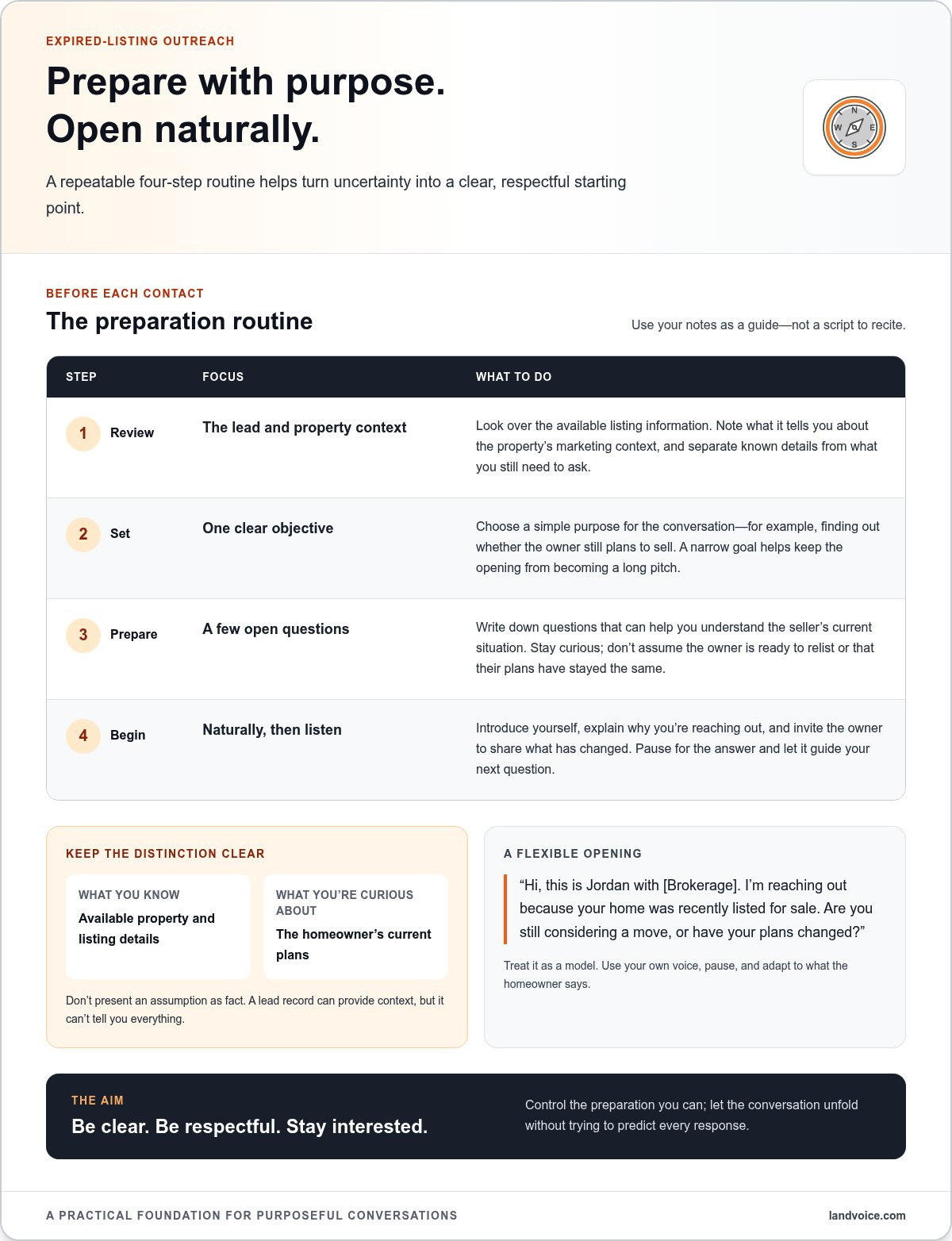
Use this four-step routine before each contact:
- Review the lead. Look over the available listing information and note what it tells you about the property’s marketing context.
- Set one objective. Choose a simple purpose, such as finding out whether the owner still plans to sell.
- Prepare questions. Write down a few open questions that help you understand the seller’s current situation.
- Begin. Use your notes as a guide, then speak naturally and listen to the response.
Relevant, current expired-listing lead information gives you a practical starting point. It can help you focus your preparation on the property and its listing history instead of scrambling for context at the last minute. Still, a lead record can’t tell you everything. Separate what you know from what you’re curious about, and don’t present an assumption as fact.
What should you review before contacting an expired listing?
Start with the details available about the property and its marketing context. Note what you can reference accurately, then identify what remains unknown, such as whether the homeowner’s plans have changed. Set one conversation goal before you reach out. Keeping that goal narrow helps you avoid turning an opening into a long pitch, and gives you a reason to ask rather than assume.
How do you open without sounding scripted?
Keep your opening brief: introduce yourself, explain why you’re reaching out, and invite the owner to share what’s changed. For example: “Hi, this is Jordan with [Brokerage]. I’m reaching out because your home was recently listed for sale. Are you still considering a move, or have your plans changed?”
Treat this as a model, not a line to recite. Use your own voice, pause for the answer, and adapt your next question to what the homeowner says. The goal isn’t to sound polished at all costs. It’s to be clear, respectful, and genuinely interested in the owner’s plans.
This preparation-first approach offers a practical way to build confidence calling expired listings: control the steps you can, then let the conversation unfold. Each time you review the lead, choose an objective, and open with purpose, you give yourself a more reliable starting point.
Build confidence by listening, asking useful questions, and handling uncertainty
A strong conversation isn’t a flawless delivery. It’s a responsive one. Use a simple sequence: ask, pause, clarify, and respond. Ask one open question, then give the homeowner time to answer. Clarify what you heard before suggesting a next step. This keeps you focused on the person, not on remembering what to say next.
Useful questions help you respond rather than recite. They give the conversation direction while leaving room for the homeowner’s priorities to shape it.
Which questions help you understand the homeowner’s current plans?
Start with a question that doesn’t presume the seller’s intentions: “Are you still considering selling, or have your plans changed?” If the owner is open to talking, follow their answer with a question about timing, concerns, or what they’d want to do differently. For example: “What would need to happen for a move to feel right?” Listen to the full answer before recommending a solution. A pause can feel longer than it is, but it gives the homeowner space to explain what matters.
How can you stay composed when the conversation gets difficult?
If a homeowner sounds frustrated, resist the urge to defend yourself or criticize the previous agent. Acknowledge the feeling without making assumptions: “It sounds like the selling process has been frustrating. I’m sorry it’s been difficult. Would it be okay if I asked what you’d want to be different next time?” This recognizes their experience and asks permission to continue, without blaming anyone or rushing toward a pitch.
Sometimes you won’t know the answer to a question. Don’t bluff or force a commitment. Say what you can answer plainly, and be honest about what you’d need to clarify before responding further. Then ask whether the owner would like to continue the discussion. A measured answer builds more trust than a confident-sounding guess.
If the homeowner declines, accept the answer and end courteously: “Understood. Thank you for your time. I wish you the best with your plans.” Respectful exits matter. You don’t need to rescue every conversation or turn every response into an opportunity.
For agents learning how to build confidence calling expired listings, this listen-first method offers a practical anchor when the conversation veers from expectation. Ask one clear question. Pause. Clarify before you respond. The aim isn’t to control what the homeowner says. It’s to stay steady enough to hear it and choose a thoughtful next step.
Practice a repeatable routine to make each expired-listing conversation easier
Confidence builds when practice turns outreach into a process you can repeat. Use a simple cycle: rehearse, contact, record observations, and adjust. The goal isn’t to make every conversation go perfectly. It’s to spot what you can improve and carry that lesson into the next one.
- Rehearse: Practice your purpose, opening, and a few likely questions.
- Contact: Put the preparation into action and focus on the conversation in front of you.
- Record: Note what felt natural, where you hesitated, and what you learned.
- Adjust: Choose one behavior to work on in your next practice or outreach session.
Keep track of actions and learning, not just outcomes. You might note that you made your purpose clear, allowed space for the homeowner to answer, or stayed composed when a question surprised you. Those are useful markers of progress. Avoid setting an invented conversion benchmark; your immediate focus is on strengthening repeatable behaviors.
How can you rehearse without making your delivery sound artificial?
Practice the conversation’s direction, not every sentence. In a short role-play with a peer or coach, work on your opening, a comfortable pause, and a few common questions. You can also record yourself to notice whether your pace is rushed or your reason for reaching out is clear. Repeat challenging moments until they feel familiar, not automatic. Leave room to listen and respond in your own words.
What should you review after each outreach session?
Make a brief note while the session is fresh. Which opening felt natural? Where did you hesitate? What question helped the homeowner explain their plans? Capture useful conversation lessons without recording unnecessary personal details. Then select one specific adjustment for next time, such as slowing down after your opening or pausing before answering. One focused change is easier to practice than trying to fix everything at once.
If you’re working on how to build confidence calling expired listings, this cycle gives you a practical way to learn from each attempt without treating any single conversation as a final judgment. Repeat the process, build on what’s working, and keep the next step manageable.
Explore expired-listing prospecting support
Turn preparation into consistent action with expired-listing tools and coaching
Preparation works best when you can repeat it. Organized expired-listing data can give you a practical starting point for reviewing a lead, understanding the available listing context, and choosing a focused objective before reaching out. Instead of rebuilding your process from scratch each time, you can follow the same steps and devote more attention to the conversation itself.
Tools support your workflow, but they don’t determine how a conversation will go. You’re still responsible for approaching each homeowner as an individual, checking what you know, and listening to what they tell you. Data can help you prepare; it can’t promise confidence, an appointment, or a listing. Your skill develops through how you use that preparation.
How can expired-listing data support a confident workflow?
Build a consistent pre-contact routine around the information available to you. Review the listing context, identify what you don’t know, and decide what you want to learn from the homeowner. Expired-listing prospecting tools can help organize this part of your workflow, while your questions and judgment keep the conversation relevant. Treat lead details as preparation, not a substitute for a respectful, individualized exchange.
When can coaching help you keep improving?
Practice is more valuable when you can examine real challenges. Expert-led training and coaching can support your prospecting skill development, helping you work through an opening that feels awkward, a question that catches you off guard, or a moment when you’re unsure how to respond. Bring a specific challenge to practice. Rehearse a few possible approaches, then focus on understanding the homeowner rather than delivering a perfect line.
To make the learning practical, connect coaching to your routine: identify one conversation moment to work on, practice it, use the skill during outreach, and reflect on what felt clearer. Keep what works. Adjust what doesn’t. Over time, you’ll have a process grounded in both preparation and experience, rather than relying on confidence to appear before you take action.
That’s a sustainable answer to how to build confidence calling expired listings: use organized information to prepare, strengthen your skills through deliberate practice, and bring what you learn into each new conversation. The tools provide workflow support. Your preparation and professional judgment bring it to life.
Make your next seller conversation a confident one
Confidence comes from preparation, attentive listening, and practice, not from having a flawless answer for every situation. Set a clear purpose before reaching out, ask questions that uncover the homeowner’s current plans, and treat each conversation as a chance to learn. That’s a repeatable path for how to build confidence calling expired listings while keeping your approach professional and focused.
Consistent preparation also takes the right support. Landvoice has served the real estate industry for over 30 years. Expired Pro provides access to expired-listing leads, while expert-led training and coaching can help you strengthen your prospecting skills. These resources support your workflow; your judgment and follow-through shape each conversation.
Start with one prepared contact, reflect on what you learn, and carry one improvement into the next conversation. You don’t need to wait until you feel completely ready to build a more consistent routine.
Frequently Asked Questions
How do I get over the fear of contacting expired listing owners?
Start with a small, prepared action instead of waiting for nervousness to disappear. Review the available listing context, set one purpose for the conversation, and prepare an opening question. Learning how to build confidence calling expired listings means focusing on behaviors you can control, such as speaking clearly and listening carefully. After each contact, note one thing you learned. Treat rejection as one possible response, not a verdict on your ability.
What should I say when contacting an expired listing owner?
Introduce yourself, explain why you’re reaching out, and ask whether the owner’s plans have changed. For example: “Hi, this is Jordan with [Brokerage]. I’m reaching out because your home was listed for sale. Are you still considering a move, or have your plans changed?” Adapt the wording to your own voice. Keep the opening brief, then give the homeowner space to answer instead of moving straight into a pitch.
How can I sound confident without memorizing a script?
Prepare your purpose and a few questions, not a word-for-word speech. Knowing the direction of the conversation helps you stay clear while leaving room to respond naturally. Practice the opening with a colleague or record yourself to notice your pace and clarity. During the conversation, pause after asking a question. A calm, attentive response often sounds more confident than a perfectly recited line.
What questions should I ask an expired listing seller?
Begin with an open question about whether selling is still a priority, such as, “Are you still considering a move?” If the owner is willing to talk, ask what timing they have in mind, what concerns them, or what they’d want to be different in a future selling process. Ask one question at a time and listen to the full answer before suggesting a next step.
What should I do if an expired listing owner rejects my call?
Accept the answer without arguing, pressuring the owner, or trying to force the conversation forward. You can respond, “Understood. Thanks for your time. I wish you the best with your plans,” then end courteously. Afterward, make a brief note about what you learned, without turning the rejection into a judgment of your skills. The professional goal is to communicate respectfully, even when the homeowner isn’t interested.
How often should I practice contacting expired listings?
Practice regularly enough to keep your opening and questions familiar, while choosing a rhythm you can sustain alongside your other work. Short role-play sessions can focus on one skill at a time, such as pausing after a question or responding calmly to a common concern. After outreach, review what felt clear and what you want to adjust. Consistency and reflection matter more than trying to perfect every line at once.
Can expired-listing lead data help me feel more confident?
Organized expired-listing data can make preparation more focused by giving you relevant listing context to review before reaching out. That can reduce avoidable uncertainty about what to discuss, but it can’t tell you the homeowner’s current intentions or guarantee a particular response. Use the information as a starting point, separate known details from assumptions, and let the owner’s answers shape an individualized conversation.
