



by Bruce Keith, on August 18, 2026
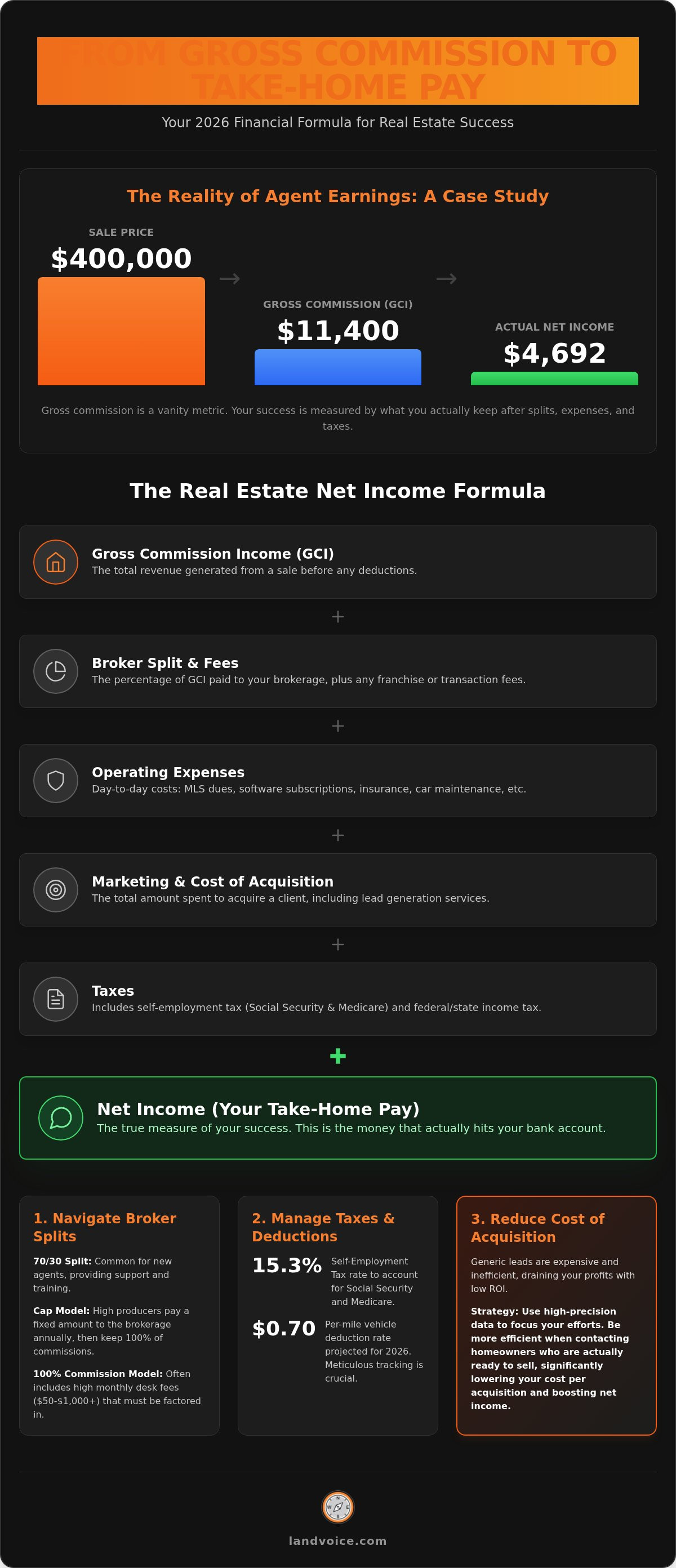
You just closed a $400,000 sale and secured an $11,400 commission, but after splits and taxes, you might only see $4,692 in your bank account. This is the brutal reality of the industry that separates elite producers from those who eventually flame out. If you want to stop guessing about your financial future, you must master exactly how to calculate net income for a real estate agent before the next surprise tax bill arrives.
You are likely exhausted by unpredictable cash flow and the high cost of acquiring leads that eats into your hard-earned margins. We agree that gross commission is a vanity metric; your true success is measured by what you actually keep. This 2026 guide provides the exact formula to command your finances and maximize your profit margins. You will learn to optimize your efficiency when contacting homeowners and leverage tools from Landvoice to lower your cost per acquisition. We are breaking down everything from the 15.3% self-employment tax to the $0.70 per mile deduction to ensure your business is built for predictable, elite-level growth. It is time to stop playing defense with your money and start building a high-performance financial strategy.
Key Takeaways
- Master the definitive formula for 2026 to separate your Gross Commission Income from your actual take-home pay.
- Learn exactly how to calculate net income for a real estate agent by accounting for broker splits, tax liabilities, and hidden operating costs.
- Identify the specific 2026 tax rates and business deductions that protect your margins from unexpected end-of-year bills.
- Discover how to slash your Cost of Acquisition by using Landvoice data to be more efficient when contacting homeowners.
- Adopt a results-oriented strategy to increase your net profit through listing-side leverage and high-performance conversion workflows.
The Real Estate Net Income Formula: Beyond the Commission Check
Stop obsessing over Gross Commission Income. It is a vanity metric that frequently hides the reality of a struggling business. In 2026, elite performers understand that top-line revenue is just the starting point of the story. If you want to build a sustainable career, you must learn how to calculate net income for a real estate agent with clinical precision. Efficiency is no longer optional. It is the only way to survive a market where margins are under constant pressure from rising lead costs and tax liabilities. You are running a business, not a hobby. Treat your numbers with the respect they deserve.
Gross vs. Net: The Critical Distinction
Gross Commission Income (GCI) represents the total revenue you generate before anyone else touches a cent. It looks impressive on an awards stage, but it does not pay your mortgage or fund your retirement. Net Income is the amount left after your brokerage takes its cut, the IRS gets its share, and your business expenses are settled. Understanding Real estate agent commission structures is vital because your split is often your largest single expense. While GCI measures your activity, Net Income measures your actual success. Your net income is the true salary of a real estate professional.
The Basic Math Equation
You cannot manage what you do not measure. To take control of your financial destiny, you need a repeatable formula that you review at least once a month. Waiting until tax season to see your profit is a recipe for disaster. Quarterly reviews are the bare minimum, but monthly tracking allows you to pivot before a bad month becomes a bad year. The math is direct:
- GCI (Total revenue generated)
- - Broker Split (Franchise fees and commission splits)
- - Operating Expenses (MLS dues, software, car maintenance)
- - Marketing and Leads (The cost of acquiring clients)
- - Taxes (Self-employment and income tax)
- = Net Income
Many agents fall into the trap of ignoring the "Marketing and Leads" variable in their daily math. They spend thousands on generic lead providers, effectively paying to work for a low ROI. You must optimize this variable to protect your take-home pay. By leveraging high-precision data from Landvoice, you slash your cost of acquisition. This allows you to focus on contacting homeowners who are actually ready to sell, ensuring your marketing spend fuels your growth rather than draining your bank account. Precision in your data leads to precision in your profits.
Step 1: Calculating GCI and Navigating Broker Splits
Your Gross Commission Income (GCI) is the raw fuel for your business. To master how to calculate net income for a real estate agent, you must first project your top-line revenue with brutal honesty. This starts with your pipeline. Do not just look at your active listings; look at your conversion rates. If you have five listings at a median price of $405,400 and a historical conversion rate of 80%, your projected GCI is based on four closings. Keeping a pulse on local inventory, such as homes for sale Guymon OK, helps you stay grounded in current market valuations. In a post-settlement market, you cannot assume a standard 3% anymore. Negotiated rates are the new norm. Use a conservative average of 2.88% for listing sides to keep your projections grounded in reality.
Brokerage Models and Your Bottom Line
The split model you choose dictates your financial ceiling. Traditional 70/30 splits are common for newer agents, but high producers often hunt for the "Cap" model. Once you pay a predetermined amount to your brokerage, you keep 100% of the commission, minus small transaction fees. This shift mid-year can cause a massive spike in your monthly take-home pay. Conversely, 100% commission models often hide high monthly desk fees that range from $50 to over $1,000. You must calculate the "real" percentage you pay by adding those fixed fees to your transaction costs. Because you operate as an independent contractor, reviewing IRS tax tips for real estate agents is essential to understand how these brokerage payments impact your taxable earnings.
Commission Nuances in 2026
The 2026 landscape requires a diverse lead portfolio to maintain a steady GCI. Relying solely on buyer leads is risky now that buyer agent compensation is negotiated in writing before every tour. To stabilize your income, you must pivot toward the listing side where you have more control over the numbers. Listing agents typically command a more predictable share of the fee. To secure these high-margin opportunities, many top-tier professionals use Landvoice expired leads to find homeowners who are already motivated to sell. By focusing on listing-side inventory, you protect your GCI from the volatility of the buyer market. This proactive approach ensures that when you finally sit down to calculate your true profit, the numbers actually work in your favor.
Step 2: Accounting for Operating Expenses and Tax Liabilities
You have your GCI. You know your split. Now you must face the operating expenses that drain your bank account. If you want to master how to calculate net income for a real estate agent, you must view every dollar spent as a strategic investment. You are not just buying things; you are funding a profit machine. In 2026, the difference between a top producer and a struggling agent is the ability to track these numbers with clinical precision.
Flat fee expenses are your baseline. Annual MLS dues, NAR membership, and E&O insurance typically cost between $1,500 and $2,500. These are fixed costs you pay regardless of your production. Variable expenses are where most agents lose control. Professional photography, signage, and car maintenance fluctuate with your volume. With the IRS standard mileage rate at $0.70 per mile in 2026, tracking your business travel is a high-yield activity. An agent driving 15,000 miles a year secures a $10,500 deduction. That is real money back in your pocket. You must set aside 25% to 30% of every commission check immediately to handle these costs and your future tax bill.
Common Business Write-Offs for Agents
Your home office and automotive costs are your primary defensive weapons against a high tax bill. Technology is your biggest leverage point. Your CRM, professional website, and Landvoice software are all fully deductible. These tools make you more efficient when making more contacts, effectively lowering your cost of acquisition while reducing your taxable income. Coaching is another critical investment. High-performance sales coaching is a deductible expense that pays dividends in your conversion rate and long-term financial stability.
The Self-Employment Tax Hurdle
The 15.3% self-employment tax is the single biggest shock for new agents. It covers the first $184,500 of your net profit in 2026. Because you are the employer and the employee, you are responsible for the full amount of Social Security and Medicare. To stay ahead, you must treat tax as a fixed expense, not a surprise deduction that hits you once a year. Profitable agents make quarterly estimated payments to keep the IRS at bay and maintain predictable cash flow. If you aren't paying quarterly, you're just borrowing money from your future self at a high interest rate.
Step 3: Calculating and Reducing Your Cost of Acquisition
Most agents treat marketing like a black hole. They throw money at digital ads and hope for a return, but they never measure the actual cost of the result. To truly master how to calculate net income for a real estate agent, you must define your Cost of Acquisition (COA). This is the total amount you spend on marketing and lead generation divided by the number of deals you actually close. If you spend $5,000 to close one deal, your profit is already bleeding out before you even pay your brokerage. High-performance agents don't just spend money; they invest in high-margin activities that drive the COA down.
Your time is your most expensive asset. If you spend four hours a day dialing inaccurate numbers, your "time-cost" is astronomical. Landvoice provides the proprietary gold standard of data, ensuring you spend your hours contacting homeowners who are actually reachable. With over 30 years of industry experience, we know that precision data eliminates the hesitation of outbound communication. When your data is reliable, your efficiency spikes, and your cost per closed deal plummets.
High-Margin Leads vs. Low-Margin Leads
Not all leads are created equal. Digital ad spend often results in low-intent leads that require months of nurturing and high platform fees. Conversely, focusing on FSBO leads and expired listings puts you in front of homeowners who have already raised their hands to sell. These are high-margin opportunities because the intent is high and the acquisition cost is low. The math of making more contacts is simple. When you use high-quality data to reach motivated sellers, you close more deals with less waste. This directly inflates your net profit by keeping more of that commission check in your own pocket.
The Efficiency Audit
It is time to audit your last 10 deals. Where did they come from? What was the specific dollar amount spent to secure them? If you find yourself overpaying for generic leads that don't convert, cut the waste immediately. Successful agents leverage tools like Landvoice Neighborhood Search to build high-margin circle prospecting lists around their recent sales. This allows you to dominate a specific area without the massive overhead of traditional advertising. By focusing on niche lead sources, you control your margins and secure predictable growth.
Stop overpaying for low-quality leads and start dominating your market with precision data. Get started with Landvoice today to lower your acquisition costs and maximize your take-home pay.
Strategic Growth: How to Increase Your Net Income in 2026
Knowing how to calculate net income for a real estate agent is only the first step toward financial freedom. Once you have a clear picture of your margins, you must pull the strategic levers that expand your profit without burning you out. In 2026, the listing side is your primary engine for growth. By focusing on listings, you control the inventory, dictate your schedule, and leverage your marketing across multiple channels. You aren't just chasing commissions; you are building a scalable enterprise.
Your conversion rate is the most significant multiplier in your business. Mastering scripts and objection handling is not about manipulation. It is about professional precision. When you combine high-performance scripts with the Landvoice Dialer, you automate the heavy lifting of making more contacts. This allows you to focus your energy on high-value conversations. To truly master the business of real estate, elite agents invest in Landvoice Pro Coaching. This isn't just about sales tips. It is about the systems, mindset, and workflows that separate the top 1% from the rest of the pack.
Mastering the Listing Presentation
A 10% increase in your listing presentation conversion rate can fundamentally change your lifestyle. Based on the median U.S. home price of $405,400, every additional closing adds approximately $11,675 to your GCI at a 2.88% rate. High-quality data is your secret weapon here. When you walk into a presentation armed with proprietary insights from Landvoice, you establish immediate authority. You aren't just another agent; you are the expert who knows the market better than anyone else because your data is superior.
Scaling Without Burnout
Scaling requires a transition from hustle to system. You cannot work 20 hours a day and expect to maintain a high net profit. You must implement a rigid daily prospecting schedule that prioritizes contacting homeowners during peak hours. The ROI of your time is non-negotiable. Paying for accurate contact data saves you hundreds of hours in manual labor, effectively adding thousands to your bottom line by freeing you to close more deals. It is time to stop playing small. Check Landvoice pricing to start optimizing your profit margins today and take control of your financial future.
Take Command of Your Financial Future
You now possess the blueprint to move beyond vanity metrics and master your true profitability. By learning how to calculate net income for a real estate agent, you've shifted from a reactive worker to a proactive business owner. You've identified the tax liabilities, brokerage splits, and operating costs that define your real take-home pay. Most importantly, you now understand that your net profit isn't just what's left over; it's a number you control by optimizing your lead generation efficiency and targeting high-margin listings.
Landvoice has spent over 30 years helping elite professionals build stable, profitable businesses. We provide the most accurate FSBO and Expired data in the industry so you can stop wasting time on dead-end numbers. With our motivational coaching, you'll master your conversion rates and dominate your market. The research phase is over. It's time to execute. Start maximizing your net income with Landvoice leads today. Your future as a top-tier producer starts with the next contact you make.
Frequently Asked Questions
What is the average net income for a real estate agent?
The median income for a real estate agent in the U.S. is approximately $50,000, but your net take-home pay depends on your business efficiency. Top-tier professionals in the 10% bracket earn over $120,000 annually. To maximize what you keep, you must master how to calculate net income for a real estate agent by subtracting splits, taxes, and acquisition costs from your gross revenue. This clarity allows you to scale with confidence.
How much should a real estate agent set aside for taxes?
You should set aside 25% to 30% of every commission check to cover federal, state, and self-employment taxes. The self-employment tax rate alone is 15.3% on the first $184,500 of your net income in 2026. Treating your tax obligation as a fixed business expense rather than a year-end surprise ensures your financial stability and prevents cash flow crises during tax season. Proactive planning protects your profit margins.
Are lead generation services like Landvoice tax-deductible?
Yes, investment in professional lead data and software is a fully deductible business expense. Using Landvoice to acquire high-quality contact information qualifies as a marketing cost under IRS guidelines. These deductions lower your taxable income while providing the high-precision data needed to dominate the listing side of the market. Always consult a tax professional to ensure you are maximizing all available business write-offs for your specific situation.
How do I calculate my cost per lead in real estate?
Calculate your cost per lead by dividing your total monthly marketing spend by the number of leads generated. However, elite agents focus on the "Cost of Acquisition," which is the total spend divided by closed deals. High-quality data from Landvoice reduces this cost by ensuring you spend your time on homeowners who are actually motivated to sell, significantly increasing your conversion efficiency and overall business ROI.
What is a good GCI to Net Income ratio?
A healthy business target is to retain 60% to 70% of your Gross Commission Income as net profit. While new agents on traditional 50/50 splits may see lower ratios, high producers on capped or flat-fee models often exceed this benchmark. Monitoring this ratio tells you if your operating costs or lead acquisition fees are eating too much of your hard-earned revenue. Efficiency in your lead sources is the primary driver of this metric.
Can I increase my net income without selling more houses?
Absolutely, you can increase your net income by optimizing your operational efficiency and reducing wasteful spending. Cutting high-cost, low-intent lead sources in favor of high-precision data allows you to keep more of each commission check. Focusing on the listing side also improves your leverage, as it generally requires less time per transaction than working with buyers, effectively raising your hourly rate and your total take-home pay.
How do broker splits change as I sell more properties?
Many brokerages use a graduated split or a capped model where your percentage increases as you hit specific production milestones. Once you "cap," you may keep 100% of your commission minus small transaction fees. Understanding how to calculate net income for a real estate agent requires knowing exactly when these shifts occur in your specific brokerage agreement to project your year-end profit accurately and plan your marketing investments accordingly.
Is it better to pay for leads or do 'Contacting Homeowners' manually?
The most profitable strategy is a hybrid approach where you pay for high-quality data to make "Contacting Homeowners" more efficient. Manually searching for contact info is a low-value use of your time. By using Landvoice, you gain immediate access to accurate phone numbers for Expireds and FSBOs. This allows you to spend your hours making more contacts and closing deals rather than doing tedious administrative research.
