



by Bruce Keith, on November 5, 2026
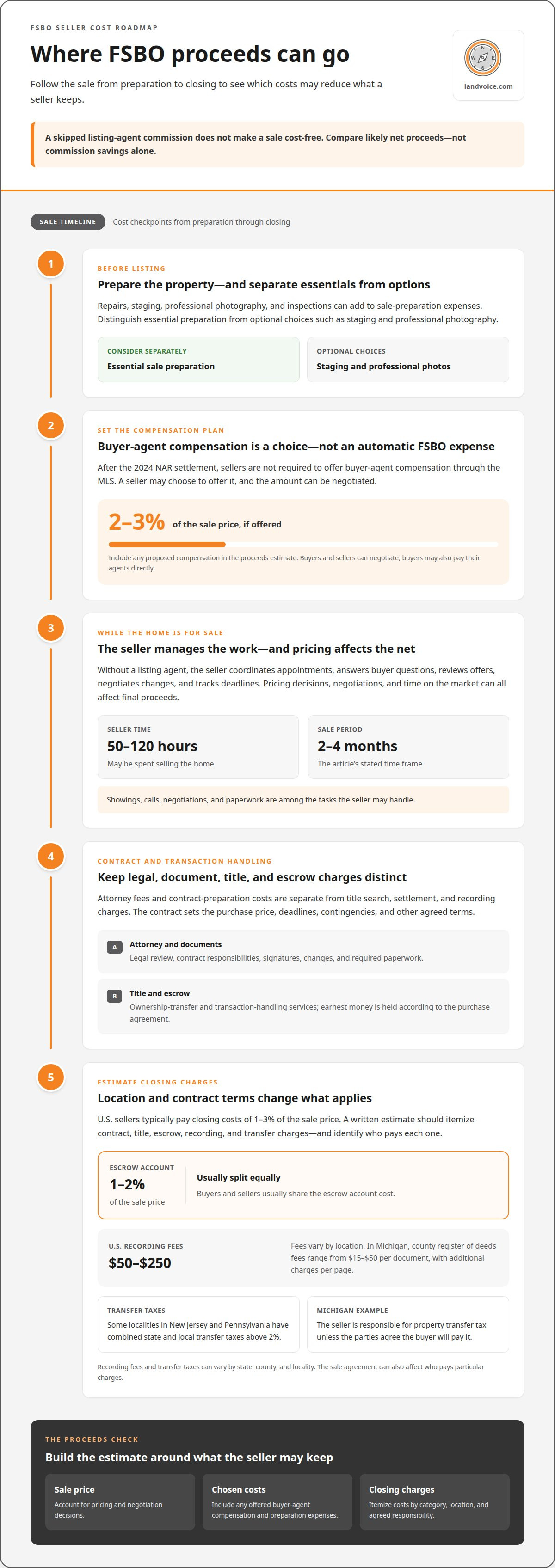
Skipping the listing-agent commission doesn’t mean selling FSBO is cost-free. To explain the hidden costs of FSBO to sellers, make the key distinction clear: sellers aren’t required to offer buyer-agent compensation through the MLS after the 2024 NAR settlement, but they may choose to offer it, and that compensation can be 2-3% of the sale price. The seller’s actual proceeds depend on more than commission.
It’s easy to focus on the savings and overlook expenses that arise before closing. Attorney and document costs, sale preparation, closing charges, and the financial effects of pricing and negotiation decisions can all reduce proceeds.
This article breaks down the costs sellers may face, including buyer-agent compensation, attorney and documentation expenses, repairs and marketing, and common closing charges. It also explains how pricing decisions can affect net proceeds, so you can set expectations with sellers using a clearer picture of what they may keep after the sale.
Key Takeaways
- Show sellers that buyer-agent compensation is negotiable, not an automatic FSBO expense, and include any offered amount when estimating proceeds.
- Account for closing charges, title and escrow services, and attorney or document expenses, which can depend on the property’s location and transaction.
- Separate essential sale-preparation expenses from optional choices such as staging and professional photography.
- Compare likely net proceeds, not just commission savings; pricing, negotiations, and time on the market can all affect the final result.
- Use a clear cost breakdown to set expectations before listing and help sellers make informed decisions about their FSBO plan.
Do I still have to pay the buyer's agent when selling FSBO?
Not automatically. A FSBO seller may offer buyer-agent compensation, but it’s a choice, not an automatic listing expense.
Explain the full proceeds picture: the compensation decision matters, but so do the sale price and the seller’s other responsibilities.
Agent Fees and Buyer-Agent Compensation
Real estate agent fees are negotiated compensation for representation, and buyer-agent compensation is one possible part of a sale’s costs. Typical U.S. real estate agent fees are 5-6% of the home’s final cost, while the listing-agent commission a FSBO seller may save is typically 2.5-3%. After the 2024 NAR settlement, sellers aren’t required to offer buyer-agent compensation through the MLS.
If a seller chooses to offer compensation, the amount can be negotiated and included in the seller’s proceeds estimate. FSBO sellers may offer 2-3% of the sale price, but buyers and sellers can negotiate compensation rather than treating a percentage as mandatory. Buyers may also pay their agents directly.
For the mandatory commission question, FSBO sellers may pay 2-3% of the sale price if they offer buyer-agent compensation. The seller decides whether to offer it and what amount to propose.
Costs Compared With Sale Proceeds
Comparing agent costs with final sale proceeds means weighing the net amount after transaction expenses, not simply subtracting a listing commission. These are reported medians, not a promise that an agent will achieve a particular price for any home.
Sale rates provide useful context, too. The same NAR profile reports that FSBO transactions made up 5% of recent home sales, while 91% of sellers worked with a real estate agent. Those figures describe different measures: one is the share of sales completed FSBO, and the other is how sellers handled their sale.
For the time question, FSBO sellers may spend 50-120 hours selling their home over 2-4 months. That time can include showings, calls, negotiations, and paperwork, which the seller manages without a listing agent.
Without a listing agent, the seller coordinates appointments, answers buyer questions, presents offers, and tracks deadlines. When an offer arrives, for example, the owner must review its terms, negotiate any changes, and keep the transaction moving. A buyer’s agent may represent the buyer, but the FSBO seller remains responsible for decisions on their side of the sale.
To frame these tradeoffs before an owner lists, agents can use FSBO seller information to support focused conversations about the sale path.
What closing costs does the seller pay in a FSBO transaction?
U.S. sellers typically pay closing costs of 1-3% of the sale price. State, county, and local rules affect which charges apply and how they’re allocated.
For FSBO sellers, a written estimate should itemize contract, title, escrow, recording, and transfer charges. This breakdown helps owners see which costs vary by location and which depend on the sale agreement.
Attorney Fees and Contract Preparation
Attorney fees and contract-preparation costs cover legal review and documents that define the sale terms. They matter because, without a listing agent coordinating the transaction, the seller must manage their own contract responsibilities.
A contract sets out the purchase price, deadlines, contingencies, and other agreed terms. As the transaction progresses, the seller also needs to track signatures, changes, and required documents.
Show these costs separately from the contract itself. For example, someone estimating FSBO expenses should distinguish attorney fees from title search, settlement, and recording charges. A real estate association may provide general transaction information, but its materials do not replace the agreement between buyer and seller.
Recording Fees and Local Variation
Recording fees pay for filing sale documents with the appropriate public office; local variation makes them important to estimate by property location. U.S. recording fees typically range from $50-$250.
In Michigan, a county register of deeds recording fee ranges from $15-$50 per document, with additional charges per page. A local register of deeds may require tax certification before recording. The number of documents and pages can therefore affect the final recording charge.
Transfer taxes also vary. Some localities in New Jersey and Pennsylvania have combined state and local transfer taxes above 2%. In Michigan, the seller is responsible for property transfer tax unless the parties agree the buyer will pay it. The tax is calculated as a percentage of the sale price by both the state and county.
For the mandatory location question, recording fees and transfer taxes can vary by state, county, and locality. Contract terms may also determine who pays particular charges, as Michigan’s transfer-tax allocation illustrates.
Title, Escrow, and Earnest Money
Title and escrow charges cover services that support ownership transfer and transaction handling. They matter because title insurance, settlement work, and earnest-money management can appear as separate costs at closing.
An escrow account costs 1-2% of the sale price, and buyers and sellers usually split that cost equally.
Escrow also holds the buyer’s earnest deposit until the sale is finalized. If the buyer rescinds the offer, the earnest money is transferred to the seller. The purchase agreement should set out the deposit and the terms that govern its handling.
To explain the closing estimate clearly, list each charge by category and identify whether the agreement assigns it to the buyer or seller. A $50-$250 recording charge, for example, should remain distinct from title insurance and escrow fees.
Pricing mistakes and missed sale proceeds
Selling by owner can reduce listing expenses, but the asking price still drives gross proceeds. To explain the hidden costs of FSBO to sellers, compare expected net proceeds, not just the commission saved. A pricing error on a high-value property can outweigh savings elsewhere.
FSBO means “for sale by owner”: the homeowner markets and negotiates the sale without a listing agent. The seller handles inquiries, showings, offers, disclosures, and transaction details directly. A buyer’s agent may still be involved, and an appraisal can affect a financed buyer’s ability to proceed. Each step can influence the timeline and final proceeds.
National sale-price figures offer context, not a guaranteed result for an individual home. The National Association of REALTORS® reported 2024 median sale prices of $380,000 for FSBO homes and $435,000 for agent-assisted homes. That $55,000 difference, or roughly 14%, compares two groups of sales. It doesn’t prove that hiring a realtor automatically raises a particular home’s value by that amount.
Pricing errors have a direct effect on proceeds. An asking price that is too high may discourage buyers or lead to later reductions. A price that is too low can leave money on the table. Comparable properties, condition, location, and buyer response all influence how a price performs.
Time on the market adds another cost. FSBO listings average 3-4 weeks longer on the market than agent-listed homes. Carrying costs continue while the home remains unsold, including mortgage payments, utilities, insurance, and property taxes.
Negotiations can change the final figure, too. Buyers may negotiate after inspections, disclosures, or an appraisal, and the seller’s response affects the agreed price and terms. A lower appraisal can put a financed sale at risk if the contract price exceeds the appraised value and the parties cannot resolve the difference.
For agents explaining the hidden costs of FSBO to sellers, present three scenarios: the target price, a lower negotiated price, and a delayed closing with added carrying costs. Subtract expected transaction expenses from each. This shows homeowners how pricing, timing, and negotiation can shift proceeds, offering a more useful comparison than commission savings alone.
Repairs, staging, photography, and inspections
Pre-sale preparation can affect both a home’s presentation and the seller’s net proceeds. For FSBO sellers, distinguish necessary repairs from optional upgrades, then consider how each expense contributes to the sale.
These expenses serve different purposes: repairs address visible issues, staging helps buyers picture the space, and photography presents the property in its marketing.
Signage and marketing costs depend on the materials, exposure, and promotion the seller chooses.
Explain inspection expenses carefully: in a U.S. sale, the buyer generally pays for the home inspection. A seller may choose a pre-listing inspection to identify issues before marketing, but that is separate from the buyer’s inspection.
Inspection findings can lead to further costs. A buyer may ask the seller to make repairs, reduce the price, or provide another negotiated concession. If an inspection identifies a repair concern, for example, the parties can address it in the agreement rather than assuming the seller must accept the first request. A real estate attorney can help review contract language and repair terms, especially when the parties change their original agreement.
Prepare a simple budget before listing. Avoid treating every suggested improvement as essential. The home’s condition, target buyer, and local expectations help determine which choices make sense.
A broader estimate can include preparation and marketing expenses, but the total will differ by property and plan. A seller using a flat-fee MLS listing, professional photography, and limited repairs has a different cost mix from one choosing staging, extensive touch-ups, and additional promotion.
Make the estimate useful by listing each item once, separating fixed choices from optional work, and noting who pays each inspection charge. This helps sellers weigh repairs and marketing against expected proceeds instead of approving expenses without a clear purpose.
Real estate attorney and documentation costs
Legal and documentation expenses may remain even when a homeowner handles the listing. Many U.S. states require sellers to use an attorney for home sales, including FSBO transactions. Include these expenses in the proceeds estimate rather than grouping them under vague “paperwork” costs.
An attorney may prepare or review the purchase agreement, explain contract language, and coordinate closing documents. The agreement records the price, deadlines, contingencies, and negotiated terms. For example, if the buyer and seller later change a repair arrangement, a written amendment should reflect their agreement. Clear documentation helps prevent misunderstandings from becoming costly delays.
Document preparation involves more than producing a contract. A home sale may require seller disclosures, title and ownership information, payoff details, and signed amendments. The documents depend on the property and transaction. A missing signature or inconsistent detail can delay closing, so sellers need a reliable way to track versions, dates, and completed forms.
Attorney costs also depend on the work involved. A straightforward review differs from drafting custom terms or resolving a dispute about an inspection request. A real estate agent may help coordinate a listing and transaction, but an agent’s role does not replace legal advice when an attorney is required or legal questions arise.
Documentation errors can cause practical problems even without a courtroom dispute. If a purchase agreement gives a different closing date from a later amendment, for example, the parties may need to clarify which date controls before arranging the final signing. An incomplete disclosure can likewise raise questions about what the seller communicated. Organizing each signed version by date gives the parties a clear record.
Explain these expenses by connecting each document to a stage of the sale. The purchase agreement sets the initial terms, amendments record later changes, and closing documents complete the transfer. This structure helps homeowners understand what an attorney handles and what the seller must provide. It also keeps legal fees separate from other itemized closing expenses.
Before a FSBO listing begins, sellers can map out expected legal tasks: review the agreement, track disclosures, document negotiations, and prepare for closing. State attorney requirements and transaction complexity shape the work. A Florida seller, for instance, should account for the cited attorney-fee range when estimating proceeds rather than treating legal support as an unexpected final expense.
Landvoice: FSBO Leads
Landvoice offers FSBO Leads to help real estate agents connect with homeowners selling by owner. These leads give you a relevant starting point for conversations about a seller’s goals, timeline, and plans for handling the transaction.
Use FSBO Leads to connect with homeowners managing the sale process themselves. A useful conversation can clarify how they’re considering buyer-agent compensation, preparation expenses, closing costs, and pricing. Keep the discussion grounded in their plans, not assumptions about what they’ll spend or net.
For agents building a focused prospecting workflow, FSBO Leads can support outreach to homeowners who may value informed guidance. Contact Landvoice to discuss FSBO Leads.
Turn Better Seller Conversations Into Your Next Step
Turn your understanding of FSBO costs into a practical conversation framework. Knowing how to explain the hidden costs of FSBO to sellers helps you ask relevant questions, understand each homeowner’s priorities, and have a more informed discussion. Focus on the seller’s goals, then shape your follow-up around what matters to them.
Landvoice offers FSBO Leads, Expired Pro, and FRBO Leads for agents building a focused prospecting workflow. These lead options help you connect with homeowners in distinct selling situations and start conversations suited to their circumstances. Choose the opportunity that best aligns with the conversations you want to develop.
Keep your outreach consistent, stay attentive to each seller’s needs, and make every conversation count.
Make your next step purposeful, and keep moving forward.
Frequently Asked Questions
How Much Does It Cost to Sell a House By Owner?
FSBO selling costs for a median-priced U.S. home depend on the sale plan, property condition, and negotiated terms. Build an estimate that separates preparation and marketing expenses from closing charges and any buyer-agent compensation offered. Then compare the total with expected proceeds instead of treating a saved listing commission as the full financial result.
How much do FSBO homes sell for compared to agent-listed homes?
These figures compare groups of completed transactions, not identical homes sold under controlled conditions. Property condition, location, pricing, and sale terms vary. Use the medians as context for a proceeds discussion, not as a prediction for an individual seller’s home.
Is FSBO Actually Cheaper?
FSBO can reduce the expense of hiring a listing agent, but it does not automatically produce higher net proceeds. Sellers still need to account for preparation, marketing, closing charges, and any buyer-agent compensation they offer. Time spent managing inquiries and offers is another tradeoff. Compare the expected FSBO sale price and all planned expenses with an agent-assisted estimate, then assess the likely net rather than focusing on a single fee.
What About the Cost of Hiring an Agent?
Real estate agent fees in a typical U.S. home sale are usually 5-6% of the final sale price, with compensation terms negotiated. The listing-agent portion that a FSBO seller may save is typically 2.5-3%. Buyer-agent compensation is handled separately and isn’t automatically required through the MLS after the 2024 NAR settlement. Compare the services and expected proceeds, not just the commission percentage.
What Is For Sale by Owner (FSBO)?
For Sale by Owner, or FSBO, describes a homeowner selling property without hiring a listing agent. The owner leads marketing, buyer communication, showings, offer review, and transaction coordination. A buyer may still work with an agent. For example, a seller might receive an offer through a buyer’s agent and negotiate directly with that agent while managing their own documents and deadlines.
What are the typical costs of selling a home FSBO in the United States?
Typical FSBO costs for a median-priced U.S. home vary with choices such as repairs, staging, photography, listing exposure, and closing services. A seller offering buyer-agent compensation should list the negotiated amount separately so the budget reflects both upfront expenses and sale-related costs.
What closing costs do FSBO home sellers pay, and who pays them?
U.S. sellers typically pay closing costs of 1-3% of the sale price. Charges can include attorney services, title work, settlement or escrow, recording, and applicable transfer taxes. The location affects which charges apply, while the purchase agreement can allocate certain expenses between buyer and seller. For example, the agreement can specify who pays a shared escrow charge or a transfer tax where allocation is negotiable.
How much does a real estate attorney or transaction coordinator cost for an FSBO sale?
Transaction-coordinator costs depend on the assigned administrative work, such as tracking deadlines, organizing documents, and coordinating signatures. Keep legal advice separate from transaction administration in the budget: they serve different roles and involve different responsibilities.
