



by Bruce Keith, on September 26, 2026
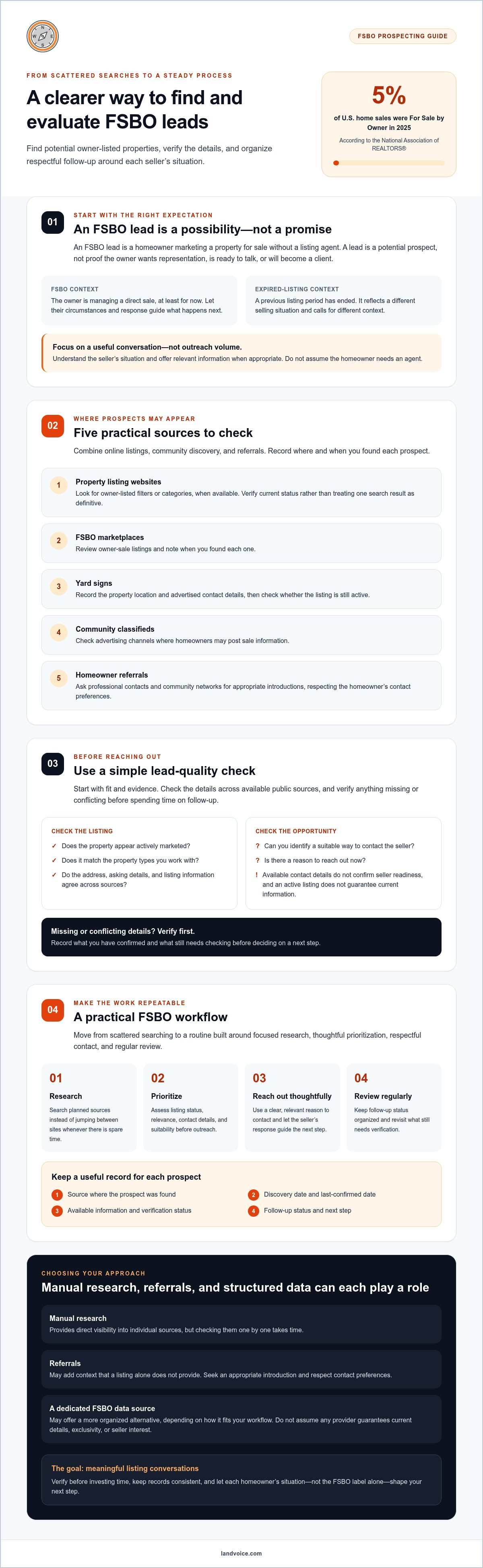
For Sale by Owner transactions accounted for just 5% of U.S. home sales in 2025, according to the National Association of REALTORS®. A focused FSBO pipeline can be valuable, but only if you know how to find FSBO leads without spending your day chasing scattered listings or questionable contact details.
FSBO opportunities can appear across multiple channels, and contact information may be incomplete or out of date. Reaching out without a clear reason or follow-up plan can turn a potential conversation into unwanted noise.
This guide covers practical sources of FSBO prospects, ways to assess whether a lead is worth pursuing, and how to build a consistent, respectful outreach process. Manual research, referrals, and a structured data source such as Landvoice can each play a role. The goal is to move from scattered searching to a repeatable workflow that supports meaningful listing conversations.
Key Takeaways
- Find FSBO leads through listing sites, marketplaces, yard signs, classifieds, and homeowner referrals.
- Check each prospect’s listing status, relevance, contact details, and suitability before reaching out.
- Record the source, last-confirmed date, available information, and follow-up status to keep prospecting organized.
- Build a repeatable workflow around focused research, thoughtful prioritization, respectful contact, and regular review.
- Consider Landvoice FSBO lead data as one option for reducing reliance on scattered manual searches.
What Are FSBO Leads, and Why Do Agents Look for Them?
An FSBO lead is a homeowner who is marketing a property for sale without a listing agent. The term comes from For sale by owner (FSBO), a direct-sale approach in which the owner handles the listing rather than hiring an agent to represent the sale. A lead is a potential prospect, not proof that the owner wants representation, is ready to talk, or will become a client.
Agents research FSBO prospects because an active listing can create an opportunity for a conversation with the seller. The goal isn’t to assume the homeowner needs an agent. It’s to understand the seller’s situation, offer relevant information when appropriate, and determine whether there’s a reason to continue the conversation. That distinction keeps prospecting focused on potential opportunities rather than names on a list.
How FSBO prospects differ from other seller leads
An FSBO owner has chosen to market the property directly, at least for now. An expired listing, by contrast, is a property whose previous listing period has ended. The situations call for different context: the FSBO seller is managing a direct sale, while an expired listing reflects a previous attempt to sell through an agent.
Don’t treat the FSBO label as a sign that the owner is seeking representation. Some sellers may prefer to continue independently; others may be open to discussing their options. Let the homeowner’s circumstances and response guide your next step.
What makes an FSBO lead worth researching?
Start with fit and evidence, not outreach volume. Check whether the property appears actively marketed and matches the property types you work with. Compare the address, asking details, and other listing information across available public sources. Missing or conflicting details are a cue to verify before investing time in follow-up.
Then assess two separate questions: Can you identify a suitable way to contact the seller, and is there a reason to reach out now? Available contact information doesn’t confirm seller readiness, just as an active listing doesn’t guarantee the details are current. Record what you’ve confirmed and what still needs checking. Alongside manual research and referrals, FSBO lead data is another option to consider.
Where to Find FSBO Leads: Five Practical Sources
Finding prospects is easier when you search with a plan instead of jumping between sites whenever you have a spare moment. Combine public listings, community discovery, and referrals, then record where and when you found each prospect. Listing categories and practices vary by platform, so confirm a property’s current status rather than treating one search result as definitive.
Finding FSBO listings through public and online sources
Start with sources that reflect how homeowners advertise properties for sale. Search property listing websites and FSBO marketplaces for owner-listed categories. Check community classifieds for sale notices, too. The National Association of REALTORS® Profile of Home Buyers and Sellers offers broader context on seller motivations. Use that context to prepare relevant questions rather than assuming every owner has the same needs.
Keep offline discovery in the mix. A yard sign or community advertisement may point you to a potential listing, but it doesn’t confirm that the home is still available or that the details are current. Treat it as a lead to verify.
- Property listing websites: Search using the site’s owner-listed filters or categories, if available.
- FSBO marketplaces: Review owner-sale listings and note when you found each one.
- Yard signs: Record the property location and advertised contact details, then verify the listing status.
- Community classifieds: Check advertising channels where homeowners may post sale information.
- Homeowner referrals: Ask professional contacts and community networks for appropriate introductions.
Using referrals and dedicated FSBO data
Referrals can provide context that a listing alone may not. Ask for an introduction when someone in your network knows a homeowner who is selling, and respect the homeowner’s preferences about contact. For online discoveries, use the same process each time: record the source, discovery date, property details, verification status, and next step.
Manual searching gives you direct visibility into individual sources, but checking them one by one takes time. A dedicated source can be a more organized alternative, depending on how it fits your workflow. Consider FSBO lead data as one option, without assuming any provider guarantees current details, exclusivity, or seller interest. To see how a structured source might fit your routine, explore a demo.
How to Evaluate FSBO Leads Before You Reach Out
A listing is a starting point, not a complete prospect profile. Before contacting a homeowner, assess four things separately: whether the property fits your business, whether it still appears active, whether contact details are available and credible, and whether your planned outreach is appropriate. This helps you prioritize promising opportunities without mistaking incomplete information for a qualified lead.
Lead quality depends on relevance, current information, and usable contact details.
A simple FSBO lead quality checklist
Work through each check and record what you can confirm. If a detail is unclear, flag it for further research rather than filling the gap with a guess.
- Listing relevance: Does the property match the property types you work with?
- Current status: Does it still appear to be actively marketed by its owner? Look for signs it may have sold, been withdrawn, or changed status.
- Listing consistency: Compare the address, property description, and other available details across sources. Record discrepancies for verification.
- Contact availability: Is there a contact method associated with the listing, and can you reasonably confirm it belongs to the seller?
- Outreach suitability: Is there a relevant, respectful reason to make contact, and is the method appropriate?
Use a comparison table with columns for source, last-confirmed date, available details, and follow-up status. For example, label an older listing “needs status check” rather than treating it as active. A clear record helps you spot stale information, avoid duplicate research, and decide what to verify next.
Contact information, privacy, and responsible research
A property advertisement may show how to reach the seller, but that doesn’t automatically establish permission for every contact method. Check the context of the information and use judgment before reaching out. The Cornell Legal Information Institute provides a legal definition of for sale by owner; use authoritative, current guidance when researching questions that affect your outreach practices.
Before contacting homeowners, verify the current federal and state requirements that apply to your situation. Don’t rely on an old checklist or assume rules are identical across locations and contact methods. If your obligations aren’t clear, seek guidance from a qualified legal or compliance professional.
Apply the same care to lead-data claims. If a source or provider describes its contact information as current or accurate, find out what that means and how it supports your workflow before relying on the claim. Evaluating information is a crucial part of how to find FSBO leads you can responsibly prioritize.
How to Build a Consistent FSBO Prospecting Workflow
A reliable pipeline comes from a process you can repeat, not a burst of searching followed by weeks of neglect. Set aside a manageable recurring prospecting block that fits your schedule. Use it to move prospects through clear stages, from discovery to review, and keep the next step visible for each record.
Organize and prioritize your FSBO pipeline
Use a CRM, spreadsheet, or another consistent tracking system. The specific tool matters less than keeping dependable records. Group prospects by source, listing status, research date, and next action so you can see which records need verification and which are ready for thoughtful follow-up.
- Select sources: Choose the listing sites, community channels, referral networks, or FSBO data source you’ll check during your prospecting block.
- Research each prospect: Review the listing and available property information. Record the source and date, and flag details that need confirmation.
- Prioritize: Focus first on records with current, consistent information and a clear, relevant reason to follow up. Set aside incomplete or outdated records for more research.
- Contact thoughtfully: Personalize your opening with accurate property context and a clear reason for reaching out. Keep it concise and professional.
- Review and update: Log the outcome, update the status, and assign a next step. Revisit the workflow during your next prospecting block.
Contact homeowners professionally and follow up thoughtfully
Record the source, research date, each contact attempt, the seller’s response, and the next step. Track opt-out requests clearly so you and anyone working from the same pipeline can respect the homeowner’s preference. If a seller asks you not to contact them, update the record and stop outreach through the relevant channel.
Your opening should show that you’ve done your homework without assuming the seller wants representation. Refer only to details you’ve verified, explain why you’re reaching out, and give the homeowner room to respond. If there’s no response, follow a measured, documented process rather than sending repeated messages without a clear purpose. Review your notes regularly to catch stale listings, close out records that no longer fit, and focus your next prospecting block on appropriate opportunities.
A steady workflow makes how to find FSBO leads a repeatable part of your business, not another scattered task. Keep the system simple enough to maintain, then refine it as you learn which sources and steps fit your routine.
To explore whether Landvoice FSBO lead data fits your prospecting workflow, review a demo.
How Landvoice Can Support FSBO Lead Discovery
Searching listings, marketplaces, classifieds, and yard signs one by one can make FSBO research hard to fit into a steady routine. A dedicated source offers another option: include FSBO lead data in your prospecting mix alongside manual discovery and referrals. It can help organize how you look for potential seller prospects, but it doesn’t replace your own checks or guarantee a seller’s interest.
Landvoice provides FSBO lead data and prospecting tools for real estate professionals. The company has served the industry since 1991. Its FSBO Leads offering may be worth considering if you want to spend less time searching scattered channels and build a more structured discovery routine.
When a dedicated FSBO lead source may fit
Consider whether manual searching is fragmented, repetitive, or difficult to maintain consistently. Then assess how a dedicated source fits your workflow. Before choosing one, review what data is available, how you would verify listing status and contact details, and whether the process works with your existing tracking system. Confirm current plan details directly with the provider. Don’t assume leads are exclusive, contact information is error-free, or sellers are ready to work with an agent.
Choose your next step and start prospecting
The fundamentals are the same with any source: choose where you’ll look, evaluate each prospect, organize your records, and contact homeowners respectfully. Keep the source and research date in your tracking system, note what you’ve verified, and record each response and next step. That structure helps you manage a consistent process without relying on a single source or treating every prospect the same.
If a dedicated source could make your FSBO prospecting routine easier to manage, review how it may fit your process. Ask about available data and current plan details, then decide whether it supports your approach to finding FSBO leads.
Turn FSBO Research Into a Repeatable Routine
Knowing how to find FSBO leads is only the first step. Choose a few dependable discovery channels, verify that each property and listing are relevant and current, then track your research, contact attempts, responses, and next steps. A manageable recurring prospecting block keeps the process organized without turning outreach into unwanted noise.
Use the workflow that fits your business. Manual research and referrals can work alongside dedicated FSBO data. Landvoice has served the real estate industry since 1991 and provides FSBO lead data and prospecting tools. Training and coaching are also available; ask about current details as you assess whether they fit your needs.
Start with one clear step: select your sources, set up your tracking system, and follow through consistently. A steady, respectful approach can create more opportunities for meaningful seller conversations.
Frequently Asked Questions
What is the best way to find FSBO leads?
A practical way to find FSBO leads is to combine a few repeatable sources and verify each prospect before follow-up. Check FSBO marketplaces and property listing websites, watch for yard signs, and ask for appropriate homeowner referrals. Record where and when you found each prospect, then confirm the property is still actively marketed. The right mix depends on your market, available time, and prospecting workflow.
Can real estate agents find FSBO leads for free?
Yes. Agents can look for potential FSBO prospects through public listings, yard signs, community classifieds, and referrals without paying for a dedicated lead service. The tradeoff is the time required to search, verify, and organize information, and the amount available may vary by source. Compare that effort with the time you can commit to prospecting. If you consider a paid data source, review its current details and terms directly.
How do I find FSBO seller contact information?
Start with contact details the homeowner included in the property listing, sign, or other public marketing. Check that the details correspond to the current advertisement and note when you verified them. Don’t guess at missing information or assume a public listing permits every contact method. Before reaching out, verify the requirements that apply to your situation. If information is uncertain, seek confirmation from an appropriate source.
Are FSBO leads worth it for real estate agents?
FSBO leads may be worthwhile if you can research properties consistently, make relevant homeowner contacts, and manage follow-up. They don’t guarantee a conversation, listing appointment, or transaction. Evaluate the time involved, the quality of the available information, and how these prospects align with your business goals. Track your activity and outcomes over time to decide how much prospecting effort to dedicate to FSBOs.
How often should I follow up with an FSBO lead?
There’s no single follow-up schedule for every homeowner or situation. Base your next step on the seller’s stated preferences, how recently you verified the information, and the reason for reconnecting. Record contact attempts and responses so follow-up stays considered and organized. If a homeowner asks you to stop, respect that request and update your records. Check applicable requirements before deciding how and when to make contact.
Do FSBO lead services guarantee accurate contact information?
Don’t assume a lead service guarantees accuracy unless its current terms explicitly state that. Contact details and listing status can change, so verify information before using it to guide outreach. Ask the provider what information is included, how it’s maintained, and what limitations apply. Review the answers against your prospecting workflow, and confirm product claims directly before making a decision. A lead record is a research starting point, not a substitute for verification.
