



by Bruce Keith, on November 5, 2026
Ending a client relationship is a business decision, not a reaction to one frustrating exchange. Before deciding how to fire a toxic real estate client, document the concerns, your attempts to resolve them, and what happened next. Recognizing when repair is possible, and when ending the relationship is more responsible, is part of the decision. Involve your broker early, then communicate professionally.
A difficult client can consume time, disrupt your workflow, and strain your judgment. The challenge is deciding whether the relationship can improve or whether its costs outweigh its potential return. Document concerns, assess the tradeoffs, and plan a professional transition without disparaging a former client. Knowing how to fire a toxic real estate client includes protecting your reputation throughout the process.
Key Takeaways
- Keep a written record of client concerns, your attempts to resolve them, and the outcomes so you can make a clear, informed decision.
- Look for patterns such as harassment, unreasonable expectations, or requests to conceal property defects when assessing whether to continue.
- Protect your professional reputation by keeping discussions about a former client factual, private, and focused on the business decision.
- Weigh the time and effort a relationship demands against its potential value and the work it prevents you from pursuing.
- Handle termination professionally by documenting communications, involving your broker, and following the agreement’s cancellation process.
1. Documenting client concerns and attempted solutions
Build a clear record before deciding how to fire a toxic real estate client. Write down each concern, your response, and the outcome. For example, note when a seller rejects pricing feedback, what comparable-property information you discussed, and whether expectations changed. Keep each entry factual, dated, and specific. Avoid labels such as “impossible” or “toxic”; describe the conduct instead.
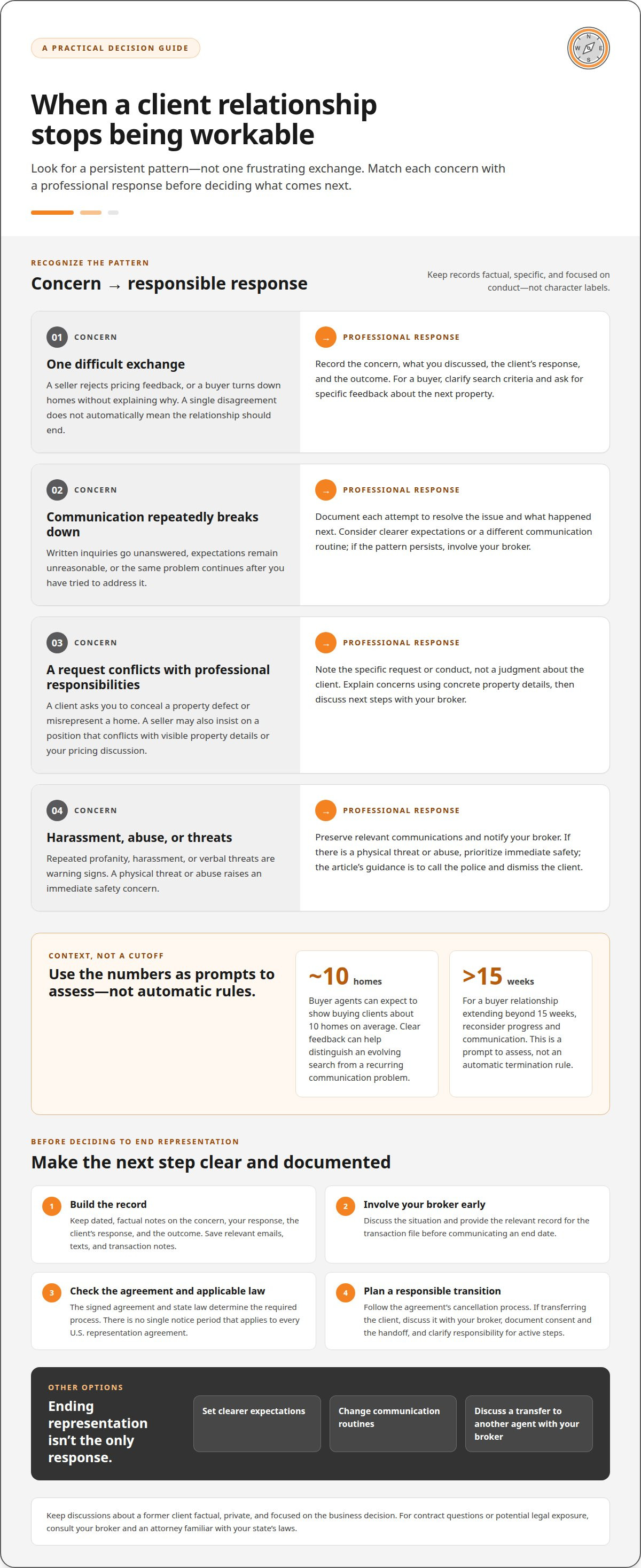
Track attempted solutions alongside the original concern. Record the client’s request, your proposed next step, the client’s response, and any agreed action. If a buyer rejects homes without explaining why, note the criteria discussed and ask for specific feedback about the next property. Buyer agents can expect to show buying clients about 10 homes on average, so clear feedback helps distinguish an evolving search from a recurring communication problem.
Save relevant emails, texts, and transaction notes in the appropriate file. After a verbal conversation, write a brief summary of what each person said, any decisions made, and the follow-up date. Send the summary to the client when appropriate and retain a copy. Before ending the relationship, document the reasons, prior actions, communications, and discussions with your broker of record. Provide the broker with a copy for the transaction file.
Alternatives to termination include setting clearer expectations, changing communication routines, or transferring the client to another agent. Discuss a transfer with your broker, document the client’s consent and the handoff, and clarify responsibility for active transaction steps.
There is no single notice period that applies to every United States representation agreement. The required process depends on the signed agreement and applicable state law. Review both with your broker before communicating an end date.
State real estate laws and brokerage policies can affect contract terms, required documentation, and who may authorize a termination. Follow the agreement and your brokerage’s procedures rather than relying on a process used in another state. A written record gives your broker the details needed to assess the situation against those requirements.
Involve your broker as soon as a client issue arises, not only when you decide to leave. Ask an attorney familiar with your state’s laws to review contract questions or potential legal exposure. Contact a local Realtor association for association-specific guidance or referral information. Record whom you consulted, the date, and any next steps.
A complete written record connects each concern with the attempted solution and its outcome. Keeping those details together clarifies the sequence of events and gives the broker of record a basis for understanding what you addressed before deciding about the relationship. Provide a copy for the transaction file instead of relying on recollection or scattered notes.
Include verbal conversations in the written record when ending a client relationship. Document them alongside other relevant information so the account reflects both the concern and what was discussed in response. Keep notes grounded in the conversation and consistent with other records provided to the broker of record for the transaction file.
2. Reasons to end a client relationship
One difficult conversation does not automatically mean the relationship should end. Look for repeated conduct that blocks the work, undermines communication, or conflicts with your professional responsibilities. For example, a seller who rejects every pricing discussion may need a reset first. A seller who repeatedly demands that you misrepresent a property presents a different concern.
Consider ending the relationship when a pattern persists despite reasonable attempts to address it. Verbal threats, profanity, harassment, failure to respond to written inquiries, and unreasonable expectations are warning signs. So are requests to conceal property defects. Record the specific request or behavior, not your judgment of the client’s character. A dated message asking you to hide a known defect is more useful than a note calling someone “toxic.”
Seller expectations can also make representation unworkable. A seller may insist that a home’s condition is flawless despite visible problems, or demand a market value that conflicts with your pricing discussion. Explain the concern using concrete property details and the agreed marketing plan. If the seller refuses to engage and expects you to support a position you cannot professionally defend, discuss the next step with your broker.
Buyer relationships need a separate performance check. The article advises buyer agents to reconsider a relationship after it extends beyond 15 weeks. That timeline is a prompt to assess communication and progress, not an automatic termination rule. For example, ask whether the buyer is still sharing useful feedback, responding to scheduling messages, and refining search criteria after each showing.
The signed buyer agency or listing agreement governs the termination process, including cancellation provisions and required notices. Review the applicable terms with your broker before setting an end date or promising that obligations have ended. A verbal understanding does not replace the agreement’s written process.
An agent may face complaints or legal exposure if a termination appears discriminatory or leaves transaction responsibilities unclear. Tie the decision to documented conduct and consistent business reasons, not a client’s protected characteristics. Before ending representation, coordinate a responsible transition for active matters with your broker and follow the agreement.
If a client makes a physical threat or abuses you, prioritize immediate safety. The guidance for this situation is to call the police and dismiss the client. Notify your broker and preserve relevant communications when it is safe to do so.
Before acting, create a decision record: identify the behavior, its effect on the transaction, the steps already attempted, and your broker’s direction. This helps distinguish a difficult but workable relationship from a pattern that makes continued representation inappropriate.
3. Avoiding badmouthing former clients
Keep your explanation brief, factual, and tied to the work. If a colleague asks why representation ended, say, “We weren’t aligned on communication and expectations, so we agreed to end the relationship.” This explains the decision without attacking the former client. Avoid labels such as “toxic,” “crazy,” or “impossible,” even in casual conversations.
Separate a private business record from a public story. Your transaction notes may describe specific conduct, such as repeated unanswered scheduling messages or a request to hide a property defect. A social post repeating those details can identify the client, invite speculation, and make a professional decision look personal. Keep client-specific discussions within appropriate business channels.
Use the same standard in every setting. A listing presentation, office conversation, group text, and online review response all call for measured language. Before sending a message, remove insults, speculation about motives, and details that do not help explain the business decision. For example, replace “She wasted my time” with “Our expectations for the process differed.”
Prepare a neutral response before anyone asks. A concise script helps keep frustration from steering the conversation. Try: “The client and I decided our working relationship wasn’t the right fit. I wish them well.” If a prospective client asks for more, return to your services and process instead of sharing private details. Build trust in your next conversation rather than recruiting an audience to take sides.
- For a colleague: “The relationship ended after we discussed different expectations for communication.”
- For a prospective client: “I can’t discuss another person’s transaction, but I can explain how I set expectations.”
- For an online comment: “I’m sorry you’re dissatisfied. I can’t discuss private transaction details here.”
Do not use a vague post to vent after a difficult termination. A photo of a client file, a recognizable property, or a pointed “some people” caption may reveal who you mean. Pause before posting, remove identifying details, and ask whether the message serves a legitimate business purpose. If it only releases anger, keep it offline.
When a complaint or dispute needs a response, share the relevant facts with your broker and follow your brokerage’s communication process. Keep your account consistent with your records. Do not embellish, guess at the former client’s motives, or circulate screenshots to people outside the matter. A calm, limited response protects your credibility while letting your work speak for itself.
Professional restraint is a practical reputation strategy. Use a prepared sentence, protect transaction details, and redirect the conversation to your process. These steps help you end one relationship without letting it define your next client interaction.
4. Evaluating time and profitability
Assess the relationship by tracking the work it requires, not by frustration alone. Record time spent on showings, calls, property research, travel, and repeated explanations. A buyer who views many properties without explaining why they do not fit creates extra work without improving the search. Compare that pattern with the client’s responsiveness and progress toward a realistic decision.
Use the typical timeline as context, not a deadline. Buyer agents can expect to spend an average of 12 weeks with buying clients. A longer relationship may still be productive if the client shares feedback and adjusts criteria. If showings continue without useful responses, set a specific review point with your broker and assess whether the search has a workable direction.
For a seller, estimate the service demands before committing more time. An overpriced listing, for example, could require more than 100 hours of marketing. Consider the property’s condition, the seller’s expectations, and the marketing effort they will support. If the seller rejects pricing discussions but expects extensive promotion, compare the expected workload with the realistic chance of reaching an acceptable sale.
Build a simple time-and-value review using the same categories for each client:
- Time already invested: Include showings, preparation, follow-up, and travel.
- Work still required: List the next concrete tasks, such as revising a search or preparing listing materials.
- Client participation: Note whether the client responds, gives feedback, and follows agreed steps.
- Opportunity cost: Identify which prospecting, client service, or transaction task the work displaces.
Then assess the trend. If the client’s cooperation improves after you clarify expectations, continuing may make business sense. If each week brings the same stalled decisions and additional demands, the projected workload may outweigh the relationship’s likely return. Do not treat a possible commission as guaranteed income; weigh the work required against the client’s demonstrated readiness and follow-through.
Decide with your broker before making the next major commitment. Bring your time record, outstanding tasks, agreement status, and a realistic path forward. For example, propose a defined change in communication or search criteria, then assess whether the client follows through. If the plan produces no meaningful change, you will have a stronger basis for deciding whether continued representation is a sound use of your time.
Protect your time carefully. For buyers who view dozens of properties that meet their criteria without explaining why those properties do not suit their needs, treat the missing explanation as a gap in the search process, not as proof that the buyer is unserious. Ask for a specific reason each property fell short and record whether the answer changes the criteria or next steps. If the buyer cannot identify a mismatch, pause before arranging more showings and clarify what information would make feedback useful.
Use the response to judge whether the work is producing direction. Clear reasons can help narrow the search; repeated viewings without explanation leave you unable to distinguish a genuine change in priorities from an unchanged search. Agree on what the buyer will communicate after the next property, then review the workload against that commitment. Continue when the discussion leads to a workable adjustment. Otherwise, raise the pattern with your broker before taking on further work.
5. How do you terminate a real estate client agreement professionally?
Start with the signed agreement, not an informal text announcing that representation has ended. Review its termination language with your broker and identify required notices, signatures, deadlines, and active transaction duties. Arizona attorney Robert Bass advises agents to consult an attorney familiar with their state’s laws before canceling a real estate client contract. That review helps you follow the agreement and keep responsibilities clear.
Prepare a complete record before delivering cancellation documents. Keep the communications, reasons for termination, and signed paperwork together. Have your broker of record initial and date each termination document. When possible, meet the client face-to-face to explain the decision calmly, then provide the written document that formally records the agreement’s end.
Use the correct paperwork for the type of representation:
- For a listing: Prepare a cancellation for the parties to date and sign. Give the former client a copy of the signed cancellation.
- For a buyer relationship: Prepare an addendum signed and dated by the agent, buyer, and broker of record. Include a local association phone number for possible referrals to another brokerage or an attorney.
- For a buyer transaction already in progress: Send the signed addendum to the escrow company and the other real estate agent involved.
Before sending a listing cancellation, confirm that every required party has signed and dated it. Keep the client’s copy and the brokerage’s transaction-file copy consistent. If a signature is missing, follow up through the agreed communication channel rather than treating an unsigned draft as completed paperwork.
For a buyer termination, coordinate the handoff before ending communication. Identify pending transaction steps, explain what the addendum changes, and send the signed copy to the escrow company and other agent. The local association phone number can give the buyer a route to referral information without requiring you to recommend a specific brokerage.
Keep your message direct and professional: explain that the relationship is ending, state the effective date reflected in the signed documents, and identify immediate next steps. Do not debate past disagreements during the handoff. A dated record, broker-reviewed paperwork, and copies delivered to the relevant parties create a clear closeout trail.
Follow the notice requirements in the signed agreement, as reviewed with your broker, and deliver the appropriate written cancellation or termination document. Ensure the required parties sign and date it, then provide copies to the relevant parties.
Landvoice
After ending a client relationship, Landvoice can support your next prospecting push with seller lead offerings such as Expired Pro, FSBO Leads, FRBO Leads, and Pre-Foreclosure Leads. Use them to focus outreach on potential sellers while protecting time for clients ready to work with you. Leads do not replace careful qualification. They create opportunities to start productive conversations and build a healthier pipeline.
Ready to strengthen your prospecting workflow? Contact Landvoice.
Build a Stronger Next Chapter
Your next client relationship starts before the first conversation. Set expectations early, notice whether communication stays constructive, and protect time for prospects ready to move forward. This discipline helps you make deliberate decisions instead of letting one difficult experience shape your business. Knowing how to fire a toxic real estate client is part of building a clear process for qualifying future relationships and spotting mismatched expectations.
Carry that process into your prospecting routine. Landvoice offers seller lead options to help you focus on making more contacts and creating room for productive client relationships. A measured approach to how to fire a toxic real estate client can help you move forward without letting one strained relationship define your business. Keep building with purpose. Your next opportunity can begin with one focused conversation.
Frequently Asked Questions
How can a real estate agent identify a toxic or abusive client?
Look for a recurring pattern that makes productive work or respectful communication difficult. One disagreement about an offer may be manageable; repeated insults, intimidation, or pressure to mislead someone signals a deeper problem. Consider the behavior’s effect: a buyer who repeatedly berates you after routine scheduling updates raises a different concern from a buyer who simply changes preferences. Focus on observable actions and their impact, not on diagnosing the client.
What steps should an agent take before ending a real estate client relationship?
First, map the work already underway and identify what could be disrupted by an immediate exit. List upcoming showings, scheduled listing tasks, pending client decisions, and any materials or property access that need a handoff. Choose a communication channel that will keep the transition clear, then prepare a concise explanation focused on the business relationship. This preparation helps prevent missed appointments or confused expectations while you follow the formal termination process.
How should agents document harassment, threats, or abusive client behavior?
Preserve original emails, texts, and voicemails, including timestamps and surrounding messages that clarify context. Keep screenshots uncropped when possible, and store copies in the appropriate transaction records rather than relying on a personal device. For an in-person incident, write down the exact words or actions, where it occurred, and who witnessed it. Do not edit evidence or share it broadly; provide relevant records to your broker through the proper business channel.
