



by Bruce Keith, on October 13, 2026
What if your prospecting report showed more than calls made and names added? Activity proves you’re putting in the work, but it doesn’t tell your team lead whether that work is building valuable pipeline. That’s the challenge when presenting prospecting ROI to your team lead: early-stage leads may not have converted yet, and unclear cost assumptions can weaken an otherwise promising case.
You can make the picture clearer without overstating results. Separate prospecting costs from activity, then connect each stage, from homeowner contacts and conversations to appointments, pipeline, and closed business. Show what’s already measurable, what’s still developing, and which assumptions shape your calculation. That gives your team lead a credible view of progress, not just a raw activity count.
This guide will help you build a transparent business case, report leading indicators alongside realized outcomes, and explain why early results may be incomplete. You’ll also learn how to compare prospecting investment with meaningful results and agree on a practical next measurement period. Bring the numbers, state the limits, and leave the conversation with a clear plan for what to track next.
Key Takeaways
- Define a clear reporting period and include the prospecting costs and outcomes you can reasonably attribute to it.
- Calculate ROI transparently, and state assumptions or limitations so early-stage results aren’t overstated.
- Compare prospecting sources using the same timeframe and stage definitions to see where progress is building.
- Make presenting prospecting ROI to your team lead more effective by leading with the decision you need and supporting it with concise evidence.
- End with a practical next measurement period and clear steps for tracking activity, pipeline, and realized outcomes.
Why Prospecting ROI Matters in a Team-Lead Conversation
Your activity log can show a full schedule: homeowners contacted, conversations started, and follow-ups completed. But activity alone doesn’t explain whether the work is creating business value. Your team lead needs to understand what those efforts produced, what they cost, and whether the results support continuing, changing, or testing the approach.
Prospecting ROI compares outcomes attributable to prospecting with the costs of that prospecting over a defined period. The word “attributable” matters. You’re showing a reasoned connection between a source and its results, not claiming that every later transaction came from one contact or that a particular source guarantees revenue. For broader background on measurement challenges and approaches, see Return on Marketing Investment (ROMI).
A useful case connects the stages: effort and contacts, movement into appointments or listing agreements, pipeline, and completed transactions. Each answers a different question. Together, they help your lead judge whether the approach is generating activity, progressing opportunities, and producing realized outcomes.
What your team lead needs to understand
Make the requested decision explicit. Are you asking to maintain the current approach, adjust how you work it, or test a different source? Then give your lead the context needed to assess that choice. State the reporting timeframe, sources included, effort invested, and costs counted. Keep those boundaries consistent so the result can be understood and compared.
Activity totals are useful evidence of execution, not financial return. A high contact count doesn’t reveal whether conversations advanced, appointments were set, or business was completed. Likewise, a quiet period may not tell the whole story if opportunities are still developing. Explain what the numbers show and what they can’t establish yet. That candor makes your case more credible, not less persuasive.
For example, if you’re reporting on one seller-lead source, identify the period and effort devoted to it, then show the outcomes you can trace to that activity. If a transaction involved several sources or follow-up paths, don’t assign the full result to one source without a clear basis. Note the attribution method, and label any judgment calls as assumptions.
Separate early signals from realized results
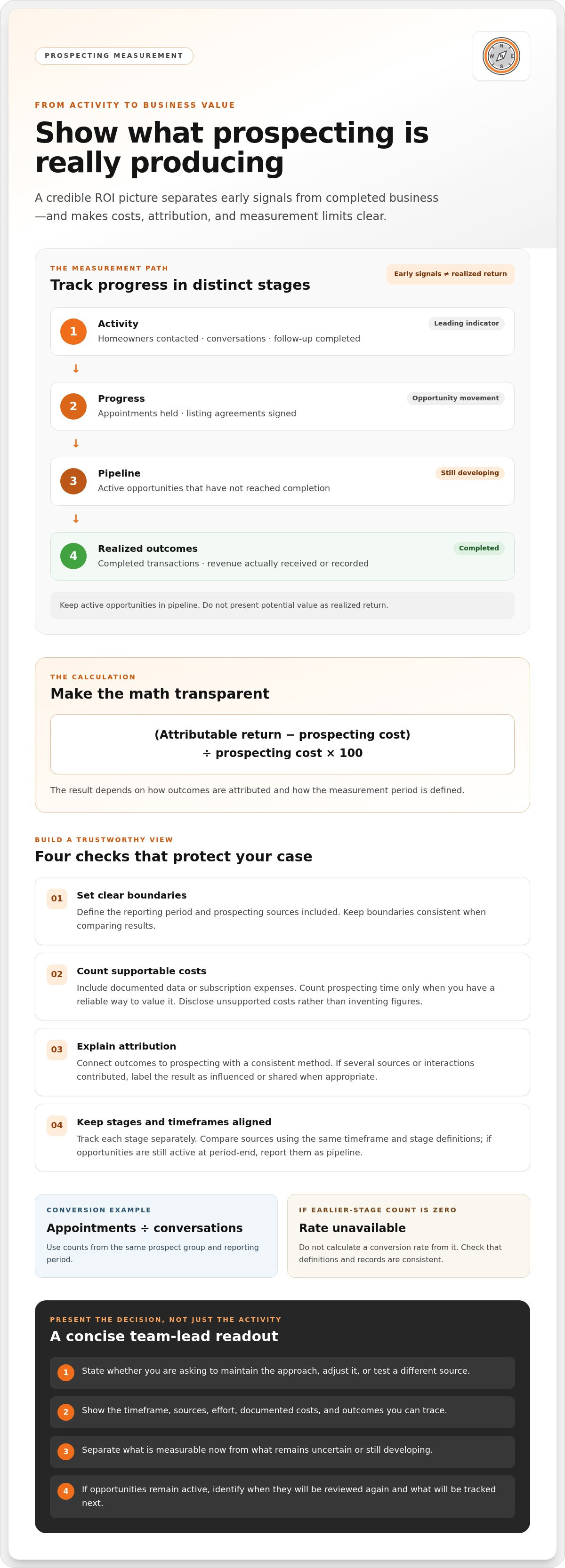
Use stage labels to prevent promising signs from being mistaken for revenue. Contacts made and conversations are activity indicators. Appointments and listing agreements show further progress, but they aren’t completed transactions. Active opportunities belong in pipeline. Keep them separate from closed business and realized commission.
- Activity: Homeowners contacted, conversations, and follow-up completed.
- Progress: Appointments held and listing agreements signed.
- Pipeline: Active opportunities that haven’t reached completion.
- Realized outcomes: Completed transactions and revenue actually received or recorded.
Presenting prospecting ROI to your team lead means making these distinctions visible. If the reporting period ends while opportunities remain active, say so and propose when you’ll review them again. Your lead gets an honest snapshot and a practical way to assess whether early signals are turning into completed business.
How to Calculate Prospecting ROI Without Overstating Results
A credible calculation starts with clear boundaries. Choose a reporting period, identify the prospecting sources included, and follow the outcomes linked to those efforts through the same period. If an opportunity is still active when the period closes, record it as pipeline rather than treating its potential value as realized return.
Prospecting ROI is attributable return minus prospecting cost, divided by prospecting cost, then multiplied by 100; the result depends on how you attribute outcomes and define the measurement period.
Choose costs and outcomes that match the period
Build the calculation from costs you can document. Include relevant data or subscription expenses, along with prospecting time only when you have a reliable way to value it. Don’t create an hourly labor rate, commission estimate, or expense figure just to make the calculation look complete. If a cost can’t be supported, disclose that limitation and keep it out of the total.
Next, decide which outcomes have a documented connection to the prospecting activity being evaluated. A contact that later becomes a client may have come through multiple sources or interactions. Use a consistent attribution method, and explain it. If the connection is uncertain, identify the outcome as influenced or shared rather than assigning the entire result to one source.
Calculate conversion and return by stage
Keep each stage distinct so your team lead can see where prospects move forward and where they pause. Track contacts, conversations, appointments, listing agreements, and completed transactions separately. Calculate each stage’s conversion rate by dividing its count by the count in the preceding stage. For example, appointment conversion uses appointments divided by conversations, provided both counts refer to the same prospect group and period.
If the earlier stage has no recorded prospects, don’t calculate a conversion rate from it. Mark the rate as unavailable, then check that your tracking definitions and records are consistent. A precise-looking percentage built from mismatched or incomplete counts can mislead more than it informs.
- Set the period. Record the start and end dates, and use the same window for costs and outcome reporting.
- Total relevant costs. Include documented expenses and supported time costs; note anything excluded.
- Classify outcomes. Separate activity, stage progress, active pipeline, and completed business.
- Calculate realized ROI. Use attributable, completed return in the formula, not an expected commission.
- State limitations. Identify attribution choices, missing cost inputs, and opportunities still in progress.
Calculate realized ROI using completed outcomes only. If revenue hasn’t been realized, report activity and pipeline separately, and label any pipeline estimate as projected. Don’t combine projected value with completed return in one ROI figure. Presenting prospecting ROI to your team lead is more persuasive when the calculation is transparent, even if it shows that final results are still developing.
How to Compare Prospecting Sources and Show What Is Working
A source comparison is only useful when each option gets a fair read. Put seller lead sources side by side over the same reporting period, and use consistent definitions for contacts, appointments, listings, and completed outcomes. Comparable periods and consistent stage definitions make source comparisons more credible because they reduce differences caused by the way results are tracked.
For example, you might compare Expireds lead data with FSBO leads for agents. Don’t expect the sources to produce the same volume or conversion pattern. The goal is to understand how each performs in your workflow, not to force unlike results into a single ranking.
Build a fair source-by-source comparison
Use a compact scorecard, and fill it with recorded results rather than estimates. Include both effort and outcome measures so your team lead can see what it took to move opportunities forward. Use the same period for all sources, and keep cost definitions consistent. If a field wasn’t tracked, label it as missing instead of filling the gap with a guess.
| Source | Cost | Time | Contacts | Appointments | Listings | Realized outcomes |
|---|---|---|---|---|---|---|
| Expired listings | Recorded cost | Logged time | Tracked count | Tracked count | Tracked count | Completed only |
| FSBO | Recorded cost | Logged time | Tracked count | Tracked count | Tracked count | Completed only |
Keep follow-up effort visible. One source may require more attempts or a longer follow-up sequence before a homeowner responds. Another may have had more time to mature into appointments or completed business. If you compare only final counts, you could mistake differences in execution or lead maturity for differences in source quality.
Interpret results with context
Check how consistently you worked each source: timing, contact attempts, and follow-up all affect the results you observe. When comparing phone data, remember that displayed phone numbers indicate if they appear on the National Do Not Call Registry. Track the source and relevant activity clearly, while treating the data as an input to prospecting, not a promise of a listing or sale.
Read small samples cautiously. A source with few tracked prospects may show a high or low conversion rate by chance, and one reporting period doesn’t establish a lasting pattern. Treat the comparison as evidence for the next decision, not a final verdict. If tracking is incomplete, say so, then set a practical process for recording missing fields consistently next period.
Presenting prospecting ROI to your team lead becomes stronger when you pair the scorecard with a brief interpretation: what appears to be working, what may be an execution or timing factor, and what you’ll measure next. That turns a source comparison into a focused decision about where to maintain effort, make an adjustment, or run a more consistent test.
How to Turn Your ROI Analysis Into a Team-Lead Presentation
Your analysis needs to lead somewhere. Open with the decision you’re asking your team lead to make, such as continuing a prospecting test or adjusting its scope. Then show concise evidence that supports the request. A focused presentation is easier to act on than a crowded dashboard that leaves the decision buried in data.
Create a concise, evidence-led summary
Use one reporting period and state exactly which sources, activities, and outcomes it covers. Define each metric briefly, then arrange the information so your lead can follow the path from effort to results. A simple table can make stage drop-offs clear without overwhelming the conversation.
| Presentation point | What to show |
|---|---|
| Objective | The decision you’re requesting |
| Timeframe | Reporting dates and included activity |
| Investment | Documented costs and logged prospecting time |
| Activity | Contacts and conversations, with metric definitions |
| Stage outcomes | Appointments, listing agreements, pipeline, and completed business |
| Interpretation | What the evidence supports, plus its limits |
| Next step | The proposed action and next review point |
Before drawing a conclusion, disclose your attribution rules and any missing data. If you’ve estimated pipeline value, label the assumptions and keep that projection separate from realized outcomes. If an actual subscription expense is part of the period’s costs, identify it clearly; you can reference prospecting software pricing when documenting that expense. Don’t include a price that wasn’t part of your actual calculation.
Keep the story tight. For example, explain where prospects advanced, where movement slowed, and what you want to learn next. The point isn’t to claim that one source caused every result. It’s to give your lead enough transparent evidence to make a sound decision.
Make a clear request and agree on measurement
End with one specific ask. Propose continuing the test, changing its scope, or adjusting how activity is tracked. Then agree on a future review date and the measures you’ll record before that conversation, such as contacts, appointments, listing agreements, and completed outcomes. This creates accountability on both sides and gives the next review a clear basis for comparison.
Frame the next step as a testable plan, not a promise of future listings or revenue. Say what you’ll do, what you’ll measure, and when you’ll review the evidence. Presenting prospecting ROI to your team lead works best when the request is direct and the outcome remains open to measurement.
Choose a Repeatable Prospecting Approach and Agree on Next Steps
A strong ROI review should lead to a repeatable process, not a one-time report. Choose seller lead sources your team can track in its existing workflow. Record the source, activity, follow-up, stage changes, and completed outcomes using shared definitions. That gives you a consistent way to assess what’s happening and decide what to adjust.
Data access is one input to prospecting performance. The data can help you identify homeowners to contact, but it doesn’t guarantee appointments, listings, or revenue. For example, Expired Pro lead data uses elite databases to help provide nearly every phone number, up to 95%, including cell phones, and includes one MLS. Phone numbers shown are indicated if they appear on the National Do Not Call Registry. Track the source as an input, then measure how your follow-up and subsequent stages perform.
Match the approach to your team’s measurement goals
Start with the question your team wants the test to answer. If the goal is to assess contactability, document attempts and conversations. If the goal is to understand progression, track appointments and listing agreements. If it’s realized business value, distinguish completed transactions from active pipeline. Keep the chosen measures practical enough to record consistently.
Include actual subscription expenses in the cost record for the same measurement period. If your team needs current subscription details, use the pricing information relevant to the data source being evaluated. Don’t substitute a remembered price or estimate for an expense you can document.
Set a test period and review the evidence
Agree on one reporting window, stage definitions, and who is responsible for keeping the records current. Before the test begins, confirm what counts as a contact, appointment, active opportunity, and completed outcome. Clear definitions prevent the team from changing the scorecard after results come in.
At the review, look across the full workflow. Compare source activity, conversion between stages, follow-up consistency, and realized outcomes, while keeping each measure distinct. If the data shows strong activity but few appointments, examine execution and follow-up before concluding that the source is underperforming. If opportunities remain open, record them as pipeline and set a later review point rather than treating them as completed business.
Presenting prospecting ROI to your team lead should end with a decision and a measurable next step. Continue the approach, adjust a specific part of the workflow, or run another defined test. Record what will change, what stays consistent, and when you’ll review the evidence. Then refine the plan based on observed results, not a promised outcome.
Make Your Next Review a Clear Decision Point
Your next prospecting review can do more than report past activity. Use it to set a sharper direction: choose what to continue, what to adjust, and what evidence will guide the next decision. That discipline turns presenting prospecting ROI to your team lead into an ongoing management tool, not a one-time defense of your effort.
Keep the process practical. Choose measures you can track consistently, assign responsibility for recording them, and set the next review point together. Then let the evidence lead. A transparent test, including results that are still developing, gives your team a stronger basis for action than unsupported promises. With over 30 years of trust behind its work, Landvoice can support your prospecting data needs as you build that repeatable process.
Bring a clear plan to your next team conversation, then keep measuring, learning, and moving forward. You’re building a stronger pipeline one well-tracked step at a time.
Frequently Asked Questions
How do you calculate prospecting ROI for a real-estate team?
Subtract the prospecting costs for a defined period from the attributable return, divide by those costs, then multiply by 100. Use completed, documented outcomes for realized ROI, and keep active opportunities out of that figure. For example, if a transaction is still in progress at the reporting cutoff, record it separately as pipeline. Presenting prospecting ROI to your team lead is more credible when the calculation clearly identifies its period and attribution basis.
What costs should I include when presenting prospecting ROI to my team lead?
Include costs tied to the prospecting activity and period you’re evaluating, such as an applicable data or software subscription. You can also account for prospecting time if your team has a consistent, supported way to value it. Avoid adding guessed labor rates, assumed commissions, or expenses that weren’t tracked. A short note about excluded costs helps your lead understand the calculation’s scope without implying the figures are complete.
Should I include pipeline value if no transaction has closed yet?
Show pipeline value separately, but don’t count it as realized return in an ROI calculation. Label it as projected and explain how you estimated it, including any assumptions about the opportunity’s stage. If the team doesn’t use a consistent method for estimating pipeline, report the number of active opportunities instead. That gives your lead visibility into developing business without presenting an uncertain estimate as closed revenue.
How can I show prospecting value before a listing agreement is signed?
Report observable progress that precedes a signed agreement, such as documented conversations, completed follow-ups, appointments scheduled or held, and the number of prospects moving to the next stage. Show the dates or period covered and use the same definitions each time. These measures demonstrate whether your prospecting process is creating momentum, but describe them as leading indicators, not proof of listings or future commission.
How often should a real-estate team review prospecting ROI?
Set the review cadence around the team’s prospecting cycle and how long opportunities typically take to mature, then use it consistently. A review that’s too early may capture activity but miss later outcomes; one that’s too late can make it harder to pinpoint where progress changed. Agree on the next review date in advance, and use interim check-ins to catch tracking gaps without treating them as final ROI results.
What should I do if I do not have enough prospecting data to calculate ROI?
Don’t force an ROI percentage from incomplete records. Present the data you do have, identify what’s missing, and start a clean tracking baseline for the next measurement window. Record each prospect’s source, contact activity, follow-up, stage changes, and eventual outcome using consistent labels. If costs or attribution can’t be supported yet, say so plainly. Your first useful result may be a reliable measurement process, not a return figure.
How can I compare expired listing leads with FSBO leads fairly?
Track both sources over the same period and apply the same definitions for contacts, conversations, appointments, agreements, and completed business. Also record follow-up effort and when each prospect entered the pipeline. One source may appear to convert less simply because its leads are newer or received fewer follow-ups. Flag incomplete records rather than estimating them, and treat a small or short-term comparison as an initial signal, not a lasting conclusion.
