



by Bruce Keith, on November 2, 2026
A small lead pipeline doesn’t have to dictate your confidence. The practical answer to how to stay motivated with a small lead pipeline is to focus on actions you can control: set manageable daily goals, track steady progress, and adjust your effort before discouragement takes over. For example, you might make adding 3 qualified prospects your daily focus.
A quiet pipeline can make every unanswered message feel like a verdict. It isn’t. Building leads takes consistent effort, and today’s activity may not create an opportunity right away. Keep moving without expecting an immediate win from every action.
Here, you’ll learn to break larger targets into manageable steps, recognize progress before a deal closes, and find support that strengthens accountability. You’ll also get practical ways to handle setbacks and keep prospecting in balance, so you can build momentum without burning out.
Key Takeaways
- Turn a quarterly target into weekly priorities and daily actions, such as adding 3 qualified prospects to your pipeline each day.
- Track progress you can control, not just closed deals, and mark meaningful milestones along the way.
- Build accountability by sharing goals and challenges with a teammate, mentor, or peer group.
- Use setbacks to review and refine your approach. Consistent effort can take time to produce visible results.
- Choose a manageable level of challenge, then adjust your workload when prospecting feels either overwhelming or too easy.
1. Breaking quarterly targets into weekly and daily goals
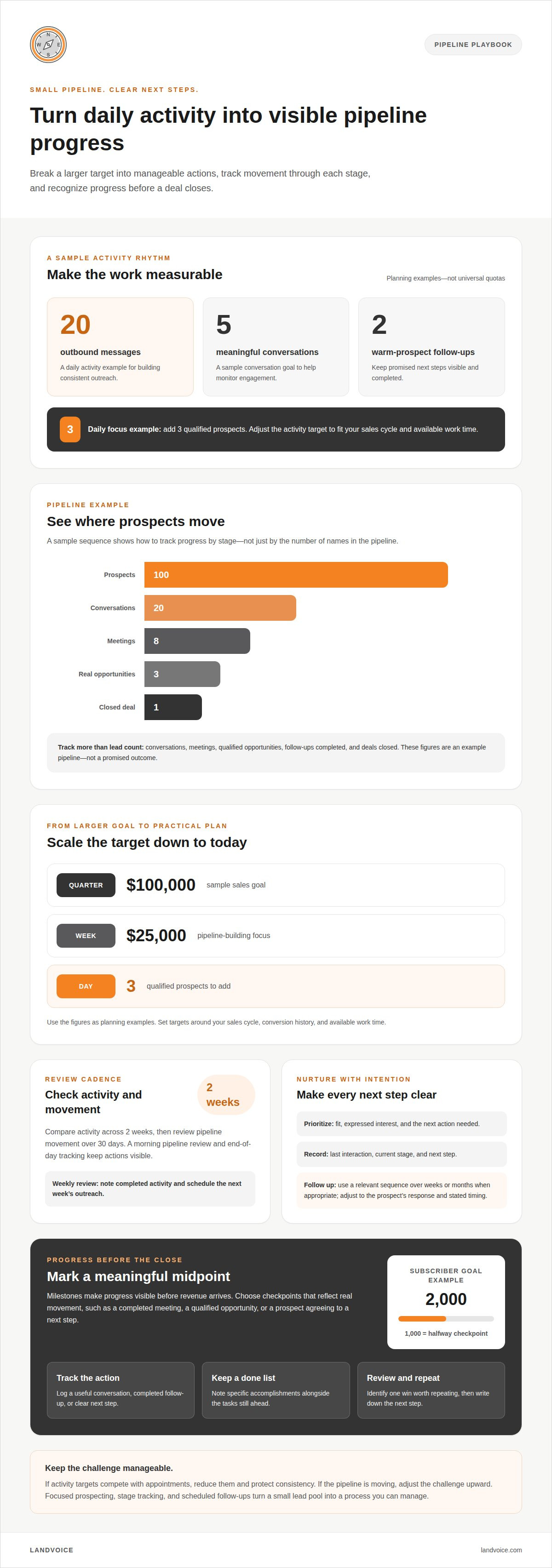
A quarterly target gives your sales work direction, but daily actions make it manageable. For example, a $100,000 quarterly sales goal can become a weekly pipeline-building focus of $25,000. Then choose a daily activity target, such as adding 3 qualified prospects. Treat these figures as planning examples, not universal quotas. Your own targets should reflect your sales cycle, conversion history, and available work time.
What daily and weekly sales activities build a consistent lead pipeline? Protect a dedicated prospecting block, send 20 outbound messages, aim for 5 meaningful conversations, and complete 2 follow-ups with warm prospects. Set a weekly review to examine completed activity and schedule the next week’s outreach. A morning pipeline review and end-of-day tracking help keep those actions visible.
What pipeline metrics should salespeople track besides lead count? Track conversations, meetings, qualified opportunities, follow-ups completed, and deals closed. A pipeline example moves from 100 prospects to 20 conversations, 8 meetings, 3 real opportunities, and 1 closed deal. The stages show where prospects are progressing and where your process may need attention. Compare activity across 2 weeks, then review pipeline movement over 30 days.
How can I prioritize and nurture a small number of sales leads? Rank prospects by fit, expressed interest, and the next action needed. Give the strongest-fit prospects timely, relevant follow-ups, and record what each person said. A simple tracker can show the last interaction, current stage, and next step. Nurturing is a sequence, not a single message: plan follow-ups over weeks or months, and assess engagement across the full sequence.
What are low-cost ways to generate more qualified leads in the United States? Follow up consistently with existing contacts, ask satisfied clients for introductions, and build visibility by sharing useful local expertise. Review your network for people who match your target market, then tailor outreach to a relevant need. These actions take organization and focused time rather than a large campaign budget. Keep lead quality in view: adding names alone won’t strengthen your pipeline.
How often should I follow up with prospects, and what cadence works best? Choose the next contact based on the prospect’s response, stated timing, and previous exchange. Set a reminder for each promised next step, then use a planned sequence across weeks or months when appropriate. One email and one follow-up aren’t enough to assess a nurturing campaign. Keep each message relevant, and stop or adjust outreach when the prospect’s response calls for it.
Use the figures as a working system, not a reason to overload your calendar. If 20 outbound messages and 5 conversations feel unrealistic alongside your appointments, reduce the activity target and protect consistency. If the pipeline is moving, adjust the challenge upward. A focused prospecting block, clear stage tracking, and scheduled follow-ups turn a small lead pool into a process you can manage.
2. Celebrating progress toward milestones
A pipeline can feel stagnant when you measure success only by closed deals. Add milestones that recognize progress before revenue arrives. If your quarterly target is 2,000 subscribers, plan a small celebration when you reach 1,000. That halfway mark gives you a visible checkpoint and a reason to recognize the work already completed.
Choose milestones that reflect meaningful progress, not busywork. A qualified opportunity, a completed meeting, or a prospect agreeing to a next step can all signal movement. For example, if a lead moves from initial contact to a scheduled conversation, record that advancement. Recognize the action, then keep the opportunity moving through your follow-up process.
Keep a “done list” beside your task list. At the end of each workday, note specific accomplishments, such as a useful conversation, a completed follow-up, or a prospect sharing their timeline. A task list shows what remains; a done list shows what you’ve already moved forward. That distinction matters during a slow stretch.
Build recognition into your routine by noting one win a day. It doesn’t need to be a revenue win. You might record a thoughtful reply, a clear next step, or a stronger outreach message. Name the action precisely. “Improved my prospecting” is hard to assess, while “personalized the follow-up around the seller’s stated timing” captures a concrete behavior you can repeat.
Match the reward to the milestone. After a focused work block, take a short break; after reaching a larger checkpoint, share the achievement with an accountability partner. Keep rewards simple and immediate. The aim is to connect consistent effort with visible recognition, rather than waiting for a major deal to acknowledge progress.
Review your milestones regularly. If a checkpoint no longer reflects meaningful progress, revise it. If a prospect goes quiet, recognize the follow-up you completed and record the next decision instead of treating silence as proof that your work failed. A milestone should clarify what to do next, not add pressure.
Sales progress can also look different across careers. One sales professional reported acquiring 55 properties since December 2020. That example doesn’t set a target for your pipeline; it underscores the value of tracking forward movement over time. Mark each closed deal, but also note the conversations and opportunities that helped move your work toward it.
Use a weekly review to identify one win worth repeating. Write down the milestone, the action that helped you reach it, and the next step. That record turns recognition into useful feedback. Build motivation from evidence of your progress, then carry that momentum into your next prospecting session.
3. Finding support from teammates and mentors
A sales manager can support motivation during a slow pipeline by setting clear activity expectations, coaching on individual deals, and recognizing progress beyond closed revenue. Regular, focused check-ins help agents discuss obstacles and leave with a specific next step.
Make each check-in useful. Bring one stalled prospect, the last interaction, and the next action. A manager can help assess whether the message fits the prospect’s needs, whether the timing is appropriate, or whether another follow-up makes sense. The goal is practical feedback, not pressure to force a result.
Peer accountability adds another perspective. Pair with a teammate to share a prospecting goal, then compare what worked and what needs adjustment. For example, one agent might test a more specific opening message while another reviews follow-up wording. Discuss the response, not just the activity count, so the exchange yields a useful lesson.
A mentor can help you distinguish a difficult stretch from a flawed strategy. Bring a concrete example, such as a prospect who stopped responding after an initial conversation. Ask what signals the mentor would look for, what they’d change, and what they’d keep. Specific questions make the discussion actionable and prevent generic advice from taking over.
For solo professionals, a group of other solopreneurs can provide structure and shared perspective. SCORE can help solopreneurs connect with mentors and peers. Talking with someone facing similar prospecting challenges can surface fresh approaches, while a mentor can offer more individual feedback. Use each conversation to identify one action to test.
Keep support focused on learning. In a team review, separate controllable actions from outcomes: preparation, relevant outreach, follow-through, and the prospect’s eventual decision. If an agent made a clear, timely follow-up but received no reply, discuss the next sensible move instead of treating silence as a personal failure.
Agree on a simple accountability format. Each person can share a current challenge, one action they’ll take, and the feedback that would help. For instance, a teammate may ask you to review a draft message before sending it. Close the conversation by recording the decision, so encouragement leads to action.
Choose support that meets your need. Ask a manager for deal coaching, a mentor for perspective, or a peer for consistent accountability. With a clear question and next step, even a quiet pipeline becomes a challenge you can work through with others.
A mentor, coach, or group of other solopreneurs can make prospecting easier to manage by building accountability and motivation, keeping the focus on steady learning rather than immediate results.
4. Managing discouragement and effort
A quiet pipeline can make each interaction feel like a verdict. Yet one example shows why outcomes and effort need separate tracking: 99 interactions produced no revenue. That stretch doesn’t prove every conversation was wasted. Review what you learned, whether your follow-up was useful, and what action makes sense next.
Sales results can arrive weeks or months after the work that started them. One salesperson sent 47 unanswered emails before questioning her fit for sales. Instead of treating silence as a final judgment, look for patterns in the messages. Were they relevant? Did they offer a clear reason to respond? Adjust one element, then observe the next interactions.
Set a sustainable minimum for prospecting. Spending 30 minutes a day on sales can create a defined starting point when your schedule feels daunting. Use that block for one focused activity, such as researching prospects or preparing personalized follow-ups. Finish by recording what you completed, so the session has a clear beginning and end.
Some clients have reported a shift in sales after spending 15 minutes a day on sales and marketing. Treat a short block as a way to build consistency, not as a promise of a particular outcome. If that time helps you start, protect it. Increase the block only when your schedule and energy can support it.
Reflect honestly 3 times per week. Ask what created useful conversations, where prospects disengaged, and what you’ll change next. Keep the review specific. If several people stopped replying after the same vague message, rewrite its opening. A written observation gives you a practical adjustment instead of another reason to dwell on rejection.
Effort has limits. Don’t make 12-hour workdays your weekly standard. When taking a full day off isn’t feasible, plan short breaks throughout the day and step away from work during each one. Disconnect instead of checking messages between tasks. That boundary helps you return with attention for the next prospect interaction.
A sales professional reported making 50 calls a day during a period of increased effort. Treat that as one person’s account, not a benchmark you must copy. Your sustainable activity level depends on the work and your capacity. Review conversation quality alongside activity, then adjust your pace before exhaustion disrupts consistency.
Learning how to stay motivated with a small lead pipeline starts with responding to discouragement instead of letting it dictate your day. Choose one action after a difficult session: revise a message, schedule a break, or ask for feedback. To stay motivated over time, make a manageable reset and return to your next planned task. One quiet day doesn’t define your performance or commitment.
5. Applying the Goldilocks Rule
The Goldilocks Rule means choosing work that is neither too hard nor too easy. With a small pipeline, set a prospecting challenge you can complete while still building skill. If contacting prospects feels overwhelming, narrow the task. If your routine feels automatic, add a meaningful stretch.
Start by identifying the task you avoid most. It might be preparing a relevant message, following up after a conversation, or organizing prospect details. Break it into a smaller action you can finish. For example, draft one personalized opening before contacting a prospect. Once that feels manageable, prepare the next message.
Adjust the difficulty, not just the volume. If a generic message gets little engagement, make your next message more specific to the prospect’s situation. If that feels intimidating, first note one relevant detail and connect it to your reason for reaching out. Each step builds capability without turning the task into an all-or-nothing test.
Use your response to the work as feedback. If you repeatedly postpone a task, ask whether it needs a clearer first step or more practice. You could rehearse a conversation with a teammate before reaching out. If you finish easily without learning anything, raise the challenge by improving your research or tailoring the next interaction.
Keep the target within your control. You can’t dictate a prospect’s decision, but you can control preparation and follow-through. For instance, aim to make each message relevant and give every active conversation a clear next step. Review the quality of those actions, then decide whether the task needs more structure or greater difficulty.
Change one element at a time. If outreach feels too demanding, shorten the work block or focus on fewer steps. If the process feels too easy, add a skill-building challenge, such as refining your opening or practicing responses to common objections. Changing one variable helps you see what improves your focus.
Reassess the fit as your skills develop. A task that once felt difficult may become routine with practice. At that point, increase its complexity rather than repeating the same comfortable action indefinitely. For example, move from drafting a message to tailoring it to a prospect’s stated needs. Progress should expand your ability, not just fill your calendar.
Use this rule to protect consistency during a slow pipeline period. Choose a task that takes real effort, define its first step, and adjust when it becomes overwhelming or effortless. That balance keeps prospecting challenging enough to develop your skills and manageable enough to sustain.
Landvoice: Expired Pro
Expired Pro from Landvoice gives real estate professionals data on expired listings to support consistent prospecting. It can be a practical next step when your pipeline feels thin and you want to focus outreach on potential listing opportunities. Pair the lead source with manageable activity goals, timely follow-ups, and clear tracking. This keeps prospecting structured as you build conversations and monitor progress.
Visit Landvoice to explore Expired Pro.
Build Your Next Step Into the Routine
Momentum doesn’t have to come from a sudden breakthrough. Treat your next prospecting session as an opportunity to learn, make a relevant connection, and refine your approach. That’s how to stay motivated with a small lead pipeline: focus on the next useful action, then use what happens to guide the one after it.
If you want a focused source for listing prospects, explore Landvoice options such as Expired Pro, FSBO Leads, and FRBO Leads. Choose an approach that fits the conversations you want to build, then bring clear goals and consistent follow-up to the work. Progress comes from showing up with purpose and staying open to adjustment.
Your pipeline can grow through one intentional action at a time. Keep moving, stay curious, and give your next conversation the attention it deserves.
Frequently Asked Questions
How can I stay motivated when my sales lead pipeline is small?
Stay motivated by making each prospect’s next step visible instead of judging your week by the number of open leads. For example, label each contact as awaiting a reply, ready for follow-up, or not a current fit. That view helps you choose useful work quickly. Note what you learned from each conversation, so a quiet pipeline still offers insight for your next interaction.
How do I set realistic sales goals when I have few leads?
Set goals based on your own sales history and current capacity, not another salesperson’s target. Review past deals to understand how prospects moved from first conversation to a decision, then use that pattern to estimate the activity your goal requires. If you’re new to tracking, start with actions you control and revise the target as you gather results. A realistic goal should stretch your effort without relying on every lead converting.
What are signs of burnout or unhealthy pressure in sales, and how can I prevent them?
Watch for persistent dread before prospecting, irritability after routine setbacks, difficulty switching off, or a noticeable drop in the care you give each conversation. These patterns can signal that your workload or expectations need attention. Identify the task causing the most strain, discuss priorities with a manager or trusted peer, and protect time away from work. If distress is affecting daily life, consider seeking appropriate professional support.
How do I stay motivated when leads do not convert into sales?
Review each non-conversion for a specific lesson instead of treating it as a verdict on your ability. Record whether the prospect lacked timing, fit, interest, or clarity about the next step. Then decide whether to nurture the relationship, close it out, or change your approach with future prospects. For example, if a lead says the timing is wrong, note their stated preference and follow up only when it’s relevant.
