



by Bruce Keith, on October 20, 2026
A busy pipeline can hide an unprofitable prospecting strategy. If you’re learning how to track lead generation ROI in real estate, count more than leads and closed deals. A source only proves its value when you compare the net revenue it contributes with the money and time it takes to win that business.
You already know that lead volume and activity reports don’t tell the whole story. A closing may involve several channels, repeated follow-up, and hours of prospecting, making it hard to see what truly drove the result. Leave those details out, and you risk doubling down on sources that look productive but deliver little net return.
Build a consistent tracking system instead. This guide shows you how to record source, follow-up activity, time, and campaign costs; calculate ROI using commission after splits and fees; and assign credit when multiple touchpoints influence a closing. You’ll also learn how to compare source-level conversion and spot follow-up gaps, so you can focus your prospecting time and spend where they contribute most.
Key Takeaways
- Learn how to track lead generation ROI in real estate by comparing attributable revenue with the full cost of each source.
- Use one consistent funnel, from leads and conversations to appointments, clients, and closings, to make source comparisons meaningful.
- Track prospecting hours alongside marketing costs to see where your time and budget deliver the strongest return.
- Keep monthly reviews useful by recording lead dates, activity, outcomes, and attribution rules consistently.
- Landvoice Data Management supports organized source analysis with notes, filters, search, tags, and map views; phone numbers appearing on the National Do Not Call Registry are indicated.
Why real estate lead generation ROI requires more than counting leads
A packed prospecting schedule can feel productive. A dashboard full of names can look even better. Neither tells you whether a source is generating profitable business. Lead volume records activity, but it doesn’t show how much revenue you actually retain after the effort and expense required to convert those leads.
Lead-generation ROI is the return a lead source produces from completed business, compared with the investment required to generate and convert that business. The result belongs to your business, not to a universal industry benchmark. It depends on your actual costs, your rules for assigning credit, and which transactions have closed.
ROI also answers a different question from cost per lead or conversion rate. Cost per lead measures the expense of acquiring a lead. Conversion rate measures the share that advances to a defined outcome, such as an appointment or closing. Lead volume counts how many prospects entered the funnel. Each measure is useful, but none alone reveals the source’s net financial contribution. For broader context on ROI as a performance measure, see Return on Investment (ROI) in real estate.
Which inputs belong in a real estate lead-generation ROI calculation?
Start with the expenses tied to a source: direct source charges, subscriptions, campaign costs, and other relevant outlays. Then log prospecting and follow-up hours using the same method for every source. You can assign time a consistent internal value based on your own business figures. For revenue, count only closed-business income attributable to that source, using what you retain after applicable splits and fees. A projected commission is not a completed return.
Keep the calculation grounded in your own records. For example, if two sources generate similar closed revenue, the one requiring more subscription spend and substantially more follow-up time may contribute less overall. But don’t assign all credit to the first touch automatically: record how you handle cases where several channels or contacts influenced the closing. Consistent attribution makes comparisons more useful, even when it can’t capture every nuance of a client’s decision.
Why cost per lead can give agents the wrong signal
An inexpensive lead can demand repeated follow-up and still produce few closings. A higher-cost lead may take less time to convert or contribute more retained revenue. Compare cost per lead with cost per closing and net contribution to see the difference: one measures acquisition efficiency, another connects spending to completed transactions, and the third accounts for the return after source costs.
That’s why how to track lead generation ROI in real estate starts with complete inputs, not a leaderboard of cheap leads. Compare sources over equivalent periods and apply the same cost and attribution rules. Don’t declare a source the winner based on limited or mismatched data. Measure what your business actually spends, the time your team invests, and the revenue that closes. Then you can make a confident decision about where to focus next.
How to calculate real estate lead generation ROI step by step
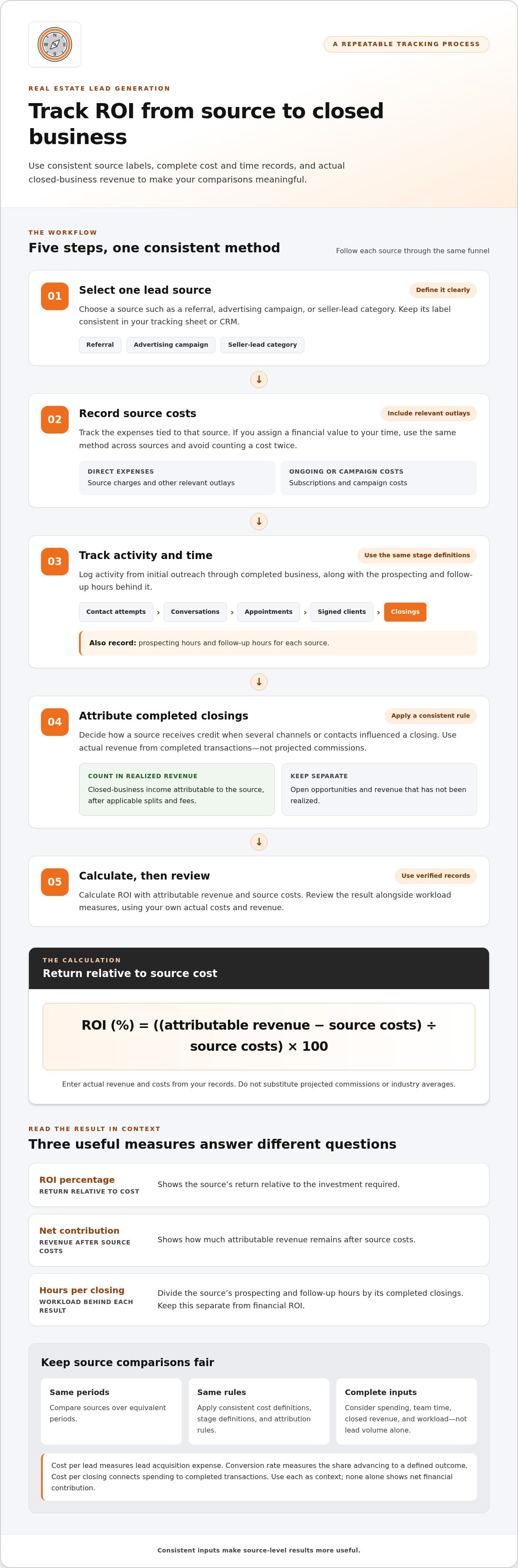
A reliable ROI calculation starts with a repeatable process, not a guess about what a lead might be worth. Use the same source labels, cost definitions, and attribution rules each time. Then your results can guide decisions instead of simply decorating a report.
- Select one lead source. Define the source clearly, such as a referral, advertising campaign, or seller-lead category. Keep the label consistent when you add leads to your tracking sheet or CRM.
- Record the source costs. Include direct expenses, subscriptions, campaign costs, and other relevant outlays. If you choose to assign a financial value to your time, use one consistent method across all sources and avoid counting the same cost twice.
- Track activity and time. Log contact attempts, meaningful conversations, appointments, signed clients, closings, and hours spent prospecting and following up. Use the same definition for each stage so one source isn’t measured more generously than another.
- Attribute completed closings. Apply a consistent rule to decide which source receives credit, then use actual revenue from completed transactions. Keep open opportunities separate from closed business and realized revenue.
- Calculate and review. Apply the formula below, then examine the result alongside workload measures. Use your own verified costs and revenue, not industry averages or projected commissions.
ROI (%) = ((attributable revenue − source costs) ÷ source costs) × 100
For example, enter the actual revenue and costs from your records into the formula rather than relying on a typical commission or estimated conversion. The National Association of Realtors (NAR) research on real estate in a digital age offers context on how consumers engage with real estate online, but your ROI calculation should reflect your own business outcomes.
Keep hours-per-closing as a separate measure: divide the source’s prospecting and follow-up hours by its completed closings. Financial ROI shows return relative to cost; hours-per-closing shows the workload behind each result. Both matter, but combining them into one percentage can obscure what the figures actually mean.
ROI percentage shows return relative to cost; net contribution shows how much attributable revenue remains after source costs. A percentage helps you compare returns against investment, while net contribution puts the remaining amount in direct financial terms. Track both to understand performance and scale.
Set up a lead-source tracking sheet or CRM
Create fields for the original source label, date received, activity milestones, direct costs, and prospecting and follow-up hours. Record contact attempts, meaningful conversations, appointments, signed clients, and closings as separate stages. For digital channels, NAR’s research can add context to the broader environment, but keep your own CRM records as the basis for source-level results.
Attribute revenue without overstating what a source produced
Choose first known source or a documented multi-touch method, then apply it consistently. Set a review window that reflects your business’s sales cycle and keep it stable across comparisons. If multiple channels influenced one closing, record that according to your chosen rule rather than crediting the full revenue to each source. This keeps results grounded in completed transactions.
This is how to track lead generation ROI in real estate with discipline: standardize the inputs, separate revenue from opportunity, and review financial return beside workload. Your own verified numbers will show where the next adjustment deserves attention.
How to compare lead sources using ROI, conversion, and time
A source comparison is only useful when every row follows the same rules. Build a report for a consistent period and use the same definitions for each funnel stage. Otherwise, a channel with more mature leads or looser stage labels can look stronger without actually producing better results.
Set up a comparison table with one row per source and these measures:
- Investment: source costs and prospecting and follow-up hours.
- Funnel activity: leads, meaningful conversations, and appointments.
- Business outcomes: signed clients and closed transactions.
- Efficiency and return: conversion at defined stages, cost per closing, financial ROI, and net contribution per hour.
Define each stage before reviewing results. For example, decide what counts as a meaningful conversation and whether an appointment means scheduled or completed. Keep those definitions stable. Then compare equivalent periods, such as lead cohorts received during the same date range, rather than comparing one source’s recent leads with another source’s older closings.
Read performance alongside sample size and lead maturity. One closing can move a small source’s ROI sharply, but it doesn’t prove the source will produce the same result consistently or that it caused every dollar of revenue. Mark small cohorts and leads still in progress as inconclusive, not as winners or failures. This keeps the comparison honest while more evidence develops.
Financial ROI doesn’t show workload on its own. Add contribution per hour by dividing the source’s net contribution by the prospecting and follow-up hours recorded for that source. A channel with solid financial return but high hours per closing may require a different follow-up workflow than one that produces comparable contribution with less time. Use both measures to decide where to optimize, not just where to spend.
Compare seller-lead channels on equal terms
Give referrals, online leads, and prospecting data the same attribution window, stage definitions, and reporting period. If you track seller-lead categories, put Expired, FSBO, and Pre-Foreclosure in separate rows rather than blending them into one prospecting total. Attribute outcomes only when your records support the source label, and keep costs and hours assigned consistently. That makes the comparison useful without implying any channel is automatically superior.
Account for long sales cycles and leads that have not closed
Keep pending opportunities visible in a separate status, but leave them out of realized-revenue calculations until business closes. Review recent activity to monitor follow-up and mature cohorts to assess completed outcomes. If an original lead later generates repeat or referral business, record that separately and apply your documented attribution rule. This preserves the connection without crediting the source more than your records support.
Consistent comparisons turn source data into decisions. That’s the practical edge in how to track lead generation ROI in real estate: distinguish early signals from realized results, then weigh revenue, conversion, and time together.
A practical checklist for tracking lead generation ROI every month
A monthly review turns scattered CRM entries into a clear operating picture. Keep the reporting period, cohort dates, and attribution rules consistent from one review to the next. Before you compare results, clean the records. Missing source labels, duplicate leads, and unassigned expenses can distort the picture before you even calculate performance.
Monthly lead-generation ROI review checklist
Work through the same checks each month. Use a consistent reporting period for costs and activity, and keep the original lead cohort dates visible so you’re comparing like with like.
- Confirm the source and date. Check that every lead has one consistent source label and a received date. Resolve duplicates and flag records with no assigned source.
- Update activity. Log contact attempts, conversations, appointments, client agreements, and closings using your established stage definitions. Record prospecting and follow-up hours against the appropriate source.
- Reconcile costs. Match source expenses, subscriptions, and campaign outlays to the same reporting period. Investigate missing or duplicated costs before drawing conclusions.
- Separate outcomes. Keep active opportunities distinct from completed transactions. Include only realized revenue in closed-business results.
- Compare performance. Review ROI, cost per closing, conversion rates at defined funnel stages, and contribution per hour. Mark incomplete or immature cohorts clearly rather than treating them as definitive.
Keep a short note of any data-quality issue that remains unresolved. If a source has unassigned costs or incomplete activity logs, flag that result as provisional. That simple distinction prevents a weak record from being mistaken for weak source performance.
Turn the numbers into a focused next-month test
Use the review to choose one adjustment, not a complete strategy overhaul. If the records support a source’s performance, continue tracking it. If results look weak but the data is incomplete or the cohort is still active, investigate before cutting it. Select one test, such as logging follow-up more consistently or reallocating prospecting hours, and document the change and the period you’ll evaluate.
Keep the test controlled. If you change follow-up timing, source mix, and time allocation all at once, you won’t know which adjustment influenced the next result. Compare the next review with the same measures and attribution rules. Treat the outcome as evidence for your next decision, not a promise that a source will produce a particular listing or revenue result.
This monthly cadence makes how to track lead generation ROI in real estate a repeatable management habit. You’ll see what the records support, where the gaps remain, and which single improvement deserves attention next.
Use seller-lead data to make ROI tracking actionable
ROI analysis is only as dependable as the records behind it. If leads from different sources are mixed together, or follow-up activity goes unrecorded, you can’t see which sources are progressing and where prospects are stalling. Give every lead a consistent source label, then keep notes, tags, and follow-up outcomes connected to that record in your chosen tracking workflow.
Separate seller-lead categories such as Expireds, FSBOs, and Pre-Foreclosures so you can compare them as distinct sources. For each lead, capture its original source and date, then record meaningful activity and outcomes as they happen. A conversation, appointment, signed client, and closing are different milestones. Keeping them distinct helps you identify where follow-up is moving prospects forward, without treating lead data itself as proof of conversion or future revenue.
Connect seller-lead activity with the tracking process
Organized data gives your review a clearer trail from prospecting to outcome. For example, a note can capture relevant follow-up context, while a tag can help group records by source or status. At review time, compare those records with your CRM or tracking sheet, and assign costs and hours using the same source categories. The discipline matters more than the tool: consistent records let you interpret results with greater confidence.
Expired listing leads and FSBO leads can each have their own source label in your reporting. If you use an FSBO guide as part of your follow-up workflow, record that activity consistently too. Keep your attribution rules intact when several touchpoints influence a transaction, and credit revenue according to the method you’ve documented.
Landvoice Data Management supports notes, filters, search, tags, and map views to help organize seller-lead records and prospecting activity. Phone numbers appearing on the National Do Not Call Registry are indicated. These tools can support a more structured tracking process, but they don’t replace your records of conversations, costs, time, and completed transactions.
Explore a prospecting workflow that fits your business
Use a demo to see seller-lead data and prospecting tools in context, then consider how source labels and follow-up records could fit into your own ROI review. Landvoice states it has been trusted for over 30 years. Organized inputs can help you assess performance; your outcomes still depend on your own activity, attribution, costs, and completed business.
Make your next prospecting decision with confidence
The value of tracking comes from what you do with the results. Choose one decision your records can help clarify, such as where to focus your prospecting hours or which follow-up step needs more consistency. Then use the next review to test that choice against real outcomes. A steady process gives you a stronger basis for action than reacting to one standout week or a single closing.
That’s the practical payoff of learning how to track lead generation ROI in real estate: you can turn source data into a focused plan for growth. Keep refining your process, and let evidence guide where you invest your attention next.
Your next move doesn’t need to be complicated. Start with one clear decision, track it consistently, and build momentum from what your own results reveal.
Frequently Asked Questions
How can a real estate agent track ROI without a CRM?
A spreadsheet can get you started. To put how to track lead generation ROI in real estate into practice, create columns for source, received date, costs, hours, funnel stage, and revenue from closed transactions. Use the same source names and stage definitions in every row, then update the sheet monthly. A CRM can make records easier to organize as your pipeline grows, but it isn’t required to begin, and neither tool guarantees precise attribution.
What expenses should I include when measuring lead generation ROI?
Include direct source expenses and relevant campaign or subscription costs tied to the leads you’re measuring. Track prospecting time separately so you can compare workload across sources, using your own consistent method to value those hours if needed. If a subscription supports several channels, allocate its cost using a clear rule and avoid counting the full amount more than once. ROI tracking evaluates performance; it isn’t the same as tax or operating-cost analysis.
How long should I track a real estate lead before judging its source?
Use a review window that reflects your actual sales cycle, then apply it consistently across sources. A lead still in negotiation belongs in an active-opportunity category, not among closed transactions. Revisit each cohort as its leads progress, and avoid making a firm call from a small sample or incomplete follow-up history. For example, compare early conversations separately from closings so a newer source isn’t penalized simply because its opportunities haven’t matured.
Can one real estate closing be attributed to more than one lead source?
Yes, because several interactions may influence a client’s decision. You can credit the first known source or use a documented multi-touch approach that recognizes more than one meaningful influence. The key is to choose the method, record it, and apply it consistently. Don’t count the full transaction revenue under every source, since that inflates the combined results. If influence is shared, show that clearly in your reporting rather than implying certainty.
What is the difference between cost per lead and cost per closing?
Cost per lead is source cost divided by the number of leads generated. Cost per closing is source cost divided by completed transactions attributed under your chosen rule. The first shows the expense of bringing prospects into the pipeline; the second connects that expense to closed business. Neither measure reveals what remains after costs, how much time conversion took, or whether the source delivered a strong overall return, so use them as complementary indicators.
How do I compare a newer lead source with one I have used for years?
Compare equivalent periods and label how mature each group of leads is. For a newer source, track early signs such as conversations and appointments, but don’t count them as closed revenue. Revisit the comparison as opportunities progress, and avoid treating unequal sample sizes as a fair contest. If follow-up records are missing for one channel, flag the results as incomplete before deciding whether to change your effort or budget.
What happens if I cannot confidently connect a closing to one source?
Mark the transaction as shared, uncertain, or unattributed instead of forcing a precise source claim. Keep it visible in a separate reporting category and state the attribution rule you use, so readers of the report can distinguish confirmed source credit from ambiguity. For future leads, capture the original source at first contact and add later influences as they arise. That improves the usefulness of new records without rewriting uncertain history.
