



by Bruce Keith, on November 1, 2026
A tough prospecting day can feel like a verdict on your ability, but it isn’t. Managing frustration after a day of prospecting starts with understanding what’s behind it: the gap between the progress you expected and the results you got, especially when your efforts feel blocked. The disappointment is real, but it doesn’t define what you can do next.
You put time and energy into reaching people, and silence or rejection can wear down your patience. The answer isn’t to dismiss those feelings or demand instant results from yourself. Pause, separate what you can control from what you can’t, and take a steadier view of the day.
Here, you’ll learn why prospecting can trigger frustration, how unmet expectations shape your reaction, and how realistic goals and mindfulness can help you reset. You’ll also see how comparing a difficult day with a worse possible outcome can put the setback in perspective, helping you regain focus and approach the next conversation with confidence.
Key Takeaways
- Notice how stress and frustration can reinforce each other, then pause before that cycle starts shaping your next decision.
- Separate what you can control from what you can’t, and reassess how important the setback may feel with time.
- Set expectations around consistent effort and learning, not just immediate responses or results.
- Use a simple mindfulness reset, such as steady breathing or a short walk, to regain focus before continuing.
- Compare the frustrating moment with a more difficult possible outcome to put the setback in perspective without dismissing how you feel.
1. What causes frustration?
Frustration often starts when a goal feels blocked or difficult to reach. After prospecting, that might mean making your planned contacts but not having conversations or booking appointments. Stress can make a setback feel harder, and frustration can add even more stress. That cycle drains your focus and can make the next outreach feel heavier. Notice the sequence: an outcome falls short of your expectations, your body tenses, and you become more reactive or avoidant.
The pressure may also come from daily hassles beyond prospecting, such as financial concerns, interpersonal conflict, or stressful events. Those demands can accumulate during a workday. Watch for changes such as irritability, anxiety, altered eating or sleeping habits, avoiding people, or abandoning tasks when overwhelmed. A difficult reaction doesn’t automatically explain its cause, but tracking when it occurs can show whether prospecting, workload, or outside stress is contributing.
Use movement to release physical tension instead of carrying it into your next task. Take a brisk walk and focus on your feet meeting the ground, or step outside and notice the change in scenery. If you can’t leave your desk, slowly tense one muscle group as you breathe in, then release it as you breathe out. Repeat with other muscle groups at a comfortable pace. These simple actions give your attention something concrete to focus on and help you move from a tense reaction to a deliberate next step.
Preventing burnout starts with treating recovery as part of the work routine, not a reward you earn only after results. Set a stopping point for the day, take a short break when your concentration drops, and avoid judging every prospecting session by immediate outcomes. Sleep matters too: a 2018 scientific review linked sleep deprivation with increased anger. If poor sleep leaves you more reactive, protect a consistent wind-down routine and notice how rested you feel before planning demanding outreach.
Choose stress-relieving activities that give your mind a different focus. Write down what happened during the prospecting day, what you felt, and one action you can adjust tomorrow. A 2020 study published in The Permanente Journal found that writing can reduce stress and improve emotional wellness. Gardening, caring for an indoor plant, or spending time with an animal can also offer a focused break from work pressure.
Discuss prospecting frustration with your manager if repeated obstacles involve workload, targets, or the outreach process. Bring a specific example to the conversation. Consider speaking with a mental health professional if distress persists, disrupts daily life, or feels difficult to manage on your own.
2. Gaining perspective on frustrating problems
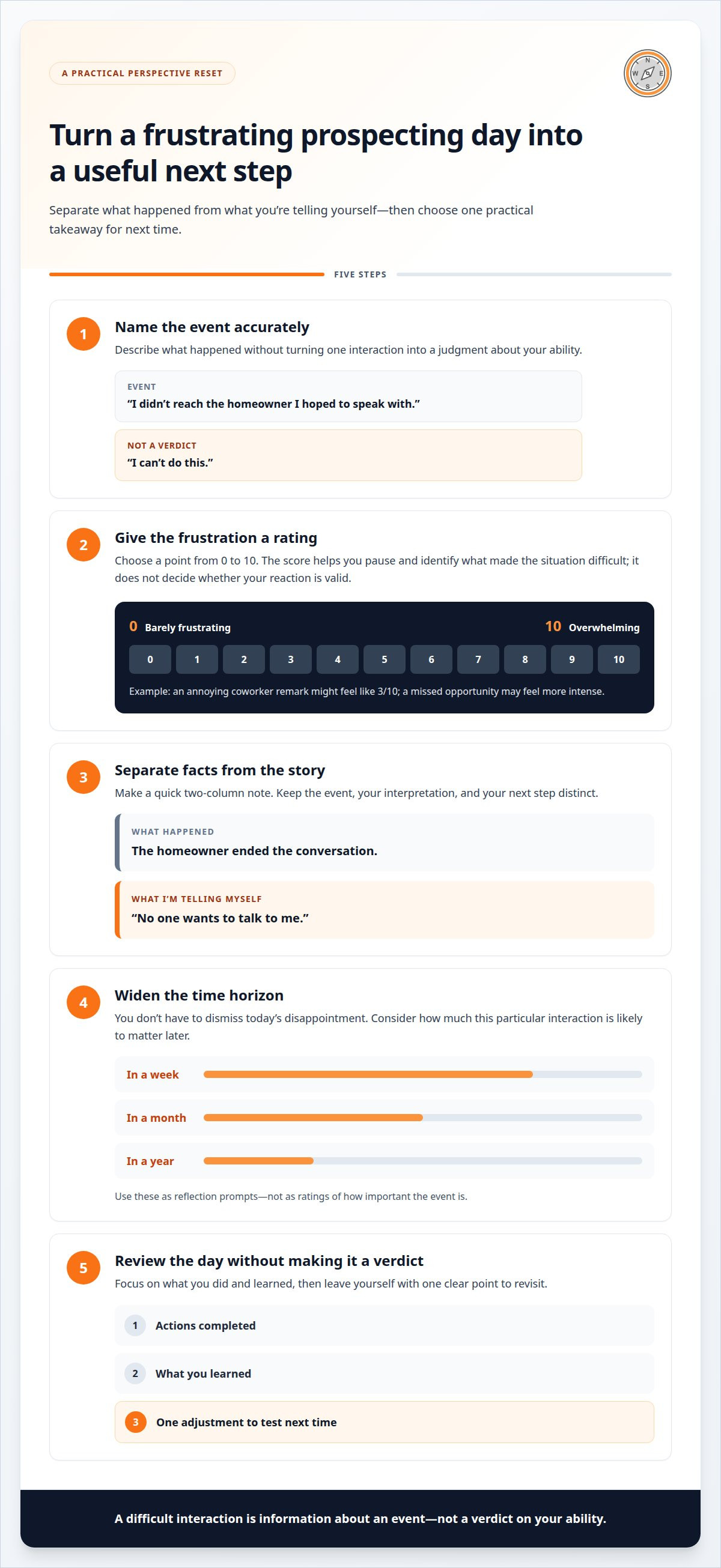
Managing frustration after a day of prospecting starts with describing the setback accurately. “I didn’t reach the homeowner I hoped to speak with” is more useful than “I can’t do this.” The first statement identifies an event; the second turns one interaction into a judgment about your ability. That shift in wording can help you decide what needs attention and what is an emotional conclusion.
Give the problem a rating from 0 to 10, where 0 feels barely frustrating and 10 feels overwhelming. An annoying remark from a coworker might rate 3/10, while a missed opportunity may feel more intense. The score isn’t a measure of whether your reaction is valid. It helps you pause and ask what specifically made the situation difficult, rather than letting frustration blur several separate events together.
Then make a quick two-column note: “What happened” and “What I’m telling myself.” For example, the event might be “the homeowner ended the conversation,” while the thought might be “no one wants to talk to me.” Keep the event, interpretation, and next step separate. This simple check can reveal assumptions that make the situation feel bigger than the facts support.
Perspective also comes from choosing a useful time horizon. Ask whether this particular interaction is likely to matter in a week, a month, or a year. You don’t need to dismiss today’s disappointment. Instead, consider how it fits into your broader work and what you want to take from it. A single contact ending early may matter less than what you learn about preparation, timing, or follow-up.
If you’re stuck on the same thought, explain the situation to a trusted coworker or friend. Share what you expected, what happened, and what you’re considering next, without asking them to solve everything. A fresh perspective may reveal a factor you missed, such as an interruption or an unrealistic assumption. You can also try viewing the interaction from the other person’s position while maintaining your own professional boundaries.
Managing frustration after a day of prospecting also means reviewing your performance without turning results into a verdict. Note the actions you completed, what you learned, and one adjustment you’ll test next time. If you completed your planned contacts but didn’t have productive conversations, recognize the work you did and choose a specific point to review. This keeps accountability practical and gives your next session a clear starting point.
3. How unmet expectations cause frustration
A goal creates direction, but an expectation can quietly become a demand for a specific result. You may plan to reach homeowners and expect each conversation to lead toward an appointment. If people don’t answer or aren’t ready, the gap between your effort and the hoped-for outcome can feel like failure. Frustration can come from the unmet expectation, not just the activity itself. Notice the difference between “I planned outreach” and “I expected an appointment today.”
Some obstacles are outside your control. A homeowner may be busy, circumstances may change, or an unexpected work issue may interrupt your schedule. Other pressures can come from financial concerns, conflict with a coworker, or difficult events outside the office. These stressors can overlap. A tense morning meeting, for example, may leave you with less patience when a prospect declines a conversation later.
Common causes of frustration include daily hassles, relationship challenges, interpersonal conflict, and work problems. In prospecting, one example might be a contact ending a conversation abruptly; another could be an unclear priority or a repeated interruption. Identify the specific trigger instead of treating the whole day as one problem. This helps you see whether the frustration came from an external event, an unmet expectation, or several pressures at once.
Set realistic prospecting goals by separating actions from outcomes. Choose actions you can control, such as preparing a contact list, completing planned outreach, or recording follow-up tasks. Track those alongside outcomes, such as conversations or appointments, without treating either measure as a judgment of your worth. At the end of a session, note what you completed, what interrupted your plan, and one adjustment for next time. This gives you a clearer view of progress than relying on memory or mood.
Expectations can also affect your mental health when every difficult interaction feels like evidence that you’re falling behind. If you catch yourself replaying a rejection as you prepare for the next contact, pause and name what happened: “That conversation ended quickly.” Then choose a practical next step, such as reviewing your approach or moving to the next planned contact. This acknowledges the impact without turning one exchange into a prediction about every future conversation.
Keep goals flexible enough to account for real working conditions. If an urgent task disrupts your prospecting plan, record the interruption and reschedule the action rather than labeling the entire day unsuccessful. Look for patterns across work sessions: repeated interruptions may call for a schedule adjustment, while a difficult interaction may call for reflection on your approach. Use what you observe to refine the process, not to punish yourself for outcomes you can’t control.
4. Mindfulness
Mindfulness helps you notice what’s happening now without judging yourself for it. After a difficult contact, you might feel irritated and start predicting that every next conversation will go badly. Pause and label the feeling: “I’m frustrated right now.” Then bring your attention back to the present instead of treating a negative thought as fact or instruction.
Try the 4-7-8 breathing technique when tension rises. Breathe in for four seconds, hold your breath for seven seconds, then breathe out for eight seconds. Repeat at a comfortable pace and focus on each breath. If counting feels distracting, count backward from 50 or name what you can sense around you. The goal is to anchor your attention, not to force a particular feeling.
The 5-4-3-2-1 Grounding Technique gives your mind a clear sequence. Notice five things you can see, four things you can feel, three things you can hear, two things you can smell, and one thing you can taste. For example, name your desk, the chair beneath you, a nearby sound, and the air around you. This sensory check redirects focusing from the frustration toward your immediate surroundings.
A brisk walk can combine movement with mindfulness. Walk outside and pay attention to your steps, the air, and the change in scenery. If your schedule is tight, step outside for 60 seconds and take in what you can see and hear. Keep the walk separate from reviewing your results. Give your attention a simple task, like noticing each foot touching the ground, before returning to work.
Take a short break when you notice frustration or stress building, or when your focus makes it hard to continue productively. Use the pause to breathe, walk, or change your surroundings. Return when you can give the next action your attention. A break is a reset, not a reason to abandon your prospecting plan.
Mindfulness can also change how you respond to a difficult interaction. After a prospect declines, notice your first impulse, such as rushing into the next contact or replaying the conversation. Take a steady breath, identify what you’re feeling, and choose your next action deliberately. You might record a follow-up task or move to the next planned contact. That pause creates space between the event and your reaction, so frustration doesn’t automatically decide what happens next.
5. Comparing a frustration with a worse outcome
A comparison can loosen the grip of a frustrating result, but use it carefully. Imagine a prospecting session that produced no appointments. A worse outcome might have been abandoning the planned outreach entirely. That contrast can help you recognize what still happened, such as completing your planned contacts. It doesn’t erase disappointment or prove the session was successful. It simply shifts the thought from “nothing went right” to a more accurate account of the day.
One example prospecting day included a partner team member securing three new resellers. That result shows what one person achieved in that specific example, not what every professional should expect. If your day produced a useful conversation or a follow-up to pursue, you can count it as progress without pretending it matches someone else’s outcome. Compare your actions with your own plan, not another person’s best result.
Keep the exercise grounded in facts. First, name the frustrating event, such as a prospect declining to continue a conversation. Next, identify the worse outcome you’re comparing it with, such as losing the chance to have that conversation at all. Then return to what the event actually tells you. It may show that this person wasn’t ready to engage; it doesn’t predict how future contacts will respond.
There’s a limit. Comparing yourself with someone facing greater hardship can make you feel guilty for being frustrated. It may also lead you to dismiss a problem that needs attention. A more useful comparison weighs possible outcomes of the same situation. A conversation that ends early can be disappointing, but it also gives you a clear endpoint and room to move on. You can acknowledge the negative feeling and still choose a constructive next action.
Use this perspective to recover, not to lower your standards or avoid learning. Ask what the setback involved, what it led you to think, and what useful information it provides. If the contact wasn’t a fit, record that and continue with your next planned step. If you noticed something about your approach that could improve, choose one adjustment to practice. That turns the comparison into a decision instead of a reason to dwell.
The takeaway is simple: comparing a situation with a worse possible outcome can restore proportion and help you identify a next step. It doesn’t mean every result is good or that frustration should disappear. Let the thought create some distance, then assess what actually happened and decide what to do next. The aim isn’t to force gratitude. It’s to keep one difficult moment from defining the entire prospecting day.
Landvoice: Expired Pro
Landvoice’s Expired Pro provides real estate professionals with data on expired listings to support homeowner outreach. It can be a practical next step when you’re ready to add structure to prospecting and focus on a specific type of potential listing. Use it alongside realistic goals and a review process that values consistent action, not only immediate outcomes. A clearer prospecting focus can help you decide what to work on next, while perspective helps keep a difficult result from defining your day.
Visit Landvoice to explore Expired Pro.
Build a steadier prospecting rhythm
Your next prospecting day is a chance to work with intention, not a test you have to pass. Managing frustration after a day of prospecting means making space to reset, then choosing one clear next action. Focus on the professional habits you’re building rather than expecting every interaction to produce an immediate result.
When you’re ready to refine your outreach routine, explore Landvoice and consider how its prospecting resources fit your goals. Choose a practical next step and put it into your workflow.
Keep moving forward with patience and purpose. Each thoughtful action gives you another chance to learn, adjust, and build momentum.
Frequently Asked Questions
What causes frustration?
Frustration often follows a blocked goal or an outcome that differs from what you expected. In prospecting, you might prepare to speak with a homeowner, then find they’re unavailable or uninterested. Outside pressures, such as a conflict at work or an unexpected task, can add strain. Look at the immediate trigger and what else was happening that day to understand why the reaction felt especially strong.
How do you overcome frustration?
Start by interrupting the reaction before choosing your next move. Step away from your screen, take a few steady breaths, and describe the problem in plain language. Then decide whether it calls for a practical adjustment, a follow-up, or simply moving on. For example, after an interrupted outreach session, update your plan for the next work period rather than trying to recover the entire schedule at once.
What can you learn from Day’s frustrating early experience?
Jason Day’s early results show that a rough stretch doesn’t determine a career. In the three tournaments before the 2011 Masters, he finished tied 45th, tied 51st, and missed the cut at the Shell Houston Open. Before that Masters, he had one PGA tournament title and no major championships in his first five years as a professional. He later reached the No. 1 world ranking. Keep one difficult period in perspective.
What is frustration and what are the signs?
Frustration is an emotional response that can arise when something you want or need feels blocked. During a workday, signs may include irritability, anxiety, avoiding conversations, or giving up on a task when overwhelmed. Notice changes from your usual pattern, such as snapping after a difficult interaction or withdrawing from coworkers. Recognizing a shift early helps you choose a response instead of letting the reaction steer your next decision.
How can you decompress after a frustrating day of sales prospecting?
Create a clear end-of-day transition. Close your prospecting notes, write down the next task you’ll handle, and step away from your workspace. Choose an activity that doesn’t require you to keep evaluating work, such as preparing a meal or taking a walk. If a specific conversation keeps replaying, record the lesson you want to retain, then leave further review for your next scheduled work period.
What causes frustration and rejection fatigue in prospecting?
Repeated difficult interactions can wear down your attention, especially if you interpret each rejection as a judgment of your ability. Fatigue can also build when outreach feels repetitive or your effort has no clear stopping point. Notice whether your patience drops after a particular type of conversation or when your schedule leaves no room to reset. That pattern can help you adjust your workflow instead of treating every contact as the cause.
What are quick stress-relief techniques after a prospecting session?
Try a brief reset that gives your attention one simple focus. Step outside for 60 seconds and notice the air, sounds, or objects around you. You could also slowly tense and release a muscle group while breathing out. Pick one technique and use it before reviewing results or beginning another task. A short pause can help you return with more control over your next action.
How can you reframe rejection and stay motivated in sales prospecting?
Separate the prospect’s decision from your judgment of yourself. Someone declining a conversation tells you about that interaction, not your potential in every future one. Afterward, record one useful observation and one action you completed, such as following your planned outreach. Give yourself credit for taking that action even without the result you wanted. Then choose a specific next step, like refining your preparation or continuing your contact plan.
