



by Bruce Keith, on August 18, 2026
The best listing leads in your market aren't on the MLS. They never were. While your competition fights over the same recycled expired listings and FSBO scraps, a separate category of highly motivated sellers is moving through the public record every single day, completely invisible to agents who don't know where to look. Learning how to find pre-foreclosure listings is the skill that separates agents with a predictable pipeline from those who are always scrambling for their next deal.
You already know the grind. Inventory is tight, outbound lead sources feel saturated, and the idea of contacting a homeowner in financial distress can feel uncomfortable before you even pick up the phone. That hesitation is understandable. But here's the reframe: these homeowners aren't victims waiting to be taken advantage of. They're people who desperately need a professional exit strategy before their equity disappears entirely. You're not intruding. You're arriving at exactly the right moment.
This guide will show you exactly where pre-foreclosure leads come from, which tools and data sources cut through the noise to deliver verified contact information, and how to approach these conversations with a script that feels helpful rather than predatory. By the end, you'll have a clear system to build a recession-proof listing pipeline your competition doesn't even know exists.
Key Takeaways
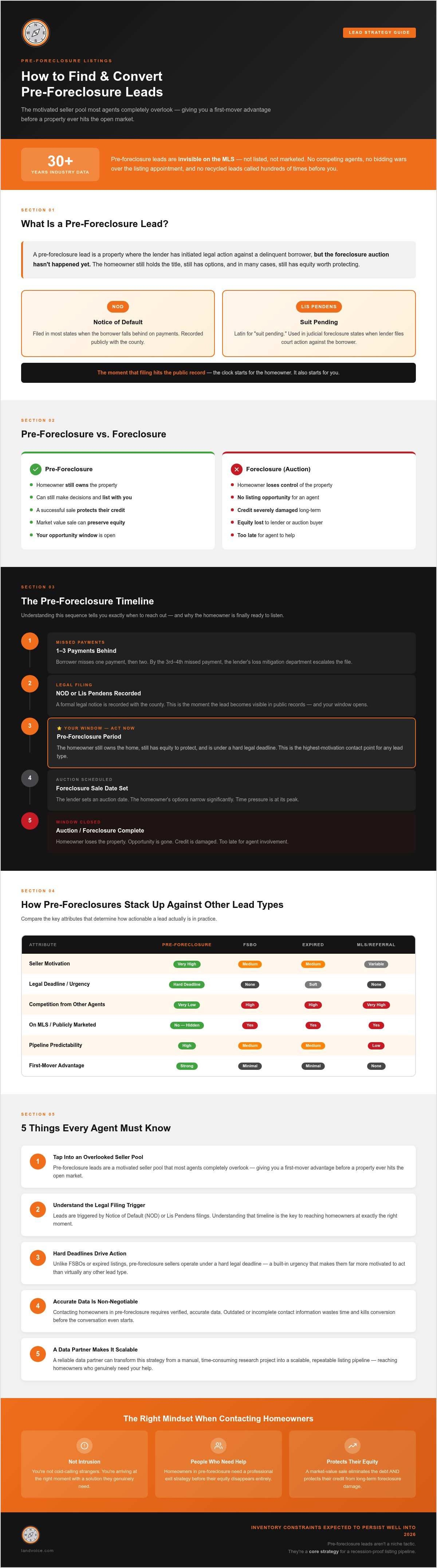
- Knowing how to find pre-foreclosure listings means tapping into a motivated seller pool that most agents completely overlook - giving you a first-mover advantage before a property ever hits the open market.
- Pre-foreclosure leads are triggered by legal filings like a Notice of Default or Lis Pendens, and understanding that timeline is the key to reaching homeowners at exactly the right moment.
- Unlike FSBOs or expired listings, pre-foreclosure sellers operate under a hard legal deadline - a built-in urgency that makes them far more motivated to act than virtually any other lead type.
- Contacting homeowners in pre-foreclosure requires verified, accurate data; outdated or incomplete contact information wastes time and kills conversion before the conversation even starts.
- A reliable data partner like Landvoice can transform this strategy from a manual, time-consuming research project into a scalable, repeatable listing pipeline.
What Are Pre-Foreclosure Leads and Why Are They Your Secret Inventory Solution?
A pre-foreclosure lead is a property where the lender has initiated legal action against a delinquent borrower, but the foreclosure auction hasn't happened yet. That gap between legal filing and auction is your window. The homeowner still holds the title, still has options, and in many cases, still has equity worth protecting. This is precisely why learning how to find pre-foreclosure listings is one of the highest-leverage skills you can develop in a low-inventory market.
The trigger for these leads is a public legal filing. Depending on the state, that's either a Notice of Default (NOD) or a Lis Pendens. Both documents are recorded with the county and signal that a lender has formally started the foreclosure process. The moment that filing hits the public record, the clock starts for the homeowner. It also starts for you.
Here's the competitive edge that most agents miss entirely: these properties are invisible on the MLS. They're not listed. They're not marketed. The homeowner hasn't called a Realtor yet. That means no bidding wars over the listing appointment, no competing agents already in the door, and no recycled lead that's been called a hundred times. You're not fighting for scraps. You're finding inventory before it becomes inventory.
The Difference Between Pre-Foreclosure and Foreclosure
Once a property goes to auction, the homeowner loses control. Pre-foreclosure is the opposite. The seller still owns the home, which means they can still make decisions, including the decision to list with you. A successful sale at market value does two things: it eliminates the debt and, critically, it protects their credit from the long-term damage of a completed foreclosure. That's a powerful value proposition you bring to the table before you even mention commission. Equity is the determining factor in lead viability. A homeowner with meaningful equity has strong motivation to sell and a real financial incentive to act fast. Properties underwater require a different approach entirely, typically a short sale conversation, so qualifying equity early keeps your pipeline focused on the most actionable opportunities.
Why High-Performance Agents Target Distressed Properties
Motivation is everything in this business. A homeowner facing a legal deadline isn't casually browsing their options. They need a solution, and they need it now. That urgency converts. It's also why pre-foreclosure leads create a more stable, predictable pipeline than chasing MLS activity or waiting for organic referrals.
The catch is data quality. Outdated contact information kills this strategy before it starts. If you're working from stale public records, you're wasting your most valuable resource: time. That's where a dedicated data partner like Landvoice changes the equation entirely. With 30-plus years in the industry and proprietary contact data built for precision, Landvoice transforms what would otherwise be a manual, time-consuming research project into a scalable system for contacting homeowners who genuinely need your help.
In a market where inventory constraints are expected to persist well into 2026, pre-foreclosure leads aren't a niche tactic. They're a core strategy.
Understanding the Pre-Foreclosure Process: Identifying Motivation Points
Time is the defining force in every pre-foreclosure situation. The moment a lender files a legal notice, a countdown begins that the homeowner can't pause, reset, or ignore indefinitely. Understanding that timeline isn't just academic knowledge. It's the strategic framework that tells you exactly when to reach out, what to say, and why the homeowner is finally ready to listen.
The typical sequence moves faster than most people realize. A borrower misses one payment, then two. By the third or fourth missed payment, the lender's loss mitigation department escalates the file. A formal legal notice gets recorded with the county. From that filing date, the homeowner has a legally defined window to cure the default, negotiate a resolution, or sell the property. Depending on the state and loan type, that window can range from a few weeks to several months. After that, the bank takes over entirely.
The Legal Triggers: NODs and Lis Pendens
The specific filing that makes a lead "public" depends entirely on state law. In non-judicial foreclosure states, the lender records a Notice of Default (NOD) directly with the county recorder's office. No court involvement is required. The filing is immediate, public, and actionable. In judicial foreclosure states, the lender must sue the borrower, which generates a Lis Pendens, a court document that alerts the public to pending litigation against the property. Both filings serve the same function for your prospecting: they mark the precise moment a homeowner's situation becomes a matter of public record.
The problem is aggregation. Pulling these filings manually means visiting county recorder websites, navigating inconsistent data formats, and cross-referencing ownership records to find usable contact information. It's a full-time research job. Landvoice solves this entirely by aggregating pre-foreclosure filings and layering in verified contact data, so you skip the courthouse entirely and go straight to contacting homeowners who need your help right now.
The Seller's Mindset: From Denial to Decision
Knowing how to find pre-foreclosure listings is only half the equation. Understanding where the homeowner is mentally when you reach them is what determines whether that contact converts.
Most homeowners enter a denial phase first. The certified mail goes unopened. Phone calls from the lender go unanswered. There's a deeply human instinct to avoid a problem that feels overwhelming and permanent. This phase can last weeks. During this window, outreach from agents typically gets ignored, not because the homeowner doesn't need help, but because they haven't accepted the reality of their situation yet.
The shift happens when the deadline becomes undeniable. A court date appears. A foreclosure sale notice posts. Suddenly, the abstract threat becomes a specific date on a calendar. That's the action phase, and it's when your phone call lands differently. You're not an intrusion. You're a professional with a concrete solution arriving at the exact moment the homeowner realizes they need one.
Your value proposition is simple and powerful: you help them make a decision before the bank makes it for them. That framing changes the entire conversation. You're not selling a listing appointment. You're offering control back to someone who feels like they've lost it entirely.
Reaching sellers at this precise inflection point requires knowing when the filing happened and having accurate contact data ready to act on immediately. That's where a data partner with 30-plus years of industry experience and proprietary contact verification becomes the difference between a productive prospecting session and a morning of dead ends.
How to Contact Homeowners in Pre-Foreclosure
Knowing how to find pre-foreclosure listings is only the starting line. What you do with that information determines whether it becomes a listing or a dead end. The five steps below turn raw lead data into a repeatable system that generates appointments with motivated sellers before your competition even knows those sellers exist.
Step 1: Secure a high-quality data feed. Everything downstream depends on this. Verified phone numbers, accurate ownership records, and current filing dates aren't optional. They're the foundation. A data partner like Landvoice delivers pre-foreclosure leads with proprietary contact verification built in, so you're not burning time chasing disconnected numbers or wrong addresses. Start here. Don't improvise.
Step 2: Qualify the equity position immediately. Pull a quick comparative market analysis against the outstanding loan balance. Meaningful equity means a standard listing is viable and the homeowner has a real financial incentive to act. Negative equity requires a completely different conversation. Qualifying early keeps your pipeline focused on the opportunities most likely to close.
Step 3: Make your first contact with a service-first approach. Your opening call isn't a pitch. It's an introduction. Lead with the homeowner's problem, not your services. More on this below.
Step 4: Follow up consistently as the auction date approaches. Timing is everything. A homeowner who ignored your first call in week two may be ready to talk in week six when the deadline is no longer abstract. Build a structured follow-up cadence around the filing date and don't abandon leads prematurely. Persistence, not pressure, is what converts this lead type.
Step 5: Deliver a clear exit strategy presentation. When you do get in the door, show up with a concrete plan: a CMA, a net proceeds estimate, and a timeline that demonstrates exactly how a quick sale protects their credit and preserves their equity. Give them a decision, not a conversation.
The Ethics of Distressed Property Outreach
Let's address this directly. Contacting homeowners in financial distress is not exploitation. It's the opposite. These homeowners are facing a hard deadline, and most of them have no idea that a professional sale could protect their credit, recover their equity, and give them control over the outcome. You're not taking advantage of their situation. You're offering them a way out of it.
The agents who struggle with this lead type approach it like salespeople. The agents who convert it approach it like problem solvers. That distinction changes everything about how the conversation feels, to both parties. Lead with empathy. Ask questions before you make statements. Listen to understand the full picture before you position yourself as the solution. The homeowner needs to feel heard before they'll trust you with their biggest financial decision.
This same psychology applies across distressed seller types. If you've worked FSBOs, you already know that a seller who feels pressured shuts down immediately. The FSBO Guide covers this seller psychology in depth, and the core principle transfers directly: position yourself as the professional who makes their life easier, not the agent who needs a commission.
Scripts That Build Trust and Secure Appointments
"Hi, is this [Name]? My name is [Your Name], I'm a local real estate agent. I specialize in helping homeowners who've received a notice from their lender work through their options before a deadline forces a decision. I'm not here to pressure you into anything. I just want to share a few options that could protect your credit and potentially put money back in your pocket. Would you have five minutes to talk?"
Short. Specific. Service-oriented. Notice it never mentions a listing appointment in the first breath.
When you hear "I'm working it out with the bank," don't argue. Validate it, then expand the conversation:
"That's great, and I hope that works out for you. What I find is that having a backup plan running in parallel gives homeowners a lot more leverage in those conversations. Would it hurt to at least know what your property is worth right now, so you have all the information?"
That response keeps the door open without dismissing their current strategy. It positions you as an ally in the process, not a competitor to it. That's exactly the dynamic that turns a skeptical homeowner into a signed listing client when the bank conversation doesn't go the way they hoped.
Comparing Lead Sources: Why Pre-Foreclosures Often Beat FSBOs and Expireds
Not all leads are created equal. Every agent knows this, yet most still default to the same two sources: expired listings and FSBOs. Both are legitimate strategies. Neither gives you the competitive isolation that comes from knowing how to find pre-foreclosure listings. The difference isn't just volume. It's the nature of the seller's motivation and how that motivation converts.
Pre-Foreclosures vs. Expired Listings
Expired listings attract a crowd. The moment a listing status flips in the MLS, dialers across your market light up simultaneously. You're not calling a lead. You're joining a queue. The expired seller is frustrated, often defensive, and has already been through the process once. Price resistance is common because they're anchored to what they originally hoped to get.
Pre-foreclosure sellers operate in a completely different emotional reality. A hard legal deadline changes everything. There's no anchoring to an aspirational list price when a court date is on the calendar. That urgency drives faster decisions, fewer objections around commission, and a seller who genuinely needs your expertise rather than just shopping for the best deal. The conversation starts from a place of need, not negotiation.
That said, expireds still belong in a balanced portfolio. Expired Pro from Landvoice delivers verified contact data on expired listings with the same precision that makes their pre-foreclosure feed so effective. Running both simultaneously gives you coverage across motivated seller segments, so a slow week in one category doesn't stall your entire pipeline.
One more dimension worth understanding: equity. When a pre-foreclosure seller has negative equity, a traditional listing isn't the right tool. That's where short sales become a secondary service worth adding to your value proposition. Qualifying equity early lets you route each lead correctly, either toward a standard listing or a short sale conversation, and demonstrates the kind of professional depth that builds referral relationships for years.
The ROI of Niche Distressed Leads
Compare the cost structure against paid digital channels. Pay-per-click and social media advertising require continuous spend to generate inconsistent volume, with no guarantee the leads are motivated to act. Pre-foreclosure data is sourced from public filings, meaning the motivation is built in before you ever make contact. Your cost-per-lead stays predictable, and you can learn more about Monthly SaaS Subscription Fees to understand how these platforms provide value without the volatility of ad auctions. Your time goes toward sellers who have a reason to move.
There's also a compounding effect that most agents overlook. A pre-foreclosure listing in a neighborhood doesn't just close one deal. It signals activity to every homeowner on that street. Pair your listing work with Neighborhood Search to identify additional listing opportunities within the immediate area. One distressed property, worked correctly, can seed an entire geographic farm.
The agents building durable pipelines aren't choosing between lead types. They're stacking them strategically, using Landvoice to filter for the highest-probability opportunities across every category and executing with verified data that doesn't waste a single dial.
Scaling Your Business with Landvoice Pre-Foreclosure Data
Every system described in this guide breaks down at the same point: data quality. You can have the perfect script, the right timing, and a genuine desire to help distressed homeowners, but if your contact information is outdated, none of it matters. This is where Landvoice stops being a convenience and starts being a competitive necessity.
With more than 30 years serving real estate professionals, Landvoice's Distressed Lead service isn't a side product built to check a box. It's a precision system built specifically for agents who treat pre-foreclosure prospecting as a core business strategy, not an occasional experiment. The difference between agents who dabble in this lead type and agents who build entire pipelines around it usually comes down to one thing: the reliability of their data source.
Automating Your Lead Discovery
The Data Genie and Pre-Foreclosure feeds deliver fresh leads directly to your dashboard, pulling from public filings and layering in verified owner contact information before you ever log in. No courthouse visits. No manual cross-referencing. No dead numbers. You open the platform, and the leads are there, verified, current, and ready to contact. That shift from research mode to execution mode is exactly what separates agents who know how to find pre-foreclosure listings from agents who are actually building a business around them.
The contact data itself is the differentiator. Accurate phone numbers tied to verified ownership records mean your prospecting sessions produce real conversations instead of voicemail loops. More contacts in less time isn't a slogan. It's the direct result of not wasting half your morning on bad numbers.
Professional Coaching for Distressed Lead Mastery
Data gets you to the conversation. Landvoice Pro Coaching is what makes the conversation convert. Working distressed leads requires a specific skill set: knowing when to listen, how to handle "I'm working it out with the bank," and how to position a listing as a solution rather than a sales pitch. Pro Coaching delivers expert scripts and objection-handling techniques built specifically for these interactions, so the discomfort that stops most agents never gets the chance to stop you.
The MLS isn't going to hand you inventory. The agents winning in this market are the ones creating it. Stop waiting for listings to appear and start building the pipeline that puts you in front of motivated sellers before anyone else knows they exist. The data is there. The tools are ready. The only variable left is you.
Your Next Listing Is Already in the Public Record
The strategy is clear. Knowing how to find pre-foreclosure listings gives you access to motivated sellers operating under a hard legal deadline, before they ever appear on the MLS and before your competition ever makes contact. You've seen why these leads convert faster than FSBOs or expireds, how to approach distressed homeowners with empathy rather than pressure, and why data quality is the single variable that determines whether this strategy scales or stalls.
None of it works without verified contact information. That's the foundation everything else is built on. Landvoice brings 30-plus years of real estate data expertise, verified contact information for distressed homeowners, and professional coaching designed to turn difficult conversations into signed listing agreements.
The homeowners who need you most are in the public record right now. The only question is whether you reach them first. Claim your exclusive pre-foreclosure leads and start contacting homeowners with Landvoice today.
Your pipeline doesn't build itself. But with the right data, it builds faster than you think.
Frequently Asked Questions About Finding Pre-Foreclosure Listings
Is it legal to contact homeowners in pre-foreclosure?
Yes, contacting homeowners in pre-foreclosure is completely legal. Pre-foreclosure filings are public records, and reaching out to homeowners who have received a Notice of Default or Lis Pendens is a standard and accepted real estate prospecting practice. You're not accessing private information. You're responding to a public filing the same way any professional would.
That said, you do need to comply with the Do Not Call Registry, state-specific solicitation laws, and any local regulations governing contact with distressed homeowners. If a homeowner asks you to stop contacting them, honor that request immediately. Compliance isn't just a legal requirement. It's how you protect your license and your reputation.
How do I find pre-foreclosure leads for free?
Free options exist, but they come with real trade-offs. County recorder websites and courthouse databases publish NOD and Lis Pendens filings as public records. You can access them at no cost by visiting the relevant county office or its online portal. Some states also publish foreclosure notices in local legal newspapers, which are searchable online.
The practical problem is aggregation and contact data. Raw filings give you a property address and a filing date. They don't give you a verified phone number or a confirmed owner name. Cross-referencing that information manually across multiple sources takes significant time, and by the time you've done it, the window to reach the homeowner first may have already closed. Free data is a starting point, not a system.
What is the best way to approach someone facing foreclosure?
Lead with empathy, not your services. The homeowner is dealing with financial stress, potential embarrassment, and a deadline that feels overwhelming. Your first contact should acknowledge their situation and offer information, not a sales pitch. Ask questions. Listen. Understand the full picture before you position yourself as the solution.
The most effective framing is to present yourself as someone who helps homeowners understand their options before a deadline forces a decision. That's both accurate and genuinely useful. Homeowners who feel heard and respected are far more likely to trust you with a listing than those who feel like they're being mined for a commission. The approach that wins here is the same one that wins everywhere: solve the problem first.
Do pre-foreclosure leads actually result in listings?
Yes, and conversion rates improve significantly when you reach homeowners early in the pre-foreclosure timeline and follow up consistently as the auction date approaches. The built-in legal deadline creates a level of motivation that most other lead types simply don't have. A homeowner who ignored your first contact in week two may be ready to sign in week six when the deadline becomes undeniable.
Knowing how to find pre-foreclosure listings is only part of the equation. The agents who convert these leads at the highest rates combine accurate, timely data with a structured follow-up cadence and a service-first approach. Persistence without pressure, paired with a concrete exit strategy presentation, is what turns a distressed homeowner into a signed client.
How accurate is the data for pre-foreclosure properties?
Accuracy varies dramatically depending on your source. Raw public records are often incomplete, delayed, or formatted inconsistently across counties. Contact information pulled from basic property databases can be outdated by months or years, meaning you're dialing numbers that no longer belong to the homeowner. That inaccuracy doesn't just waste time. It kills momentum across an entire prospecting session.
A dedicated data partner like Landvoice addresses this directly with proprietary contact verification layered on top of public filing data. The result is verified phone numbers tied to confirmed ownership records, so your prospecting sessions produce actual conversations instead of dead ends. Data quality isn't a secondary concern in this strategy. It's the entire foundation.
What is the difference between a judicial and non-judicial foreclosure?
In a non-judicial foreclosure state, the lender can foreclose without going to court by recording a Notice of Default directly with the county. The process moves faster, timelines are shorter, and the public filing appears quickly after the borrower defaults. In a judicial foreclosure state, the lender must file a lawsuit against the borrower, which generates a Lis Pendens. Court involvement slows the process considerably, sometimes by months.
For prospecting purposes, the key difference is timing. Non-judicial states give you a tighter window to act after the filing date. Judicial states offer a longer runway but require you to track court filings rather than just county recorder documents. Knowing which process your state uses shapes how urgently you need to act once a lead appears in your data feed.
How can I help a homeowner who has no equity?
A homeowner with no equity, or negative equity, isn't a candidate for a standard listing. The right tool in that situation is a short sale, where the lender agrees to accept less than the full loan balance to release the lien. It's a more complex transaction, but it still protects the homeowner from the full credit damage of a completed foreclosure and gives them a degree of control over the outcome.
Adding short sale expertise to your value proposition expands the range of distressed homeowners you can genuinely help. It also creates referral relationships with lenders, attorneys, and housing counselors who encounter these situations regularly. Qualifying equity early in your outreach lets you route each lead correctly and demonstrate the kind of professional depth that builds a lasting reputation in distressed property work.
Can I use a dialer to contact pre-foreclosure leads?
Yes, and for agents working pre-foreclosure leads at any real volume, a dialer isn't optional. It's a productivity multiplier. Manually dialing through a list of leads is slow, inconsistent, and easy to abandon when the day gets busy. A dialer removes that friction entirely, letting you move through contacts faster and spend your time on actual conversations rather than the mechanics of dialing.
Landvoice offers its own built-in dialer designed specifically for real estate prospecting, so your contact data and your outreach tool live in the same platform. That integration means no exporting, no reformatting, and no switching between systems. You log in, your leads are there, and you start contacting homeowners immediately. That's how a strategy scales from an occasional tactic into a repeatable pipeline.
