



by Bruce Keith, on November 10, 2026
Prospecting for homeowners with high equity works best when you use more than estimated equity to build your list. Mortgage type, ownership length, homeowner and property details, age, equity range, and geography can all help focus your prospects. The goal is to combine useful filters, not simply cast a wider net.
A large list does not guarantee better conversations. Property values and mortgage balances offer clues, while a homeowner’s profile and location add context. The right mix can help you prioritize outreach and spend less time on prospects who do not match your criteria.
This guide explains how mortgage type and ownership length inform targeting, which homeowner and property data can sharpen a list, and when age, equity range, and geography matter. You’ll leave with a clearer framework for building a focused prospect list and making confident outreach decisions.
Key Takeaways
- Use mortgage type and ownership length as signals for prioritizing prospects, while treating each as one part of the equity picture.
- Combine property valuations, mortgage details, homeowner information, and loan-to-value calculations to create a more focused list.
- Consider age as a targeting factor, but keep outreach relevant to the homeowner’s circumstances and potential needs.
- Set equity ranges and geographic boundaries around your prospecting goals; local conditions can shape which areas deserve attention.
- Use property records and homeowner data together to estimate equity more thoughtfully and guide your next outreach decisions.
Using mortgage type and length of ownership for prospecting
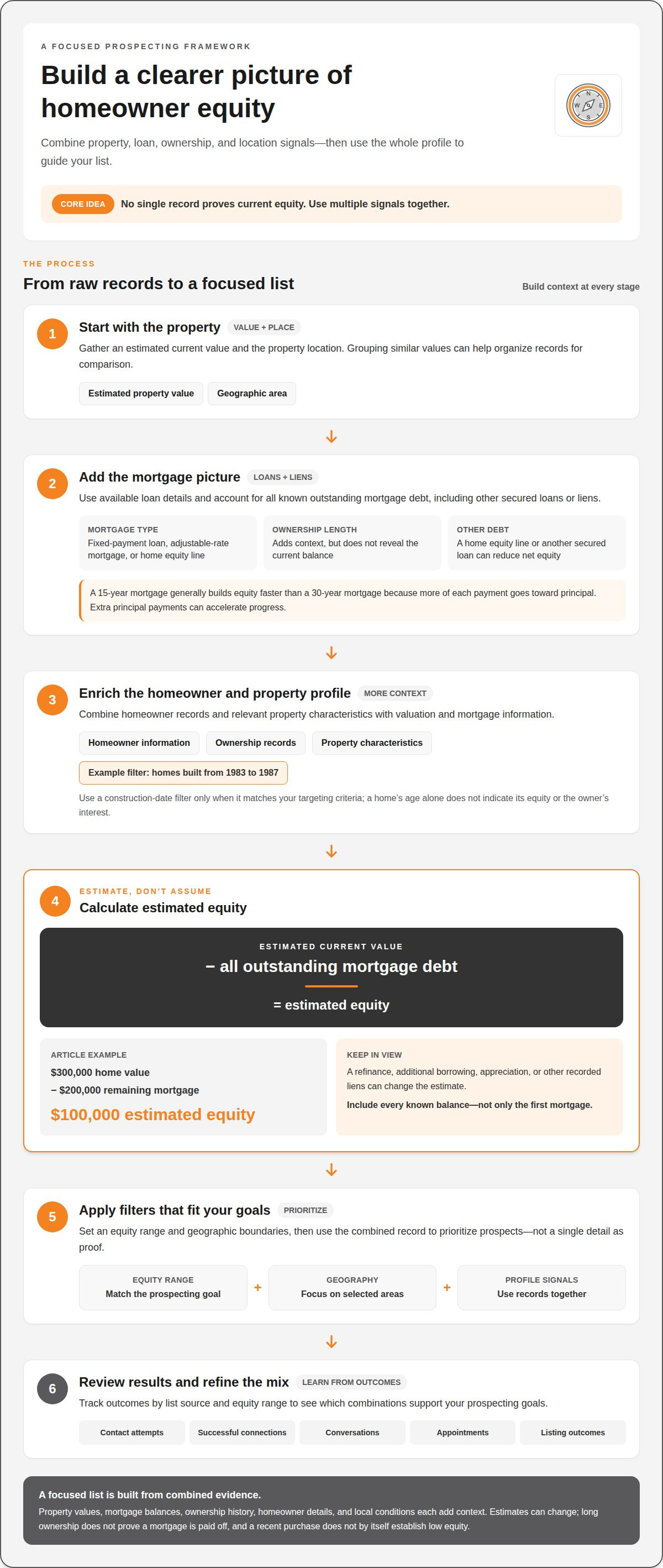
Mortgage details and ownership length help estimate whether a homeowner may have built substantial equity. A 15-year mortgage generally builds equity faster than a 30-year mortgage because more of each payment goes toward principal. Extra principal payments can accelerate that progress. Ownership length adds context, but it doesn’t reveal the current balance or account for home-value changes. Use these signals together when prospecting for homeowners with high equity.
Estimate equity by subtracting all outstanding mortgage debt from the home’s estimated current value. For example, a home valued at $300,000 with $200,000 remaining on its mortgage has $100,000 in equity. Treat that figure as an estimate: a home equity line or another secured loan can add debt and reduce the owner’s net equity.
Mortgage type helps explain how a balance may change over time. A fixed-payment loan, adjustable-rate mortgage, or home equity line can affect a homeowner’s debt differently. Review available loan details alongside estimated value, ownership duration, and other recorded liens. A recent purchase does not by itself establish low equity, just as long ownership does not prove a mortgage is paid off.
Lien priority matters, too. A first mortgage usually has priority over later liens, while a home equity line may be secured by a separate lien. For a useful estimate, account for every known balance rather than subtracting only the first mortgage. If recorded documents show multiple loans, include them in the debt picture before assigning an equity range.
What prospecting methods work best for reaching high-equity homeowners? Combine property-value estimates with mortgage and ownership records, then narrow the list by geography and your target equity range. When prospecting for homeowners with high equity, use multiple signals to prioritize outreach rather than treating any single detail as proof of equity.
How do high-equity homeowner lists compare with absentee-owner or pre-foreclosure lists? Equity lists center on estimated property wealth; absentee-owner lists identify ownership and occupancy patterns, while pre-foreclosure prospects reflect a different property situation. Choose the list type that best matches the conversation you want to start.
Home equity conversion mortgages (HECMs) add a retirement-related detail. Homeowners must be at least 62 years old to qualify, and HECM is an FHA mortgage program, not a government benefit. Borrowers don’t make monthly mortgage payments, but must keep paying property taxes and homeowners insurance and maintain the home.
How do privacy laws and do-not-call rules apply to real estate prospecting? Requirements depend on the contact method and applicable jurisdiction. Build appropriate list screening, recordkeeping, and opt-out handling into your outreach process.
What metrics should you track? Record contact attempts, successful connections, conversations, appointments, and listing outcomes by list source and equity range. Review results over time to see which combination of mortgage details, ownership length, and geography supports your prospecting goals.
Customizing prospect lists with property and homeowner data
A useful prospect list combines property details with homeowner and mortgage information. Start with estimated property value, available mortgage details, ownership records, and location, then apply criteria tied to your outreach goals. A value estimate alone may miss a refinance, a new lien, or other debt that changes the equity picture.
Property valuations and loan-to-value calculations help organize records into meaningful equity ranges. Mortgage details add context, while homeowner data can help distinguish records that otherwise look alike. Document images may offer further information about recorded property or loan details. Treat each data point as part of the profile, not proof of a homeowner’s current plans.
Set filters around the prospects and conversations you want to prioritize. For example, you might organize a list using:
- Property value: Group homes by estimated value to compare similar properties.
- Mortgage details: Include available loan information when estimating remaining debt.
- Homeowner records: Use ownership details to distinguish individual profiles and property records.
- Property characteristics: Apply relevant features, such as a selected construction period.
- Geography: Limit records to the areas where you plan to make contacts.
A construction-date filter can serve a specific campaign. For instance, prospect lists can be filtered for homes built from 1983 to 1987. That range is useful only when it aligns with your targeting criteria. Pair it with valuations and mortgage data rather than assuming a home’s age indicates its equity or the owner’s interest.
Appreciation can change estimated equity even if the homeowner is paying the same mortgage amount. A refinance or additional borrowing can also change the debt side of the calculation. Keep the list useful by noting which records rely on estimates and which have supporting loan or property documents. Prioritize outreach using the combined profile, not a single field.
What U.S. laws regulate marketing to homeowners by phone, text, email, or direct mail? Requirements vary by channel, recipient location, consent, and outreach method. Before launching a campaign, screen records, honor opt-outs, and apply the requirements relevant to each contact channel.
Review list performance by source and filter combination. If a property-value range paired with a particular area produces more relevant conversations, refine future lists around that pattern. A focused workflow can help you put better-organized records into action. Explore a focused prospecting workflow.
Home equity marketing should focus on prospects who meet lending criteria, not rely on a broad, untargeted list. Apply that principle when choosing filters: use property and homeowner information to narrow records to prospects who fit the intended lending profile, rather than treating every available record as equally relevant.
Consider estimates, loan details, ownership records, and geography together. Avoid letting a single property characteristic stand in for lending suitability. When a profile lacks enough context to assess fit, give it lower priority until supporting property or loan details are available. This ties list selection to clear criteria and gives outreach a sounder basis.
Older homeowners with high equity
Age can add context to a property profile, but it doesn’t establish someone’s plans or financial needs. The median U.S. home equity contract customer is in their 50s when signing. Some home equity investment providers target older homeowners with substantial equity who may not qualify for traditional loans. For prospecting, treat age as one filter among several, not a reason to assume interest.
High equity can represent a financial resource, but homeowners have different priorities. One may be considering a move, while another wants to stay in the home and preserve assets. A property record can suggest ownership and estimated value, but it cannot tell you whether the owner wants to sell, borrow, or discuss options. Keep the conversation open-ended and guided by the homeowner.
Build your audience around relevant property and ownership signals, then tailor your message to the service or information you can genuinely provide. Avoid presenting equity as cash a homeowner can automatically access. Available options depend on the homeowner’s circumstances, the property, and financing terms. Do not imply that age alone predicts a need or ability to qualify.
What messaging appeals to homeowners with high equity without making misleading claims? Give a clear, relevant reason for contacting them and invite them to share their goals. Describe potential choices in measured terms, without promising approval, savings, or a particular financial outcome.
Older homeowners may be weighing several considerations before discussing their property. A respectful approach helps keep the interaction useful:
- Give context: Explain why the property or ownership profile prompted your outreach.
- Ask, don’t assume: Let the homeowner identify whether moving or staying is relevant.
- Use plain language: Separate estimated equity from funds the owner could access.
- Respect the response: Record preferences and honor requests to stop contact.
What are the risks and ethical concerns of targeting homeowners based on equity? Estimates can be outdated or incomplete, and age-based assumptions can lead to intrusive or unsuitable conversations. Use property data carefully, protect personal information, and avoid pressure based on a homeowner’s presumed financial vulnerability.
A practical review can improve an age-inclusive campaign. Compare each property record with available ownership and valuation details, then note the limits of any estimates. Keep messaging focused on the homeowner’s stated goals, not presumed interest in a loan or sale. If an older owner says a move is not under consideration, shift the conversation instead of pressing an equity-based pitch.
Strong prospecting respects the person behind the record. Use age and equity as context for targeting, then let each homeowner’s actual priorities guide the conversation.
Targeting prospects by equity range and geography
Equity ranges help you prioritize prospects instead of treating every estimated balance alike. For each property, compare estimated equity with current value, then group records into ranges that fit your outreach goals. A homeowner with more than 25% equity may fit a HELOC prospect profile, but that threshold doesn’t establish interest or eligibility for a line of credit.
Geography adds another useful filter. In Q4 2025, Vermont had the highest listed share of equity-rich mortgaged homes among states, at 87%. Louisiana had the lowest, at 20.1%, while New Hampshire stood at 60.2%. These state figures provide context, not a prediction for an individual neighborhood or property.
Average home equity per borrower also varies by state. Hawaii’s average was $688,000, compared with $626,900 in California and $114,700 in Louisiana. Those averages can help frame regional research, but don’t replace property-level estimates. Local home values, mortgage balances, and additional liens shape the equity picture for each homeowner.
Use a consistent set of filters to turn broad geographic signals into an actionable list:
- Choose a service area: Set a state, metro area, or neighborhood boundary relevant to your outreach.
- Set an equity band: Group records by estimated equity or equity share, rather than labeling every owner “high equity.”
- Compare local context: Use state or regional patterns to prioritize research, then assess individual property records.
- Review debt signals: Account for available mortgage details and any recorded line of credit when estimating net equity.
Equity estimates can shift as property prices and mortgage balances change. A 5% U.S. home-price drop would move 188,000 properties below the equity threshold. That sensitivity makes the valuation date important: a list built from older estimates may place a property in the wrong range. Refreshing values and debt details helps keep prioritization aligned with current conditions.
Geographic averages should guide allocation, not dictate assumptions about residents. For example, Vermont’s 87% share doesn’t mean every Vermont homeowner has substantial equity. Use the state figure to decide where to investigate, then narrow by property value, mortgage information, and your chosen equity range.
Track results by geography and equity band. Compare connection rates, conversations, and appointments across areas, then adjust which ranges receive attention. This shows whether a broad state-level signal translates into useful local prospecting, without treating regional averages as facts about individual homeowners.
Average home equity per borrower in Oklahoma was $123,900. The average California mortgaged borrower had $626,900 in home equity, enough to buy a median-priced home in 48 out of 50 states entirely in cash. These state-level contrasts can inform where to focus research, while property-level balances remain central to individual estimates.
What data sources identify homeowners with high equity?
No single record provides a complete equity picture. A useful estimate combines property valuation, mortgage details, homeowner data, document images, and loan-to-value calculations. Each source answers a different question: what the home may be worth, what debt is recorded, who owns it, and how those details relate.
Start with property valuation data to estimate current market value. Compare that estimate with available mortgage balances and other recorded loan details. Loan-to-value calculations express debt in relation to property value, making it easier to sort records into equity bands. An estimate remains an estimate, especially when a loan balance or valuation is incomplete.
Mortgage and property documents add important context. Document images can show recorded transactions and loan information that a summary field may not capture. Homeowner data connects property records with ownership details. Together, these sources can help distinguish a property profile from an assumption based on location or appearance.
Use each data type for a clear purpose:
- Property valuations: Establish the estimated value used in an equity calculation.
- Mortgage details: Account for available loan balances when estimating property debt.
- Document images: Review recorded documents for relevant transaction or lien details.
- Homeowner data: Associate property information with ownership records.
- Loan-to-value calculations: Organize debt and value into comparable prospect segments.
Reconcile the fields before prioritizing a prospect. If a document image indicates a later transaction than a summary record, the profile may need closer review. If valuation data and recorded mortgage details point to different equity ranges, do not present the estimate as precise. Keep source fields attached to the record so your team knows what informed its classification.
Build list criteria around the data available for your campaign. For example, set a target equity range, select a geography, and include properties with valuation and mortgage details that support an estimate. Then separate records with fuller documentation from those relying on fewer fields. This distinction helps focus outreach without treating every homeowner as equally qualified.
Refresh the underlying records as part of list management. A refinance, additional borrowing, or a change in property value can shift estimated equity. Compare updated valuations and loan information before carrying an old classification into a new campaign. This makes your targeting more deliberate and gives you a clearer basis for prioritizing property records.
Landvoice
Landvoice helps real estate professionals build prospecting pipelines with property-focused lead sources. If you’re applying equity research to listing outreach, Expired Pro, FSBO Leads, FRBO Leads, and Pre-Foreclosure Leads can support different prospecting priorities. These sources identify homeowners through listing or property circumstances, giving you additional ways to shape conversations alongside your own property-data criteria.
Use these options when you want to broaden or diversify your outreach beyond an equity-filtered list. Match the lead source to your current prospecting focus, then bring your local knowledge and homeowner research into each conversation. For more information about how Landvoice can fit your workflow, contact Landvoice.
Put Your Prospecting Plan Into Motion
Turn your property research into a focused outreach plan. Choose a clear audience, decide what makes a record worth prioritizing, and shape a message around the homeowner’s possible goals. Keep your language accurate: estimated equity is a useful signal, not a promise of available funds or an intent to sell.
Prospecting for homeowners with high equity becomes more purposeful when it supports a broader listing pipeline. Landvoice offers Expired Pro, FSBO Leads, and FRBO Leads as additional prospecting sources to consider alongside property data. Choose the source that fits your immediate business focus, then make each contact relevant and respectful.
Refine your approach as you learn which audiences and messages lead to meaningful conversations. Consistent, thoughtful outreach gives you a practical path from research to stronger prospecting habits.
Contact Landvoice to find prospects
Frequently Asked Questions
What does high home equity mean, and how is it calculated?
Home equity is a property’s current value minus the debt secured against it. To estimate it, subtract outstanding mortgage and other secured loan balances from an up-to-date value estimate. You can also express equity as a share of value by dividing estimated equity by the property’s current value. A record showing a small remaining balance relative to estimated value may merit further review, but it does not prove the owner’s plans.
How can I find high-equity homeowners in a specific U.S. area?
Define your target geography, then combine property-value estimates with available mortgage and ownership records. Sort the resulting profiles into equity ranges and prioritize records that fit your outreach goals. For example, apply the same value and debt criteria across records in your selected service area. This creates a consistent way to compare prospects without treating a regional average as an individual homeowner’s equity estimate.
What is the best way to verify a homeowner’s equity estimate?
Recalculate the estimate using a current property valuation and the homeowner’s outstanding secured debts. Publicly recorded documents can help identify mortgages or other liens, but an original loan amount may not reflect today’s balance. Keep the valuation date and records used with your estimate. If key debt details or a current value are unavailable, classify the figure as preliminary rather than presenting it as confirmed equity.
