



by Bruce Keith, on August 18, 2026
Most real estate agents are flying blind, guessing their net profit while watching their hard-earned commissions vanish into a black hole of untracked expenses. You work too hard to let your GCI slip away because of poor record-keeping or low-return lead sources. It's frustrating to close a massive deal only to realize your marketing costs ate the lion's share. You deserve a clear, one-page view of your financial health. This specialized real estate agent profit and loss statement template is your GPS for prospecting and profit. It transforms raw data into a strategic weapon, allowing you to dominate your market with total confidence.
Mastering your business finances is the difference between an average year and an elite-level breakthrough. You'll learn how to track the exact ROI of your efforts when contacting homeowners and see exactly where to reinvest for maximum growth. We will show you how to leverage the 2026 standard mileage rate of 72.5 cents per mile and the 23% QBI deduction to slash your tax bill. This guide provides the framework to eliminate tax season anxiety and accelerate your path to massive commissions. Stop guessing and start executing your plan for financial dominance in 2026.
Key Takeaways
- Discover how elite agents use financial statements to identify which lead sources are true profit-drivers and which are simply money-pits.
- Implement a specialized real estate agent profit and loss statement template to gain a clear view of your net profit after brokerage splits and transaction fees.
- Master the lead ROI formula to stop wasting your energy on low-quality data. Focus your efforts on lead sources that actually convert into closed deals.
- Align your expense categories with IRS standards to secure your deductions. This organization eliminates tax season anxiety and keeps more commission in your pocket.
- Use your financial clarity to fuel aggressive growth phases. Reinvest your margins into premium Landvoice lead assets to dominate your local market.
What is a Real Estate Profit and Loss Statement and Why You Need One
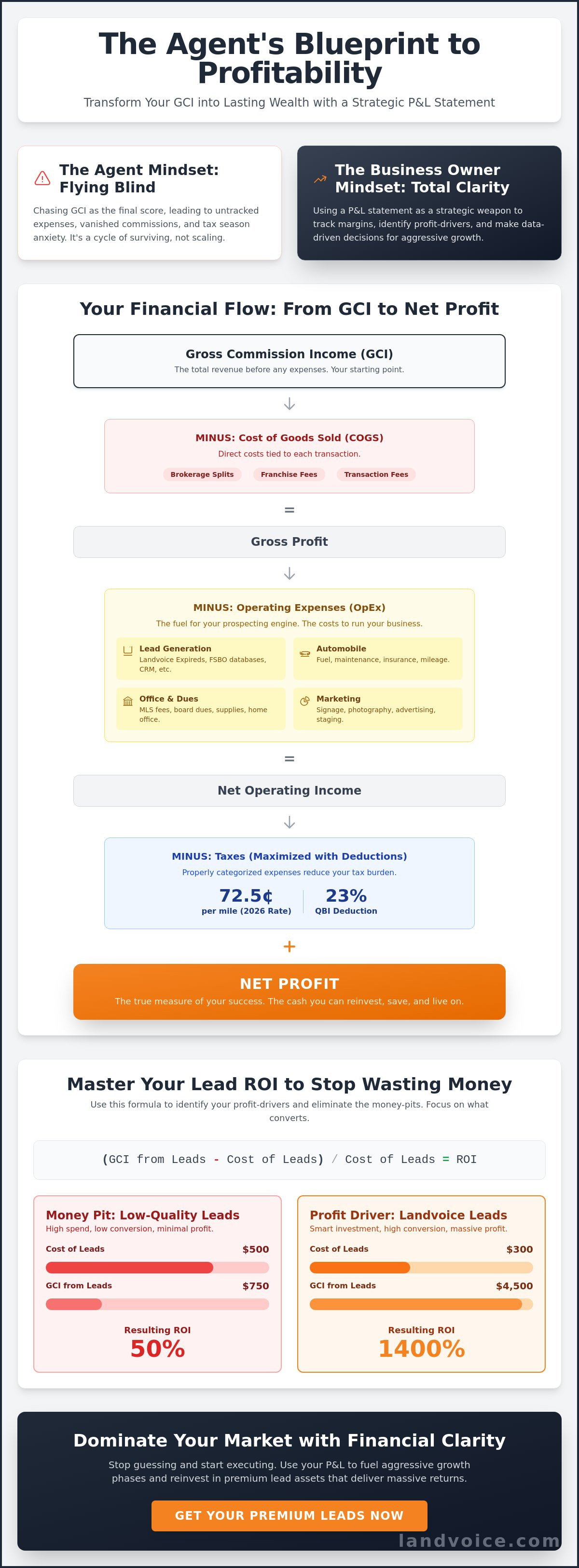
Most agents chase Gross Commission Income (GCI) as if it's the final score. It isn't. GCI is a vanity metric that often hides the brutal truth about your actual bank account balance. To truly dominate your market, you must utilize an Income Statement. This document, commonly known as a P&L, acts as the financial scoreboard for your prospecting efficiency. A specialized real estate agent profit and loss statement template summarizes every dollar flowing into your business and every cent leaking out. It's the only tool that reveals your true net profit after splits, marketing costs, and operational fees.
Top producers don't play guessing games with their livelihood. They use a P&L to ruthlessly identify profit-drivers and eliminate the money-pits that drain their resources. If a specific lead source costs hundreds of dollars a month but yields zero closings, the P&L exposes that failure immediately. Conversely, when you see that FSBO leads are providing a massive return on investment, you gain the confidence to double your spend. This is how you move from hoping for success to engineering it through data-driven decisions.
The Mindset Shift: From Agent to Business Owner
You must stop treating your commission checks like personal bank accounts. When you operate without a clear real estate agent profit and loss statement template, you're essentially an employee of your own chaos. Real business owners track their margins with total precision. This level of financial clarity is what eliminates the fear of investing in high-quality lead data. You'll stop surviving from one closing to the next and start scaling your operation. Transitioning to a business-owner mindset means you know your exact margins. It allows you to fund your growth with certainty rather than anxiety.
Frequency of Tracking: Monthly vs. Quarterly
Quarterly reviews are for stagnant businesses. If you're serious about making more contacts and closing more deals, you need a monthly pulse check. High-speed prospecting requires quick pivots. Monthly tracking helps you identify seasonal market trends so you can adjust your marketing spend on the fly. You might find that Expired Pro data performs significantly better during specific months. Setting a "Financial Friday" routine is the best way to stay ahead. Spend thirty minutes each week reviewing your overhead to ensure your business remains a lean, profit-generating machine.
Essential Categories for Your Real Estate P&L Template
To scale your business, your real estate agent profit and loss statement template must be organized with surgical precision. You can't just lump generic business costs together. You need to separate Revenue, Cost of Goods Sold (COGS), and Operating Expenses to see where your money actually goes. Revenue captures your total Gross Commission Income and those secondary referral fees. COGS includes your brokerage splits, franchise fees, and transaction coordinator costs. These are the direct "taxes" on your production. Operating Expenses are the fuel for your prospecting engine. Finally, Net Profit is the number that dictates your lifestyle and your ability to reinvest in elite lead assets.
Your P&L should act as a mirror for your daily activities. If you spend four hours a day on the phone, your expenses should reflect the tools that make those hours productive. When you categorize these items correctly, you stop wondering why your bank account doesn't match your GCI. You start seeing your business as a series of levers you can pull to increase your bottom line. While you're tracking these operational costs, remember that many expenses, including portions of your home setup, may fall under IRS guidelines on home office deductions. Organizing these categories now saves you from a nightmare during tax season.
Marketing and Lead Generation Expenses
This category is where you track the high-performance data that drives your listings. You need specific line items for Expired Listing Leads and FSBO databases. These aren't just costs; they're the raw materials for your inventory. Don't forget to track your spend on Neighborhood Search for circle prospecting around your recent wins. Grouping your direct mail, digital ads, and signage here allows you to compare the cost of passive marketing against the high returns of proactive outreach. You'll quickly realize that the most profitable agents spend their budget on data that allows them to start more conversations.
Technology and Software Costs
Modern prospecting requires a robust tech stack. Your SaaS subscriptions, such as your CRM and the Landvoice Dialer, belong in this section. You should also include your communication costs, like your cell phone data plan and high-speed internet. Verified data is a strategic investment in your time rather than a simple expense because it eliminates the hours wasted on wrong numbers. Using a high-quality dialer ensures you maximize every minute spent making more contacts. When your technology works for you, your cost per closed transaction drops significantly. Precision in your tech spend leads to total control over your growth.
Calculating ROI: Turning Lead Spend into Commissions
Your real estate agent profit and loss statement template is more than a tax document. It's a performance diagnostic tool. To scale your business, you must master the Lead ROI Formula: (Commission from Lead Source - Cost of Lead Source) / Cost of Lead Source. This simple calculation separates the elite producers from the hobbyists. If you aren't tracking this, you're likely overspending on vanity marketing while starving your most profitable channels. Understanding Profit and Loss Statements allows you to see your business as a series of strategic investments rather than just a list of bills. When you see a massive return on FSBO leads, the decision to increase your budget becomes a mathematical certainty.
The Conversion Gap occurs when your lead spend remains high but your revenue has plateaued. This gap usually points to two specific issues: poor data quality or a breakdown in your follow-up workflow. Cheap data is often the most expensive asset you can buy. It seems like a bargain until you factor in the dozens of wasted prospecting hours spent chasing disconnected numbers. Your P&L should highlight these inefficiencies so you can pivot toward high-quality, verified information immediately. Stop guessing which leads work and start letting the numbers dictate your next move.
Analyzing Lead Source Performance
Top agents don't treat all leads the same. You need to compare the ROI of Expireds, FSBOs, and your Sphere of Influence side-by-side. One of the best-kept secrets in the industry is the use of Old Expireds. These are often low-cost, high-margin revenue streams because the initial competition has faded away. By allocating your budget based on data-driven results rather than gut feelings, you ensure every dollar spent is working toward your next commission check. Use your P&L to ruthlessly cut underperforming sources and double down on what wins.
The Cost of Inaction and Poor Data
You have to calculate your 'Time Expense' to see the full picture. How many hours are you wasting on unverified numbers or wrong contacts? Top agents prioritize verified cell phone numbers in their P&L strategy because they value their time above all else. Think of Landvoice as a multiplier for your efforts. Accurate data reduces your 'Cost Per Appointment' by ensuring you spend your time making more contacts rather than digging through bad info. When you eliminate the friction of poor data, your profit margins naturally expand. Precision is the ultimate competitive edge.
How to Implement Your P&L Template for Tax Efficiency
Protecting your hard-earned commissions is just as critical as generating them. You've used your real estate agent profit and loss statement template to identify which lead sources drive growth; now you must use it to shield your income. Organizing your financial data to mirror IRS Schedule C categories ensures a seamless transition from daily operations to tax filing. This alignment eliminates the end-of-year scramble and guarantees you don't miss high-value deductions. You should always consult with a qualified CPA to validate your specific deduction eligibility and ensure you're maximizing your local tax advantages.
Separating your personal and business bank accounts is the first rule of professional stability. Mixing funds creates a messy trail that complicates your bookkeeping and increases your audit risk. When you keep your business finances isolated, every expense is easier to track and justify. This includes your investment in professional development. Tracking fees for Landvoice Pro Coaching and other specialized training ensures these growth-focused costs are correctly categorized as business deductions. Precision in your record-keeping translates directly to more money in your pocket.
Deductible Business Expenses for Agents
Your P&L must account for the specific costs of staying in the game. Desk fees, MLS dues, and board memberships are essential line items. Marketing materials and prospecting software are generally 100% deductible business expenses. You must also keep your travel and vehicle logs audit-ready. For 2026, the IRS standard mileage rate is 72.5 cents per mile. Whether you're driving to a listing presentation or meeting a FSBO lead, every mile counts toward reducing your taxable income. Keeping these records updated weekly prevents you from leaving thousands of dollars on the table.
Preparing for the 2026 Tax Season
Elite agents never let tax season catch them off guard. You should set aside a percentage of every commission check for estimated taxes to avoid massive year-end penalties. The self-employment tax rate remains at 15.3% for 2026, so proactive planning is vital. A clean P&L reduces your CPA fees because they don't have to spend hours untangling your records. Use the "End-of-Year Sprint" to review your profit margins and decide on last-minute business investments. If you have excess profit, it's the perfect time to secure your premium lead data for the coming year. This strategy lowers your taxable income while positioning you to start making more contacts immediately in the new quarter.
Dominate Your Market: Scaling with Financial Clarity
Financial tracking is the first step; execution is the second. You've established your real estate agent profit and loss statement template to see the truth about your business. Now, you must use that truth to fuel your growth. Clarity without action is just trivia. Clarity with execution is power. When your P&L shows a healthy margin, you don't sit back and celebrate. You use those profits to fund an "Aggressive Prospecting" phase that leaves your competition in the dust. You've seen the numbers. You know what works. It's time to pour gasoline on the fire.
Filling the revenue side of your P&L requires a consistent stream of high-intent opportunities. Landvoice provides the unfair advantage you need to dominate your local market. While other agents waste time on stale data or unverified numbers, you'll be making more contacts with homeowners who are ready to sell. This precision establishes your technical superiority. It ensures your prospecting hours yield the highest possible return. Remember the industry's golden rule: you can't manage what you don't measure. By measuring your success through a specialized real estate agent profit and loss statement template, you gain total control over your professional destiny.
Reinvesting Profits for Exponential Growth
Success creates a new set of challenges. When your P&L shows consistent growth, it's time to move from a solo operation to a scalable team. Use your margins to add a virtual assistant or an ISA to handle the initial outreach. This allows you to focus on closing. You can also scale your lead volume by expanding your niche. Move from mastering FSBOs to dominating Pre-Foreclosures. For more advanced tactics, check out our FSBO Leads Guide to refine your listing strategy.
Your Next Steps for Financial Mastery
The time for research is over. The time for execution has begun. Follow these steps to secure your financial future:
- Build your template: Don't wait for a "better time" to organize your finances. Download or build your P&L today to see your true net profit.
- Audit your spend: Look at every dollar spent on lead generation. Are you getting the best data for your dollar, or are you paying for wrong numbers?
- Reinvest in quality: Shift your budget toward verified, high-performance data that shortens your path to a commission check.
Dominate your market with Landvoice data and see the ROI in your P&L. Stop guessing and start growing your business with the precision of an elite professional.
Secure Your Edge and Scale Your Income
Financial mastery is the only path to sustainable success in this industry. You've learned that a real estate agent profit and loss statement template isn't just for tax season; it's your strategic roadmap for growth. By tracking your ROI and identifying high-performance lead sources, you eliminate the guesswork that keeps average agents stuck. You now have the framework to maximize your deductions and reinvest your commissions with total confidence. Precision in your numbers leads to total control over your career.
Success requires the right data partner. Landvoice has been the industry leader for over 30 years, providing the best cell phone numbers in the business. Top-producing agents across the US and Canada rely on our precision to fill the revenue side of their P&L with high-margin listings. Stop wasting your time on unverified data and start making more contacts that actually convert. We provide the technical superiority you need to establish a permanent competitive edge in your market.
Stop guessing and start growing—see Landvoice pricing and plans. Your path to elite-level commissions starts today. Go execute your plan and dominate your market with total financial clarity.
Frequently Asked Questions
What is the best format for a real estate P&L template?
Digital spreadsheets or cloud accounting platforms are the gold standards for a real estate agent profit and loss statement template. These tools allow you to automate complex calculations and track your lead source ROI in real time. You need a dynamic format that separates fixed operational costs from variable marketing spend. This clarity allows you to pivot your strategy instantly when a specific lead source starts outperforming the rest of your portfolio.
How often should a real estate agent update their profit and loss statement?
You should update your P&L statement at least once a month to maintain total control over your profit margins. High-producing agents often perform weekly "Financial Friday" check-ins to monitor their marketing spend and lead conversion rates. Frequent updates allow you to spot "money-pits" before they drain your quarterly profits. Staying current ensures you're always ready to reinvest in high-performing data assets like Landvoice FSBO leads.
Can I use a generic small business P&L for my real estate practice?
Generic templates fail to account for the specific commission cycles and unique expenses of the real estate industry. Your business requires specialized categories for brokerage splits, franchise fees, and niche lead data. A generic small business P&L won't show you the true ROI of making more contacts through high-intent sources. Using a tailored real estate agent profit and loss statement template ensures you're tracking the specific metrics that drive your growth.
What are the most common tax deductions for real estate agents?
Common deductions include the 2026 IRS mileage rate of 72.5 cents per mile and your total marketing spend. You can also deduct desk fees, MLS dues, and software subscriptions like Landvoice Expired Pro. Professional development costs, such as Landvoice Pro Coaching, are also fully deductible business expenses. Always track your vehicle logs and home office expenses to maximize your eligibility for the 23% QBI deduction.
How do I calculate my net profit as a real estate agent?
Calculate your net profit by subtracting your Cost of Goods Sold and Operating Expenses from your Gross Commission Income. COGS includes brokerage splits and referral fees, while Operating Expenses cover your marketing and tech stack. The remaining figure is your true take-home pay. This number tells you exactly how much capital you have available to reinvest into aggressive prospecting or personal wealth building for the coming year.
Should I include my brokerage split in my P&L statement?
Yes, your brokerage split must be included as a Cost of Goods Sold (COGS) in your P&L. It is a direct cost of production that significantly impacts your bottom line. Tracking this alongside franchise fees and transaction coordinator costs gives you a clear view of your actual margins. Knowing this exact number helps you negotiate better splits or choose a brokerage model that aligns with your long-term financial goals.
Is prospecting software considered a marketing or technology expense?
Categorize prospecting software as a Marketing or Lead Generation expense to better track your acquisition costs. This allows you to measure the direct ROI of tools like the Landvoice Dialer against the commissions they produce. General technology categories should be reserved for infrastructure like your CRM or cell phone plan. Grouping it with marketing spend ensures you see exactly what it costs to generate a closed transaction.
How does a P&L help me get more listings?
A P&L helps you get more listings by identifying which lead sources provide the highest return on your time and money. When the data shows that making more contacts through Landvoice data yields a massive return, you can confidently double your prospecting budget. It removes the hesitation associated with investing in premium lead assets. Financial clarity gives you the "unfair advantage" to outspend and out-prospect your competitors for every listing.
