



by Bruce Keith, on October 23, 2026
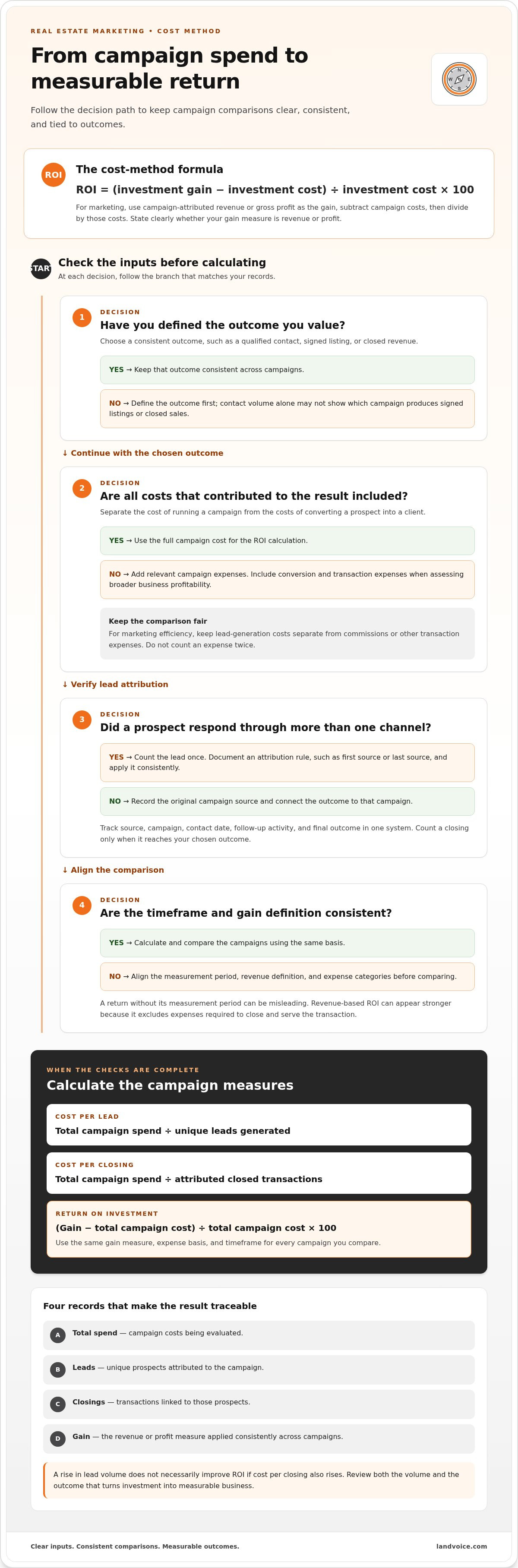
A lead isn't a return until it contributes to closed business. ROI measures what you gained relative to what you invested: (investment gain minus investment cost) ÷ investment cost × 100. An ROI calculator for real estate marketing applies that formula to campaign results and costs, so you can see whether your outreach is generating value.
You already know marketing takes time and money, but a busy pipeline alone doesn’t show whether either is paying off. A useful calculation connects campaign spending to measurable outcomes and uses a clear timeframe, so short-term costs aren’t judged against results that take longer to arrive. Learn how to calculate marketing ROI, which expenses to include, and how to compare campaigns consistently. Then use the results to decide where to focus your next investment.
Key Takeaways
- Measure ROI by comparing investment gain with the full cost, then express the result as a percentage.
- Separate gross revenue from net returns so expenses don’t make a campaign look more profitable than it is.
- Include the costs that influence performance, from marketing spend to the time and resources used to convert prospects.
- Use a consistent timeframe when comparing campaigns; a return without its measurement period can be misleading.
- Consider Expired Pro as one way to build a focused pipeline of expired listing prospects and assess outreach against your costs.
Basic real estate ROI formula
Calculate return on investment by subtracting total investment cost from investment gain, then dividing by cost. Multiply the result by 100 to express ROI as a percentage. The Internal Revenue Service states that ROI is calculated by dividing revenue by cost.
For example, a rental property earns $900 in monthly rent and has $300 in monthly expenses. Its annual net operating income is $7,200. Against the original purchase price, that equals an 11.1% return.
Marketing ROI applies the same logic to prospecting: add the revenue or gross profit attributable to a campaign, subtract its costs, then divide by those costs. If you measure revenue rather than profit, label the result clearly. Revenue-based ROI can look stronger because it excludes the expenses required to close and serve the transaction.
Real estate marketing ROI benchmarks vary by market and property type. Lead costs, competition, conversion rates, and transaction values all affect results. Rental campaigns also depend on operating expenses and income, while listing-focused marketing depends on whether outreach leads to signed listings and closed sales.
A useful ROI or ROAS benchmark in the United States is one that produces returns above the campaign’s full costs over a defined period. No single percentage applies to every market or property type. Compare channels using the same revenue definition, expense categories, and timeframe.
Track and attribute real estate leads by recording their original source, campaign, contact date, follow-up activity, and final outcome in one system. Use consistent channel labels for calls, forms, and other responses, then connect each closed transaction to its originating campaign. This separates leads that simply responded from those that generated revenue.
A useful ROI calculator for real estate marketing relies on inputs you can trace to campaign records, accounting data, and transaction outcomes. Separate one-time setup expenses from ongoing costs, and don’t count an expense twice. If a lead interacts with several channels, document your attribution rule, such as first source or last source, and apply it consistently.
Before comparing campaigns, define the outcome you value: a qualified contact, a signed listing, or closed revenue. Measure that same outcome across channels. One campaign might generate more contacts while another produces more signed listings. Looking only at contact volume would miss the difference. A clear formula turns marketing activity into a decision you can act on.
Cost-method ROI calculation
The cost method measures gains against the money invested. Include the acquisition or campaign expenses that contributed to the result, then compare the net gain with the full cost. For property investments, purchase price, improvements, and transaction-related spending shape the cost basis. For marketing, include campaign spend and connect it to leads or closed business.
Consider a property bought for $100,000, improved for $50,000, and sold for $200,000. The cost-method ROI is about 33%. If other costs apply, include them before calculating the actual return.
Financing changes the cash you contribute, so separate total project cost from your initial out-of-pocket investment. In a financed-property example, a $70,000 out-of-pocket investment and a $200,000 sale price produce a 71% ROI. Keep the calculation’s basis clear: returns measured against cash invested answer a different question from returns measured against the full property cost.
For marketing, divide total campaign spend by the number of leads generated to calculate cost per lead. Divide the same spend by closed transactions attributed to the campaign to calculate cost per closing.
Use consistent definitions for every input. Count each lead once, even if the person responds through multiple channels. Count a closing only when the transaction reaches your chosen outcome. Keep lead-generation costs separate from commissions or other transaction expenses when comparing marketing efficiency. Include those expenses when calculating broader business profitability.
To make the result useful for decisions, record these inputs for the same campaign period:
- Total spend: include the campaign costs you’re evaluating.
- Leads: count unique prospects attributed to that campaign.
- Closings: track transactions linked to those prospects.
- Gain: use the revenue or profit measure applied consistently across campaigns.
Compare actual results with your original assumptions. If lead volume rises but cost per closing also climbs, the extra contacts may not improve ROI. If the closing rate changes, recalculate cost per closing instead of relying on cost per lead alone. This view helps you identify which campaigns turn investment into measurable outcomes.
The displayed real estate investment projection reports total cash invested of 80,500. Treat that figure as the cash-basis input for reviewing the projection, rather than assuming it represents every cost associated with the project. Compare projected gain with the same investment basis used in the ROI calculation, and preserve the distinction between cash contributed and total project cost.
This distinction clarifies whether a projected return reflects an investor’s cash exposure or the economics of the whole investment. If a projection changes, update the relevant cash invested and gain figures together. Otherwise, the resulting percentage may no longer reflect the assumptions under review. State the basis clearly when comparing alternatives.
Costs that reduce real estate ROI
Every expense tied to earning a return reduces what remains. When using an ROI calculator for real estate marketing, separate campaign spending from the costs of converting a prospect into a client. This shows whether a channel is expensive to run or whether follow-up and transaction costs are reducing the gain.
That figure is only one part of the investment. Add any campaign tools, creative work, staff time, and follow-up resources included in your analysis. Use the same cost categories for each channel, or incomplete bookkeeping may make one campaign look more efficient than another.
For marketing ROI, subtract commission splits, brokerage fees, and transaction costs from the gross commission attributed to the campaign. Decide whether you’re measuring gross commission after marketing spend or net income after these deductions, then apply that definition consistently.
Rental property costs affect an investor’s cash flow differently. Operating expenses typically range from 35% to 85% of rental income, depending on the property and its expenses. Maintenance, utilities, and management can reduce the income available to cover financing and build returns. Include operating costs when evaluating rental performance, but keep them separate from marketing expenses when comparing lead channels.
Review each cost category before interpreting a result:
- Campaign costs: advertising, content production, and tools directly supporting outreach.
- Conversion costs: staff time and follow-up resources used to move a lead toward a transaction.
- Transaction costs: commission splits, brokerage fees, and closing-related expenses.
- Property costs: operating expenses that affect rental income and property cash flow.
A campaign may appear profitable when you compare gross commission with advertising spend. After commission splits and transaction costs, however, the amount retained may be lower. Track both figures when they answer different questions: channel efficiency and net income. Don’t subtract an expense twice. If staff time is already recorded as a campaign cost, don’t add it again under conversion costs.
Keep rental and marketing calculations separate. A rental investor evaluates income after operating costs, while an agent measures prospecting returns against campaign and transaction expenses. Combining the two can hide which activity reduced the result. Record each expense by purpose and connect it to the relevant property, campaign, or closing. Then review which costs rose alongside weaker cash flow or lower retained commission. You’ll have a specific cost to investigate instead of a vague conclusion that marketing underperformed.
For rental projections, distinguish routine upkeep from other operating expenses: typical annual maintenance costs for residential investment properties are 1% to 4% of property value. U.S. property insurance costs are estimated at about 3% of a property's value in the mid-2020s and are expected to rise about 2% to 3% per year in the coming decade. These assumptions can change projected net income, so revisit them as costs shift.
A rental property's ROI depends on how its investment cost and profit are defined. For lead-generation comparisons, industry data indicates that the conversion rate for online real estate leads is often modest, making cost per lead an incomplete measure when evaluating a comprehensive ROI calculator for real estate marketing.
Customizing calculator variables
A spreadsheet, CRM report, or channel dashboard can calculate ROI if it uses consistent cost, conversion, and revenue definitions. Customize the inputs for each campaign, and keep mortgage principal separate from marketing expenses.
Measuring Leads, Conversions, and Sales
Measure campaign performance by tracking leads, their progress, and resulting sales. Record each lead’s source, status, and outcome in a CRM or campaign log. Compare lead volume with qualified prospects, signed listings, and closed transactions. This funnel view shows where results change, helping you assess whether lead quality, follow-up, or conversion is affecting returns.
Channel-Specific ROI Calculations
Calculate each channel’s ROI by comparing its attributable gain with its full costs. For social media and Google Ads, connect campaign records to inquiries and closed business, including management and creative expenses. For direct mail, compare responses with campaign costs. For SEO, include content and optimization resources, then attribute resulting leads and sales consistently. This makes channel comparisons more useful.
Start with a shared spreadsheet or reporting template. Give each campaign a distinct source label, such as “social media,” “Google Ads,” “direct mail,” or “SEO.” Add columns for spend, leads, qualified opportunities, signed listings, closed transactions, and attributed revenue. A CRM can preserve those labels as prospects move through the pipeline.
Next, choose the conversion event that matches your goal. A campaign focused on listing appointments should measure appointments and signed listings, not impressions alone. A sales-focused campaign should connect prospects to completed transactions. Use the same outcome when comparing channels, or one may appear stronger simply because it uses an easier conversion milestone.
Match financial inputs to what the calculation measures. Marketing ROI should include campaign-related expenses and the revenue or profit attributed to the campaign. A property investment model may also include mortgage financing, rental income, appreciation, and operating expenses. Don’t mix mortgage principal or property operating costs into a marketing-only calculation unless you’re evaluating the broader investment.
ROI calculations can be sensitive to assumptions, according to the U.S. Census Bureau. Test the effect of changing one input at a time, such as conversion rate or attributed revenue. Keep the original assumptions beside actual results, and update the calculation when campaign performance changes.
- Set the measurement period: use the same start and end points across channels.
- Keep attribution consistent: choose a source-credit method and apply it to each campaign.
- Separate forecasts from actuals: compare projected conversions with recorded outcomes.
This approach turns a basic template into a practical decision tool. You can see which variable needs attention, whether it’s lead quality, follow-up, attribution, or campaign spending.
ROI limitations without a timeframe
An ROI percentage without its measurement period can mislead. A 50% return over several months and a 1,000% return over 50 years describe very different performance.
Time changes what a result means. A short campaign window may capture advertising spend before leads have time to convert. A longer window may capture more closed business, but it can also include later costs or results from other campaigns. Set a measurement period and use it consistently when comparing channels.
Property investments have the same timing limitation. A rental property can generate operating income while its purchase price changes through appreciation. Reporting the gain without the holding period hides how long capital remained invested. Compare investments over the same period, or use an annualized measure when durations differ. Show the timeframe beside the ROI figure.
Real estate marketing presents its own timing challenge. A lead may respond in one reporting period, sign a listing later, and close in another. If you count advertising costs immediately but attribute revenue only after closing, the early result can look weak. If you credit a later sale without matching it to the campaign costs, the return can be overstated. Track each lead’s source and progress through the full conversion path.
Marketing ROI can be inaccurate when expense records are incomplete, leads are duplicated, attribution is inconsistent, or revenue is credited before a transaction closes. Changing the measurement window between campaigns also makes comparisons unreliable.
Choose a reporting rule that fits the decision you need to make. A short-term review can assess lead responses and follow-up activity. A longer campaign review can include signed listings and closed sales. Don’t compare an early-stage campaign with a mature one as though both had the same time to produce results.
For clearer insights, record these details beside every ROI result:
- Start and end dates: identify the exact period covered by costs and outcomes.
- Outcome counted: specify whether you’re measuring leads, signed listings, or closed revenue.
- Attribution rule: record how each lead or sale receives campaign credit.
- Cost timing: match expenses to the campaign period that generated them.
Imagine two advertising campaigns with the same return percentage. If one produced that return over several months and the other over a much longer period, the percentages alone don’t show which used capital more efficiently. Include the timeframe in tables, dashboards, and presentations. This simple habit keeps a strong-looking number from hiding slow conversion, delayed sales, or costs that arrived later.
Landvoice: Expired Pro
Landvoice offers Expired Pro for agents who want to focus prospecting on expired listings. If reaching potential sellers fits your strategy, track outreach costs alongside resulting conversations, signed listings, and closed business. This gives you a clear way to assess whether this lead source supports your goals.
Use the same timeframe and cost definitions as you do for other campaigns. Consistent measurement makes results easier to compare and helps guide your next marketing decision. Visit Landvoice to learn more.
Turn Your ROI Insights Into Action
Use campaign results to make a focused decision. Choose a lead source, define the outcome you want, and measure performance consistently. An ROI calculator for real estate marketing can help you assess whether your strategy supports that goal, but its value comes from acting on what the results reveal.
If you’re considering new prospecting opportunities, Landvoice offers Expired Pro, FSBO Leads, and FRBO Leads. These options help you focus outreach on homeowners and property owners, then assess the results against your marketing investment.
Use your findings to sharpen your pipeline and bring more discipline to your next campaign. Make your next decision with purpose, track the outcome, and keep building a strategy you can evaluate with confidence.
Your next growth decision starts with a clear view of the numbers. Keep measuring, refining, and moving forward with confidence.
Frequently Asked Questions
What is ROI?
ROI, or return on investment, measures the gain or loss from an investment relative to its cost. For a real estate agent, it can show whether a campaign’s results justify the resources committed to it. Positive ROI means the measured gain exceeds the included costs; negative ROI means it falls short. Interpret the figure alongside the outcome measured and the period covered.
What is the formula for calculating real estate marketing ROI?
Use this formula: (attributed gain − marketing investment) ÷ marketing investment × 100. A marketing ROI calculator for real estate can streamline the arithmetic, but the result depends on accurate attribution and consistent inputs.
What costs should be included in a real estate marketing ROI calculator?
Include costs directly connected to the campaign and the outcome you’re measuring. Depending on your accounting scope, these may include advertising, creative production, marketing software, and staff time, plus transaction deductions if you’re measuring net income. For example, if a CRM expense supports several campaigns, allocate it consistently instead of charging the full amount to each one. Record each cost once and keep the scope consistent.
