



by Bruce Keith, on October 12, 2026
Your calendar shouldn’t force you to choose between serving today’s clients and creating tomorrow’s business. But one urgent message can push prospecting aside, and repeated postponements can leave your pipeline dangerously thin. Time blocking for prospecting vs client work gives both priorities a place without pretending real estate days always go to plan.
It’s reasonable to worry that protected prospecting time could make you less responsive. The answer isn’t a rigid schedule or an open calendar that lets every request take over. It’s a practical system with focused lead-generation blocks, intentional client response windows, and room to adapt when a true priority interrupts the day. This article shows you how to build that calendar, decide what deserves an immediate response, and reset disrupted blocks instead of abandoning them. You’ll create a routine that keeps new contacts moving while clients stay informed and well served.
Key Takeaways
- Build your calendar around fixed commitments and client deadlines, then reserve focused blocks for prospecting and recurring work.
- Use time blocking for prospecting vs client work to give pipeline-building and active client service clear, intentional space.
- Before interrupting a work block, weigh the request’s urgency and the consequences of postponing it.
- Review appointments, deadlines, pipeline activity, and available time each week to shape a realistic schedule.
- Track prospecting progress and keep lead information organized so you can make better use of your scheduled outreach sessions.
Time Blocking for Prospecting vs. Client Work: Why Both Need Space
An open to-do list gives every task the same territory: your attention, right now. That’s a problem when client messages, transaction details, and lead-generation tasks compete for the same hours. Time blocking replaces that open-ended approach with calendar appointments for specific types of work. The method is straightforward: decide what needs your attention, then reserve time to do it. A useful overview of the approach appears in Time Blocking.
In real estate, prospecting builds the pipeline of potential future clients. Client work serves people already in active relationships or transactions with you. Both matter, but they protect different parts of your business. If every incoming request immediately takes priority, the day can fill with service tasks while future-business activity gets pushed to “later.” Repeat that pattern, and prospecting becomes reactive: it resumes only when the pipeline starts to feel uncomfortably thin.
Scheduled pipeline work creates future opportunities; scheduled client service delivers on the relationships and transactions you’ve already earned. Treating both as deliberate calendar commitments helps you see what the day is designed to accomplish, rather than letting the loudest task decide.
What counts as prospecting time in a real estate business?
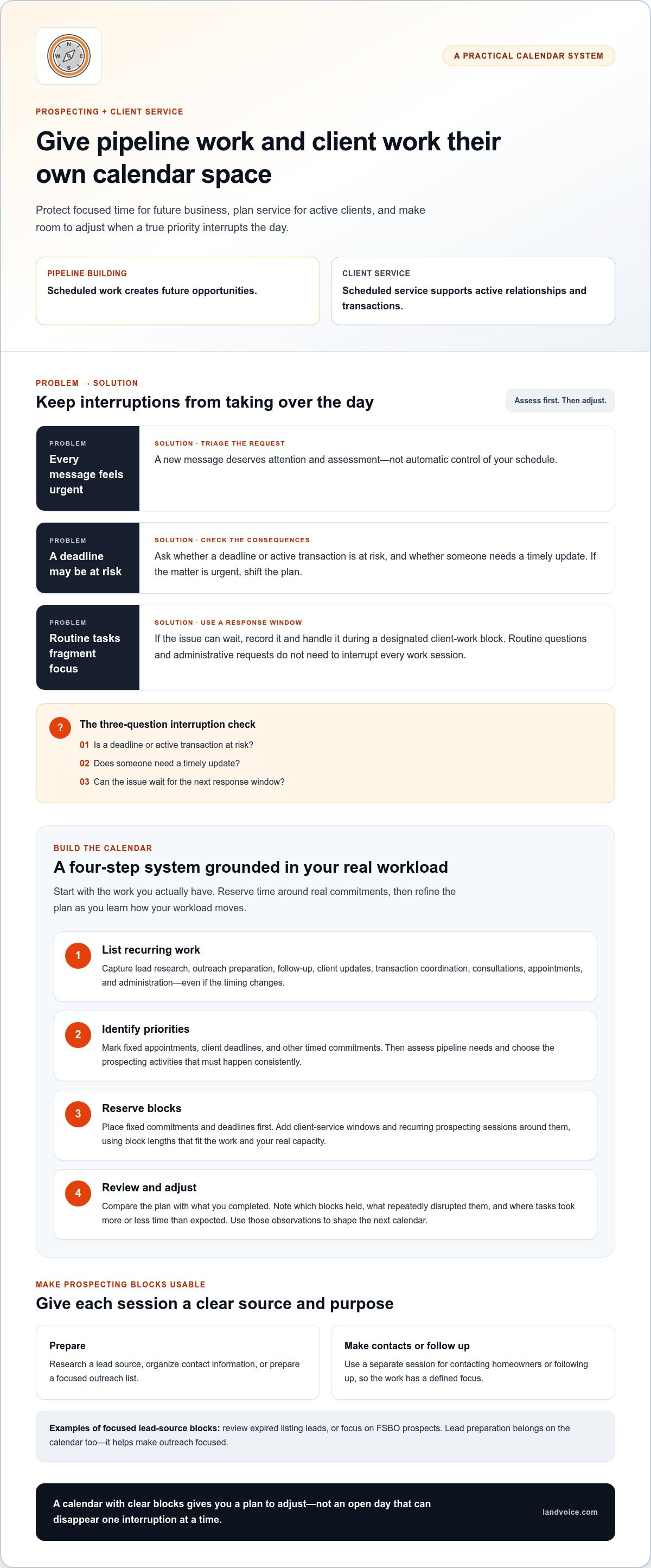
Prospecting time includes the work that helps you identify and connect with potential sellers. That can mean researching a lead source, organizing contact information, preparing a focused outreach list, and contacting homeowners. For example, one block might be dedicated to reviewing expired listing leads, while another focuses on FSBO prospects. Each block has a clear source and purpose, so you can prepare instead of spending the session deciding what to do.
Keep the work grouped by source or activity. Use one session to organize leads and another to make contacts or follow up. That separation reduces task-switching and makes it easier to track whether you completed the work you planned. Prospecting isn’t just the outreach itself; the preparation that makes outreach focused belongs on the calendar too.
What belongs in a client-work block?
Client-work blocks cover planned service for active relationships and transactions: client updates, transaction coordination, consultations, and time-sensitive follow-up. Grouping similar tasks can help you move through them with focus while keeping commitments visible. But planned service is different from an unexpected request. A new message deserves attention and assessment, not automatic control of your entire schedule.
When an interruption arrives, triage it. Ask whether a deadline or active transaction is at risk, whether someone needs a timely update, and whether the issue can wait for your next response window. Urgent matters may require you to shift the plan. Routine questions or administrative requests can often be recorded and handled during a designated client-work block. That’s not neglect; it’s a way to provide consistent care without allowing every notification to fragment the day.
The goal of time blocking for prospecting vs client work isn’t to make your calendar untouchable. It’s to make priorities visible. Protect pipeline activity, reserve real time for client service, and leave room to respond when circumstances genuinely call for a change. A calendar with clear blocks gives you a plan to adjust, rather than an open day that can disappear one interruption at a time.
How to Build a Time-Blocking System Around Your Real Estate Workflow
A workable calendar starts with your actual workload, not an idealized schedule. Build it in sequence: capture the work that repeats, decide what matters most, reserve time for it, then review what happened. This gives prospecting a dependable place without squeezing client commitments into whatever time remains. For a broader overview of effective time management strategies, the University of St. Augustine for Health Sciences also discusses time blocking as one way to organize work.
Use this four-step method to design your first version:
- List recurring work. Include lead research, outreach preparation, follow-up, client updates, transaction coordination, consultations, appointments, and administration. Capture tasks that happen regularly, even if their timing changes.
- Identify priorities. Mark fixed appointments, client deadlines, and other commitments that already have a time attached. Then assess pipeline needs and decide which prospecting activities must happen consistently.
- Reserve blocks. Place fixed commitments and deadlines first. Add client-service windows and recurring prospecting sessions around them, choosing block lengths that fit the work and your real capacity.
- Review results. Compare the plan with what you completed. Note which blocks held, what repeatedly disrupted them, and where tasks took more or less time than expected. Adjust the next calendar instead of judging it by whether every day went perfectly.
A useful calendar reflects your priorities and leaves room for change. It should guide your decisions, not become another rigid standard you can’t meet. Start with a realistic version, then refine it as you learn how your workload moves.
How do you decide when prospecting belongs on the calendar?
Look at your current pipeline needs, upcoming appointments and deadlines, and the parts of your working day when you can focus best. Choose recurring windows you can protect consistently, then test them against real client demands. Build in the supporting work too: preparation, organizing leads, outreach, and follow-up. If a block only allows you to begin, but never complete the workflow, redesign it.
Don’t prescribe a universal hour or copy another agent’s routine. A schedule that fits your commitments and energy is more useful than one that looks perfect on paper. Keep the core window steady long enough to assess it, then shift it if the pattern regularly collides with appointments or leaves you working when your focus is low.
How should you plan client work and response windows?
Group routine updates and administrative follow-up into planned client-service windows, while keeping scheduled appointments and genuine deadlines visible. Decide when you’ll review messages and communicate realistic response expectations clearly, so clients know how to anticipate updates. If a request arrives outside a planned window, assess its urgency and consequences before reshuffling the day. That judgment helps you stay responsive without treating every notification as an emergency.
Use time blocking for prospecting vs client work as a working framework, not a wall between responsibilities. When a genuine priority interrupts a block, move the affected task to a specific open slot and continue with the revised plan. A calendar you review and adapt can protect consistent pipeline activity while making client commitments easier to see and manage.
Prospecting vs. Client Work: Handle Interruptions Without Losing the Day
A client request can deserve immediate attention. But an incoming message isn’t automatically an urgent matter, and treating every interruption as one can erase the prospecting block you worked to protect. The goal isn’t to put pipeline activity ahead of clients. It’s to assess what needs action now, what can be scheduled, and what belongs in your next planned response window.
Compare the two kinds of work by purpose and by the likely cost of delay. Prospecting supports future business, so postponing it repeatedly can weaken the consistency of your pipeline-building routine. Client work supports current relationships and transactions, and some requests may involve a deadline, a transaction milestone, or an immediate client impact. Context matters. A routine question and a time-sensitive issue shouldn’t receive the same response simply because both arrive during a prospecting session.
Use a simple triage framework:
- Act now: The details suggest a deadline, transaction milestone, or meaningful client impact could be affected by waiting. Pause the block and handle the issue.
- Schedule soon: The request needs attention, but the situation appears manageable until a specific upcoming time. Assign it a place on the calendar rather than leaving it in your inbox.
- Return during the next response window: The request is routine and doesn’t appear to require an earlier response. Note it and address it during planned client-service time.
These are decision prompts, not universal rules. Use your knowledge of the client, transaction, and circumstances to judge urgency. If you can’t provide a complete answer right away, a prompt acknowledgment can let the client know you’ve seen the request and when you expect to follow up. Keep that expectation realistic and honor it.
When should a client request interrupt a prospecting block?
Check three things: the deadline, the impact on the client, and any relevant transaction milestone. For example, a question with no immediate deadline may fit the next response window, while an issue tied to an imminent milestone may call for faster attention. The same type of message can have different urgency depending on its context. If the answer needs research or coordination, acknowledge the request and schedule the work rather than letting an unfinished response linger.
How can you recover a block after an interruption?
Once the immediate issue is handled, don’t let the interrupted block vanish from the calendar. Move its unfinished work to a specific open slot, even if that means shifting another flexible task. Record the interruption briefly, such as “transaction question” or “deadline change,” then look for patterns during your weekly review. Repeated disruptions may signal that the block needs a different time or a more realistic buffer.
A smaller backup prospecting window can also help when the original session disappears. Use it for a defined, manageable piece of pipeline work, such as organizing leads or completing follow-up. It won’t always replace the full block, but it gives you a practical recovery option. That’s the value of time blocking for prospecting vs client work: a disruption changes the plan, not the priority of keeping both parts of your business moving.
A Weekly Time-Blocking Routine for Prospecting and Client Service
A useful weekly calendar starts with a clear view of the week ahead. During your review, scan appointments, client commitments, transaction deadlines, pipeline activity, and the time you can realistically work. Then place fixed commitments first and fit prospecting, service, administration, and recovery space around them. The aim isn’t to copy someone else’s schedule. It’s to build a repeatable pattern that fits your business and can flex when priorities shift.
For example, you might reserve an early-week block for prospecting preparation and homeowner outreach, then schedule client updates and transaction coordination in separate windows. Keep appointments visible, assign administration a defined space, and leave an open block where possible for work that runs long or changes unexpectedly. If appointments cluster on certain days, move prospecting to a less crowded window. If a session repeatedly gets cut short, shorten it or split the work across more than one available slot.
There’s no universally correct block length or weekly frequency. Choose a cadence you can maintain alongside your current commitments, then adjust based on what the week shows. A reliable, manageable routine gives you a better starting point than an ambitious calendar that repeatedly goes untouched.
How can you make prospecting blocks easier to start?
Remove the “what should I do first?” pause before the block begins. Prepare a short task list and choose the lead source in advance. For instance, you could organize FSBO lead information before a session, then use the scheduled time to review targets, make contacts, and record follow-up tasks. Define completion by actions you control, such as finishing the planned research or completing the outreach list, not by promised appointments or listings.
Keep the task list specific enough to start immediately. “Work on prospecting” can feel open-ended; “review this lead group, contact the selected homeowners, and note next steps” gives the session a clear finish line. Adjust the list to fit the time actually available.
How should you review and improve the schedule?
At week’s end, compare the calendar with the work completed. Note which blocks held, which moved, and what repeatedly caused changes. Then use a simple scorecard: prospecting sessions completed, follow-ups completed, and client commitments met. If prospecting keeps colliding with appointments, move it based on that pattern. If client work consistently overruns its window, revise the block or leave more recovery space. Change the calendar based on evidence, not guilt or guesswork.
This review turns time blocking for prospecting vs client work into a working system rather than a fixed template. Keep the parts that serve you, shift the parts that don’t, and carry unfinished priorities into a specific slot for the coming week.
Make Time Blocking Work With Consistent Prospecting Support
A calendar creates structure, but a repeatable prospecting workflow helps you use the time you’ve protected. Keep the core principle in view: schedule pipeline-building deliberately, and serve current clients through planned, responsive workflows. Your calendar should support both. Lead tools can reduce the setup friction of a prospecting session by keeping lead information and progress organized, but they don’t replace your judgment or guarantee appointments or listings.
Landvoice provides real estate lead data and prospecting tools, including lead-management and prospecting-progress features. An agent can use lead data to prepare a focused block around a chosen source, then decide which prospects to prioritize, how to approach them, and what follow-up makes sense. That keeps the workflow organized while leaving the decisions where they belong: with you.
Where can lead tools fit into a prospecting block?
Use tools before and during the session to make the work clear. Before the block, select a lead source and organize the information you plan to work with. During the block, focus on researching, contacting homeowners, and recording next steps. Tracking progress can help you see what activity you completed and what follow-up remains, so the next session has a defined starting point instead of another round of setup.
Keep your prospecting process connected to client service. A lead tool can support access to information and help you manage activity, but it can’t decide which client request deserves attention or how you should handle a conversation. You set those priorities. Protecting a block means creating the conditions for focused work, not switching off your professional judgment.
What is the next step toward a more consistent routine?
Start by mapping your current weekly commitments. Mark appointments, client deadlines, recurring service tasks, and the prospecting activity you want to complete. Then choose one block you can protect without forcing the rest of the week into an unrealistic pattern. Give it a specific purpose, such as preparing one lead source, contacting homeowners, or completing planned follow-up.
After the block, review what happened. Did you start promptly? Which tasks did you complete? What interrupted the session, and what should move to the next one? Use those observations to adjust the timing, length, or preparation for the following week. That’s a practical way to make time blocking for prospecting vs client work fit your actual workflow, rather than treating the calendar as a fixed template.
Test one protected block, review the result, and build from there. For a closer look at how prospecting tools can support an organized routine, explore a workflow demonstration.
Put Your Next Prospecting Block on the Calendar
Your calendar doesn’t need to be perfect before you begin. Choose one prospecting block for the coming week, give it a clear purpose, and treat it as a real business commitment. Then use the week’s experience to refine your approach. That first protected session can turn time blocking for prospecting vs client work from an idea into a routine you can improve over time.
Support that routine with an organized workflow. Landvoice has served real estate professionals since 1991, offering lead data and prospecting tools that can help keep lead work organized. Your judgment still guides how you contact homeowners, follow up, and balance prospecting with client needs.
Protect the time, do the work, and adjust with purpose. Consistent action gives you a stronger foundation for the business you’re building.
Frequently Asked Questions
How many hours a week should a real estate agent spend prospecting?
There’s no universal number of prospecting hours that fits every agent. Set a starting point by weighing your pipeline goals, current client commitments, available work hours, and recent activity. If you’re unsure, choose recurring blocks you can sustain through a busy week, then track whether you completed them. During your weekly review, adjust the schedule based on what actually happened, not on an assumed quota for leads, appointments, or listings.
Should prospecting come before client work on an agent’s calendar?
Neither should automatically come first; your calendar needs to reflect both future-business activity and existing obligations. Add fixed appointments and deadlines, then protect recurring prospecting periods and planned response windows around them. If a client matter is genuinely time-sensitive, it may take priority. Routine requests can often wait for a scheduled window. The right sequence depends on your commitments that week, so use the calendar to make trade-offs visible before the day gets busy.
Can you time block when real estate work is unpredictable?
Yes. Treat the calendar as a flexible framework, not a script that predicts every workday. Recurring prospecting sessions and client-response windows create structure, while open recovery periods give you room for work that runs long or arrives unexpectedly. If a showing or transaction issue displaces a task, assign it a named slot instead of leaving it on an unscheduled list. Review recurring disruptions weekly and use those patterns to adjust future blocks.
What should you do if a client contacts you during a prospecting block?
Assess the deadline and likely impact on the client before switching tasks. If the matter needs prompt attention, handle it and put the interrupted prospecting task into a specific replacement slot. For a routine request, acknowledge receipt if appropriate, then respond during your next planned window. Clear communication expectations can reduce uncertainty about follow-up. Use your knowledge of the client and situation; a single rule won’t fit every message or transaction.
Is time blocking better than using a to-do list for real estate prospecting?
They serve different purposes and can work together. A to-do list captures tasks; calendar blocks reserve time to complete selected priorities. For example, keep a short list of prospects to research, then schedule a session to work through it and record follow-ups. Neither approach guarantees productivity on its own. Make the plan realistic, review what got done, and adapt it when client needs or appointments change. Use whichever format makes your next action clear.
How do you stay consistent with prospecting when your schedule changes?
Choose recurring blocks, prepare the next session’s task list in advance, and keep a backup window available for disrupted days. Track whether each planned session happened and note the reason if it moved, such as an appointment running over or a deadline changing. Reschedule missed work instead of treating one interruption as a reason to drop the routine. Keep the system manageable, then refine it using patterns from your actual weeks.
