



by Bruce Keith, on October 10, 2026
What if the best way to make clients feel supported isn’t replying instantly, but making sure they know when and how you’ll respond? Setting client expectations for communication early can prevent the familiar tension of unanswered texts, mismatched channel preferences, and uncertainty about what happens next. Clear agreements build trust without making you available at every hour.
You already know communication can shape how clients experience a transaction. A quick update at the right moment can reassure them, while silence around an important milestone can leave them guessing. The answer isn’t sending more messages or promising constant access. It’s creating a dependable plan together from the first conversation.
This guide will help you agree on preferred channels, realistic response times, and an update cadence clients can count on. You’ll also learn how to explain milestones and next steps clearly, so clients stay informed without unnecessary check-ins. Set expectations with confidence, protect your focused work time, and give every client a reliable communication experience from first conversation through closing.
Key Takeaways
- Setting client expectations for communication starts with agreeing on channels, response windows, update frequency, and next steps.
- Use a simple ask, agree, document, confirm, and revisit process to make your communication plan easy to follow.
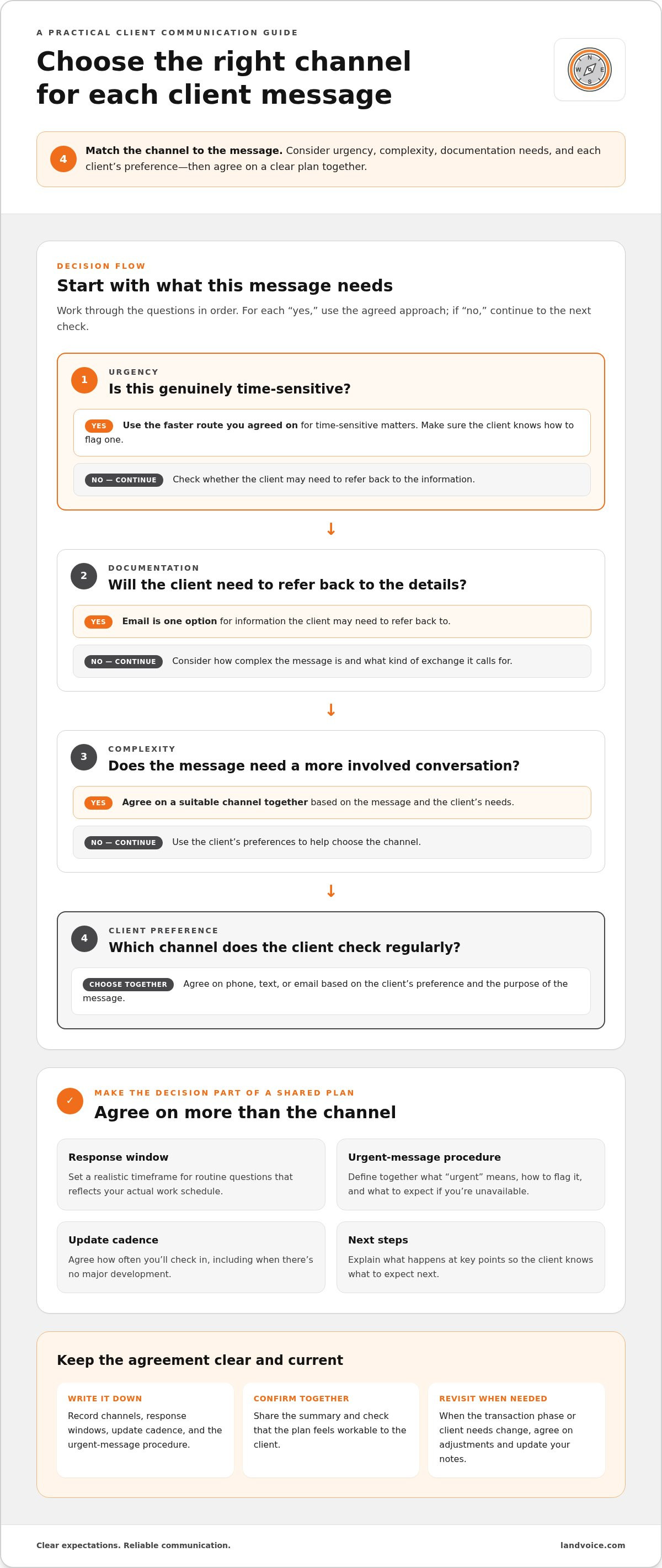
- Match the channel to the message: consider urgency, complexity, documentation needs, and each client’s preference.
- When plans shift, acknowledge the change, explain what happened, reset the timeline, and follow through on the new commitment.
- Build reliable client updates into your workflow so active transactions stay organized while you protect time for future pipeline development.
Why setting client expectations for communication matters in real estate
Unclear communication expectations can create friction even when you’re working diligently. You might be coordinating a showing, waiting for a document, or handling another client’s urgent need. Meanwhile, your client may see a quiet inbox and wonder whether their question was missed. The problem isn’t always a lack of effort. Often, you and your client simply have different assumptions about what a reply or update should look like.
Setting client expectations for communication means agreeing on how you’ll stay in touch, when clients can expect a response, how often you’ll provide updates, and what happens next at key points. These agreements give both sides a shared reference point. They also make it easier to distinguish a routine question from a time-sensitive matter, without suggesting that you’re available instantly at every hour.
A client communication plan is a shared agreement about channels, response timing, update frequency, and next steps throughout the working relationship.
That agreement matters because people interpret communication through expectations they already hold. The discussion of Interpersonal Communication and Expectations explores how expectations influence interactions and how new expectations can be established. In practice, a simple conversation at the start can replace guesswork with a predictable process. You’re not setting up barriers. You’re showing clients what support looks like and giving them a clear way to get it.
What clients need to know from the start
Make the basics specific. Tell clients whether phone, text, or email is best for different kinds of messages, and explain how to flag something time-sensitive. Set a realistic response window for routine questions based on your actual schedule, then explain what clients should do if an issue can’t wait. Also describe how you’ll keep them updated when there’s no major development, such as sending a brief check-in at an agreed point rather than leaving them to wonder.
How unclear expectations affect the working relationship
Silence can mean “I’m handling it” to you and “I’ve been forgotten” to a client. That gap can weaken confidence even when the transaction is moving forward. Reliable responsiveness doesn’t mean being available around the clock. It means acknowledging messages within the agreed window, communicating when timing changes, and following through on promised updates. Explain this early as a reassurance: clients know how to reach you and what to expect, while you can protect time to do the work well.
Keep the conversation collaborative. Ask what helps the client feel informed, then explain the communication rhythm you can consistently maintain. A client may prefer frequent brief check-ins; another may want updates only at meaningful milestones. Agreeing on a workable approach prevents mismatched assumptions from becoming a source of tension. Clarity is not a rigid rulebook. It’s a professional commitment both sides can rely on from the first conversation through closing.
Build a communication plan clients can understand and follow
A useful plan shouldn’t sound like a policy manual. It should turn your conversation with each client into a clear, workable agreement. Use five steps: ask, agree, document, confirm, and revisit. This approach to setting client expectations for communication gives you a repeatable framework while leaving room to adapt it to the client, transaction, and changing priorities.
Ask what works, agree on a realistic approach, write it down, confirm you’re aligned, and revisit the plan when circumstances change.
- Ask. Find out how the client prefers to communicate and what helps them feel informed. Ask which channels they check regularly, how they like to receive important details, and whether past experiences have shaped their expectations. Listen before recommending a routine.
- Agree. Match channels and response windows to the kinds of messages you’ll exchange. For example, you might use email for information the client may need to refer back to, and agree on a faster route for genuinely time-sensitive matters. Define what “urgent” means together.
- Document. Record the preferences, expected response windows, update cadence, and urgent-message procedure in a welcome message or onboarding notes. A written summary gives both of you one reliable reference instead of relying on memory.
- Confirm. Send the summary to the client and invite them to correct anything that doesn’t fit. A simple “Does this feel workable?” can reveal a mismatch before it becomes frustration. Make sure the client understands what to do if a message needs a faster response.
- Revisit. Check whether the plan still works when the transaction enters a new phase or the client’s needs change. Adjust the cadence or channel by agreement, then update your notes so the new approach is clear.
Agree on channels, response windows, and urgent messages
Be specific without promising more than you can consistently deliver. A response window should reflect your real work schedule, not an ideal day with no appointments or competing client needs. Discuss how the client should flag time-sensitive questions and what to expect if you’re unavailable. Practical guidance on Client Communication Best Practices also emphasizes setting expectations early and choosing channels with purpose.
Set an update rhythm and record the agreement
Choose a cadence that fits the transaction. You might agree to check in after a defined milestone or send a short status note at a regular point, even when there’s no major news. Tell the client what those updates will cover. Keep the plan flexible, and invite concerns before assumptions take hold. A clear, shared routine is more useful than a rigid script.
Strong systems matter beyond client messaging, too. If you’re organizing prospecting and follow-up alongside active transactions, explore a demo of tools that support lead management.
Choose the right communication approach for each client and milestone
The right channel depends on what the client needs to understand, how quickly they need it, and whether they’ll want to refer back to the details. A quick scheduling confirmation and a complicated transaction update shouldn’t automatically get the same treatment. Use the client’s preferences as your starting point, then match the channel to the message. That’s how setting client expectations for communication becomes practical in the flow of a transaction.
Match the channel to the message
Use text for concise coordination when the client prefers it. Phone calls work well when a topic is complex, emotional, or likely to prompt questions that are easier to address in conversation. Email is useful for detailed explanations, summaries, and information the client may need to revisit. Respect preferences, but document important decisions in writing even if you first discuss them by phone.
| Message purpose | Useful channel | Why it fits |
|---|---|---|
| Brief scheduling detail | Text or the client’s preferred channel | It keeps simple coordination direct and easy to act on. |
| Complex update or concern | Phone, followed by a written recap when helpful | A conversation allows clarification; a summary can preserve key points. |
| Detailed information or next steps | The client can review the details and refer back to them. | |
| Time-sensitive issue | The agreed urgent channel | Using the route established together reduces uncertainty about where to look. |
Treat the table as a decision aid, not a fixed script. If the client prefers calls, you can still send a concise written recap after a substantive conversation. If they prefer email, make clear how urgent matters should reach you. The goal is to honor their preference while ensuring the message is clear and useful.
Adjust cadence to the client relationship and transaction
The core commitment to clear, dependable service stays steady, but the information clients need changes as a transaction moves forward. Separate routine check-ins from milestone updates: agree on a regular status rhythm, then communicate when a meaningful next step occurs. Ask whether the client prefers a brief summary or more context. Tailor the detail to their comfort and the decision at hand.
Client context matters from the first conversation. A seller managing their own sale may need a different opening discussion than a client with a different transaction path. Use questions to understand what they already know, what they’re concerned about, and how they want information presented. For background on this seller context, see these FSBO lead resources. Then shape your communication to the person, not to an assumption about the category.
Before each significant milestone, consider what the client needs to know now, what may require a conversation, and what should be easy to revisit later. That quick check keeps your updates relevant, protects against information overload, and helps clients stay oriented as the transaction progresses.
Keep communication expectations on track when plans change
A communication plan is only useful if it holds up when schedules shift. A promised update may take longer because a transaction milestone moved, a response window may be missed during a demanding day, or a client may not see a message in the channel you expected. Don’t let the gap create a second problem. Address it directly, explain what happens next, and make the revised plan easy to follow.
Use a simple recovery sequence:
- Acknowledge the missed update or changed timing without blaming the client or hiding the gap.
- Explain what has changed and share only the context the client needs to understand the impact.
- Reset the timeline with a realistic day, time, or next milestone rather than a vague promise to follow up soon.
- Follow through using the agreed channel, even if the update is that there’s no new development yet.
This sequence restores clarity and gives the client a dependable next step. It also keeps the focus on the communication system, not on excuses or a rehearsed script. If the revised timing changes the next expected update, say so plainly and update your notes.
Reset expectations after a delay or missed message
Start by recognizing the gap, then identify the next useful action. For example, if a promised status update needs to move, tell the client when you’ll provide it and where they should look for it. Avoid “I’ll get back to you soon.” Instead, name a realistic time or milestone. Check that the client knows which channel will carry the update, especially if you’re switching from a call to email.
Confirm understanding without making the client responsible for the breakdown. Ask a neutral question such as, “Did that update reach you, and is this still the best channel for the next one?” If they missed a message, resend or summarize the key information through the agreed route. The aim is to close the loop, not to prove who should have noticed the original message.
Revisit the plan as circumstances evolve
Client availability, communication preferences, and transaction pace can all change. Schedule a brief check-in when you notice a shift, then ask whether the current rhythm still works. If the routine materially changes, revise the written agreement so both of you have the same reference point. Keep urgent developments distinct from routine status updates, and make clear which channel to use for each.
Consistency doesn’t mean sending the same type of message at every stage. A milestone may call for a timely explanation, while a quieter stretch may need a concise status note. Tell clients what has changed, what remains on track, and when they can expect to hear from you again. This is how setting client expectations for communication stays useful throughout the relationship, not just during onboarding.
Make consistent client communication part of a stronger real estate workflow
Clear agreements work best when they’re supported by a workflow you can maintain during a packed week. A client may need a reply, another transaction may reach a key milestone, and prospecting still needs attention. If every follow-up depends on memory, commitments can slip. Build reminders and next steps into the system you already use, so staying responsive doesn’t rely on keeping every detail in your head.
Use simple systems to support follow-through
After a client conversation, record the next action, who owns it, and when it’s due. Keep client commitments distinct from prospecting tasks. A note to send a transaction update belongs in the active-client workflow; a reminder to follow up with a homeowner belongs in your future-pipeline workflow. Lead-management tools can help organize prospecting activity and maintain visibility into follow-up, but they don’t replace your judgment or serve as a client-messaging plan.
Keep the workflow practical. Use reminders for promised updates, milestone check-ins, and unanswered client questions. Review the task list at a regular point in your workday and adjust priorities when something changes. For instance, if a transaction event shifts, update the related task and notify the client through the agreed channel. This links your internal follow-through to the communication plan without sending clients unnecessary messages.
Prospecting is a separate, ongoing effort to build future conversations, not a substitute for serving current clients. If you’re organizing outreach by seller context, expired listing leads are one example of a source that may inform your prospecting workflow. Keep those outreach tasks in their own lane, so active-client commitments remain visible and protected.
Put the communication plan into action
Make the agreement easy to find and easy to use. For each client, keep a concise record of:
- The preferred channel for routine messages and detailed updates.
- The agreed response window and how to flag an urgent matter.
- The expected cadence for routine check-ins and milestone updates.
- The next communication commitment and any change agreed along the way.
Review the arrangement at meaningful milestones, not just when there’s a problem. A brief check-in can show whether the update rhythm still feels useful or whether the client wants shorter summaries, more context, or a different channel. Make adjustments together and update your notes, so the new plan is clear to both of you.
That’s the practical value of setting client expectations for communication: clients know what to expect, and you have a repeatable process for delivering on it. Keep active-client service and pipeline development organized side by side, without confusing one for the other.
Make clear communication your professional standard
Every client relationship gives you a chance to show what dependable service feels like. Make setting client expectations for communication part of your regular business practice, then keep refining how you deliver on those commitments. Small, consistent actions can strengthen confidence long after a single transaction ends.
That same commitment to steady progress applies to building your future business. Landvoice has served real estate professionals since 1991, supporting agents as they develop their prospecting workflows. Keep your client service and pipeline goals moving forward with a process you can sustain.
Set your standard, follow through, and keep building the kind of client relationships that support lasting success.
Frequently Asked Questions
How early should a real estate agent set communication expectations?
Discuss communication preferences during your first substantive client conversation, before recurring updates begin. Agree on which channels to use, realistic response windows, how often you’ll check in, and what to do with urgent messages. Then send a brief written recap so the client can refer back to it. Revisit the arrangement if the transaction pace, client availability, or communication needs change. Early clarity gives you both a practical starting point.
How quickly should a real estate agent respond to client messages?
There’s no single response time that fits every agent, client, or situation. Set a realistic window you can maintain and explain how routine questions differ from urgent matters. If you can’t provide a full answer within that window, acknowledge the message and give a useful time for your next update. For example, let the client know you’re reviewing a detail and when you expect to follow up. Consistency matters more than promising instant replies.
Should real estate agents text clients or email them?
Choose based on urgency, complexity, client preference, and whether the details should be easy to revisit. Text can work for brief coordination, while email can preserve a fuller explanation or a list of next steps. A nuanced concern may be easier to explore in a conversation, followed by a written recap if needed. Agree on channel use together rather than relying on one method for every message. The right mix keeps communication clear and accessible.
What should an agent do when a client expects replies after hours?
Acknowledge the client’s preference, but don’t promise constant availability if you can’t provide it. Explain when you typically respond to routine messages and agree on a separate way to flag genuinely time-sensitive issues. Be specific about what happens next, such as whether you’ll respond during your next working period or use the agreed urgent channel. A supportive boundary helps clients understand how to reach you without creating an expectation of immediate access at all hours.
How often should agents update clients when there is no news?
Agree on a predictable check-in rhythm, even during a quiet stretch. The right cadence depends on the client and the transaction, so ask what helps them feel informed without overwhelming them. A brief note can say that there’s no material change, confirm what you’re monitoring, and identify when they should expect the next update. That small touchpoint gives clients a clear reference for the period ahead instead of leaving them to guess whether anything is happening.
What if a client does not respond to an important message?
Follow the contact path you agreed on, allow a reasonable interval, and try another agreed channel if appropriate. Make your follow-up easy to act on by stating what information or decision you need and whether a next step depends on it. Keep a clear record of your outreach. Don’t assume a sent message was seen or understood. If you reach the client another way, briefly restate the key point so they have the context in one place.
Can communication expectations change during a real estate transaction?
Yes. Client schedules, preferences, and transaction pace can shift, so the original arrangement may need an update. Raise the change directly and agree on any revised channel or check-in cadence. Then summarize the adjustment in writing, including what the client should expect next. For example, if a new phase calls for more frequent status notes, agree on that change together. Flexibility works best when both of you understand the updated plan and when it takes effect.
