



by Bruce Keith, on November 27, 2026
Cash reserves matter, but they cannot protect a real estate business on their own. Building a recession-proof real estate business means preparing your cash, credit, marketing, and operations before a downturn pressures revenue. Markets move in cycles. The advantage comes from making deliberate decisions while you still have room to act.
This guide explains how to strengthen your business for tougher conditions without relying on a single safety net. You’ll learn how to choose markets with resilient fundamentals, build cash reserves and available credit, limit leverage, and keep marketing and follow-up consistent. You’ll also learn to plan around business cycles and manage expenses so you can respond with more control when conditions change. The goal is not to predict the next downturn, but to build a business with stronger foundations and practical options when the market shifts.
Key Takeaways
- Keep marketing and follow-up consistent, and build repeatable systems that help you stay connected with prospects and clients.
- Assess locations by population, employment, and wage growth to spot stronger underlying demand.
- Build cash reserves and preserve access to credit so you can manage vacancies, maintenance, and slower revenue.
- Review loan terms and stress-test your finances against falling property values before taking on more debt.
- Plan for market cycles by controlling expenses and making business decisions with enough time and flexibility to adapt.
Systems for marketing, follow-up, and operations
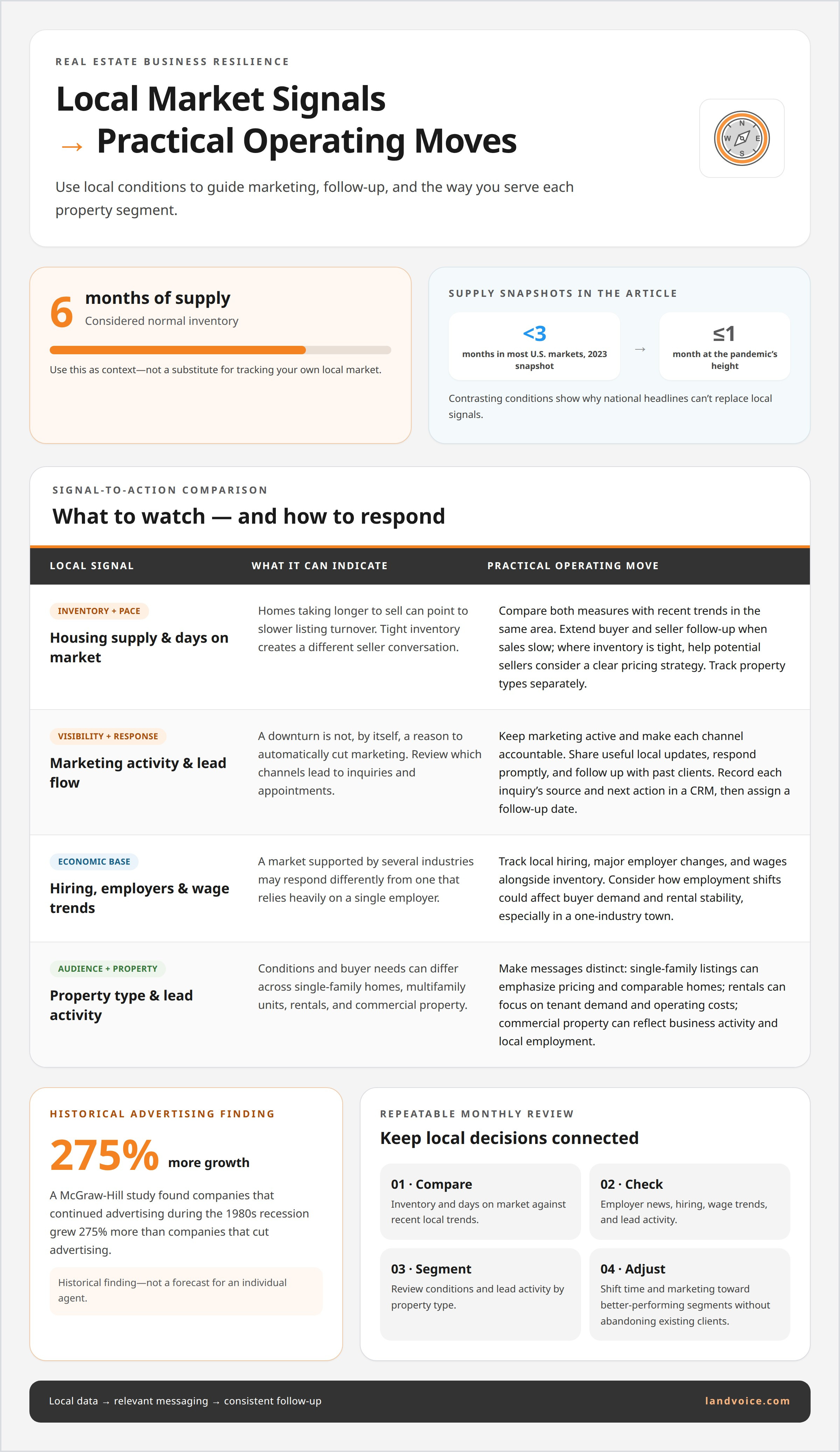
Recession strategies depend on local inventory, days on market, employment diversity, and property type. Track these signals systematically, then adjust your marketing and follow-up to match the conditions you observe.
-
Track local inventory and days on market
Review local housing inventory and days on market regularly, then compare both with recent trends in the same area. Six months of housing supply is considered normal inventory; a 2023 snapshot showed supply below three months in most U.S. markets. During the pandemic’s height, supply reached one month or less. These contrasting conditions show why national headlines can’t replace local market signals.
Use the data to guide practical decisions. If homes are taking longer to sell, plan for slower listing turnover and extend follow-up with buyers and sellers. If inventory is tight, identify areas where potential sellers may need a clear pricing strategy. Track property types separately, since conditions for single-family homes may differ from those for multifamily units.
-
Adapt marketing to economic downturns
Keep marketing active during a downturn, but make each channel accountable. Schedule useful market updates, timely responses to inquiries, and follow-up with past clients. For example, a monthly neighborhood update can explain changes in inventory, asking prices, and days on market using local data. Review inquiries and appointments by channel to focus effort where it leads to real conversations.
Don’t treat marketing as an expense to cut automatically when revenue slows. A McGraw-Hill study found companies that continued advertising during the 1980s recession grew 275% more than companies that cut advertising. That historical finding isn’t a forecast for an individual agent, but it supports keeping visibility in the plan. Use social platforms, relevant property-listing sites, and consistent client communication to maintain presence.
Connect marketing with follow-up operations. Record each inquiry, its source, and the next action in a CRM, then assign a follow-up date. This helps keep prospects from disappearing between an online response and a conversation. Review the workflow regularly and remove steps that delay a useful response.
-
Tailor strategies to markets and property types
Match your operating plan to the local employment base and the property types you serve. A market supported by several industries may respond differently from one that relies heavily on a single employer. Track local hiring, major employer changes, and wage trends alongside inventory. In a one-industry town, employment shifts may affect buyer demand and rental stability more directly.
Adapt your message to the property type. For a single-family listing, emphasize pricing and comparable homes; for a rental, focus on tenant demand and operating costs. Commercial property may depend more on business activity and local employment. In luxury residential niches, platforms like brianliberto.com demonstrate how advisors tailor positioning and market insights to high-net-worth clients. Keep marketing messages and follow-up sequences distinct for each audience, and revise them as local conditions change.
Use these signals to create a repeatable review process. Each month, compare inventory, days on market, employer news, and lead activity by property type. If one segment slows, shift your time and marketing toward better-performing segments without abandoning existing clients. This keeps operations responsive to local conditions instead of dependent on a single property category.
Choosing locations with population, employment, and wage growth
Choose markets using durable local demand signals, not headlines or recent price gains alone. Compare population, employment, and wage growth, then assess how each supports the property type you plan to serve.
- Compare population trends across candidate locations. Focus on places where population is growing, since additional residents can support housing demand. Look beyond citywide figures: compare neighborhoods and nearby communities to see where households are settling. Growth can be uneven, so local patterns matter when choosing where to invest or build your real estate business.
Ask what is drawing people to an area. New residents may need rentals, starter homes, or larger properties, depending on their circumstances. Compare available housing with those needs. If population growth appears concentrated in one part of a metro area, consider whether your property type and operations fit that submarket instead of assuming demand extends everywhere.
- Test employment growth and industry diversity. Expanding employment can support housing demand, but the mix of employers matters too. Review which industries anchor the local economy and whether hiring is spread across multiple sectors. A town dependent on one major employer faces a different risk profile from a market with a broader employment base.
Look for signs that jobs are expanding across the area, not only at one prominent company. Consider how a shift in that employer’s activity could affect renters, buyers, and local businesses. Pair employment trends with population movement: job growth without corresponding resident growth may signal different housing needs from a place attracting both workers and households.
- Evaluate wage growth against housing demand. Growing wages can indicate that local workers have greater capacity to afford housing, while stagnant wages may constrain what residents can pay. Compare wage trends with the homes or rentals you are considering. The goal is to understand whether local income patterns support demand for that property type, not to assume higher wages automatically mean higher returns.
Use a consistent review process before choosing a location. Compare population, employment, and wage trends, then consider how interest rates or a local employer slowdown could change demand. Revisit the same indicators as conditions shift. This gives you a clearer basis for choosing markets and avoids relying on a single attractive metric.
For a more focused way to connect neighborhood research with your prospecting workflow, explore the demo.
Preparing cash and available credit for a downturn
Build a cash plan around the obligations your real estate investments must meet, even when income slows. Separate operating cash, emergency reserves, and available credit so each has a defined role.
- Map essential expenses and expected cash flow. List recurring obligations, including mortgage payments, property taxes, insurance, utilities, and routine maintenance. Then compare expected income with payments due. For a rental property, model a vacancy alongside normal expenses; for an agent, account for periods when transactions take longer to close. Cash-flow mismanagement is cited as the reason 82% of small businesses fail, so track incoming and outgoing payments rather than relying on the account balance alone.
Use a cash-flow management system to organize invoices, payment dates, and operating expenses in one view. Review the figures regularly and update estimates when rent, maintenance needs, or transaction timing changes. Clear records help you spot a shortfall early, before it forces a rushed decision about borrowing or delaying an essential payment.
- Build reserves for specific risks. Set aside cash for unexpected vacancies, repairs, and economic slowdowns. Estimate likely property obligations from your own records, then prioritize essential costs over discretionary spending. A landlord with a vacant unit, for example, still needs a plan for mortgage payments and necessary repairs while finding a new tenant.
Keep reserve funds separate from money intended for expansion or another investment. This makes it easier to see what remains available for emergencies. Revisit the plan when property expenses change, and do not treat projected rent or a pending commission as cash already on hand.
- Protect access to credit before conditions tighten. Review available credit while your finances are stable, including its terms, repayment schedule, and borrowing cost. Credit can provide another source of liquidity, but it also creates an obligation. Compare that cost with available cash before using credit to cover a temporary gap, and avoid relying on high-interest borrowing for recurring expenses.
For rental properties, identify loans coming due within the next year or two. A downturn can tighten lending, so plan ahead for upcoming maturities and payments. Put each loan’s due date and required payment in your cash-flow calendar, then consider how a slower leasing period could affect your ability to repay.
- Set financial priorities and adjust them as conditions change. Write measurable goals for reserves, debt payments, and operating costs, then compare actual results with your budget. If income falls, protect essential property operations first and pause spending that does not support revenue or tenant needs. If cash flow improves, decide in advance whether extra funds will strengthen reserves or reduce costly debt.
This process ties investment decisions to liquidity rather than optimism. A documented budget shows which expenses can change and which obligations remain fixed. Update it when rents, maintenance, or loan terms change, and use the figures to make deliberate decisions instead of reacting to a sudden cash squeeze.
Avoiding excessive leverage
Debt can magnify returns, but it can also strain cash flow when property values or income fall. Stress-test each loan before taking on more leverage, and make repayment capacity a priority.
- Model a property-value decline before borrowing. Test whether you could manage a 20% drop in value without needing to sell under pressure. Compare the lower estimated value with the outstanding loan, expected income, and costs that continue regardless of market conditions. This scenario helps reveal how much room your investment has to absorb a downturn.
Loans at 80% loan-to-value or less would avoid being underwater in the stated scenario where property values fall 20%. Treat that as a stress-test reference, not a guarantee against other risks. Buyers and owners should also consider whether they could keep making payments if rent or transaction income weakened.
- Review loan structures before committing. Compare the payment schedule, interest rate, and loan term with the property’s expected income and operating costs. A payment that fits in strong market conditions may leave little flexibility if vacancies rise or repairs become necessary. Identify the point at which income would no longer comfortably cover debt service and essential expenses.
For existing loans, assess whether refinancing could secure a more favorable interest rate or shorter term. Compare the revised payment and total repayment obligations with the property’s cash flow. A shorter term may reduce the time spent carrying debt, but the payment still needs to fit your operating plan.
- Prioritize high-interest debt and protect operating flexibility. List outstanding loans by interest cost and payment obligation, then direct available funds toward reducing expensive debt while preserving cash for essential operations. Paying down high-interest debt can help landlords maintain positive cash flow in challenging market conditions. Avoid using every available dollar to reduce principal if that leaves the property exposed to a vacancy or urgent repair.
For example, a rental property owner can compare the cost of high-interest borrowing with routine property expenses. If debt payments consume too much income, additional borrowing can compound the pressure. Set a clear limit on new debt based on the property’s ability to support payments in slower conditions.
- Reassess leverage whenever the investment changes. Review debt exposure when refinancing, buying another property, or taking on a major renovation with experienced teams like Swiss Build Ltd. Recalculate the loan-to-value position using a lower property-value estimate, then compare required payments with realistic income. A deal that works only if prices rise or every unit stays occupied leaves little room for disruption.
Before expanding, consider whether you could hold the property through a slower sales period rather than depend on a quick exit. Lower leverage gives you more flexibility to manage the asset, adjust expenses, and avoid selling solely to meet immediate debt obligations.
Understanding real estate and business cycles
Models with diversified income and manageable debt are better positioned to withstand changing conditions. Recession risks include weaker cash flow, lower property values, and longer sales timelines. Find distressed properties through local market research, then assess condition, ownership costs, and financing before committing.
- Use past price movements to challenge assumptions. According to University of Reading, US nationwide property prices rose by over 61% between 2000 and 2005, then fell 38% in the following four years. That shift shows why recent appreciation alone can’t support a sound investment decision. Compare current assumptions with possible declines, slower sales, and the income needed to hold a property.
Build a decision plan around your cash flow and time horizon. A property could take one, two, or three years to sell for the desired price after values begin to fall. Consider whether you could continue covering its costs during that period instead of depending on a quick resale.
- Choose a business model for resilience, not just upside. No single model performs best in every recession. Varied income sources and manageable obligations can reduce dependence on one rent stream or transaction type. For example, a property owner might assess whether furnished rentals, income from unused space, or add-on features fit local demand and operating capacity.
Compare each option’s costs, likely demand, and management requirements before changing your model. A furnished rental may require different operations from a long-term tenancy. Keep the decision tied to local employment and wage trends, which can influence renters’ budgets and buyers’ ability to transact.
- Account for risks before pursuing distressed properties. Lower asking prices do not remove the risks of weaker demand, repair needs, or tighter financing. Research distressed opportunities through local listings and market activity, then assess the property’s condition, ownership costs, and expected income. Compare your findings with financing terms and available cash before making an offer.
Stress-test the purchase against a decline in value and a longer holding period. If the property needs repairs, account for their effect on cash flow and the time required before it can earn income. Do not base a decision on a discount alone; total ownership costs matter.
- Track cycle signals and competition before changing course. Review local trends in prices, rents, listings, and days on market alongside employment conditions. A slowing market may affect property types differently, so separate your analysis by neighborhood and asset class. Use the findings to adjust pricing, marketing, or acquisition plans instead of reacting to a national headline.
Set regular review points for your assumptions and compare actual income with your plan. If sales take longer or rental demand softens, revisit expected holding costs and debt obligations. This cycle-aware process helps you make deliberate moves while preserving flexibility as market conditions change.
Landvoice
Landvoice supports real estate professionals who want to maintain a steady prospecting pipeline as markets shift. Options include Expired Pro, FSBO Leads, FRBO Leads, and Pre-Foreclosure Leads, giving agents different homeowner segments to work with. These tools can fit when you’re strengthening listing outreach alongside cash reserves, disciplined spending, and careful market planning. Use the lead sources that align with your prospecting strategy and follow-up process, rather than relying on a single channel to sustain business activity. To discuss how Landvoice can support your outreach, contact Landvoice.
Put your next growth move into action
Building a recession-proof real estate business is an ongoing discipline, not a one-time plan. Keep refining how you attract listing opportunities and stay connected with homeowners as conditions evolve. A consistent prospecting routine gives you a practical way to pursue new business, even when transactions take longer.
Landvoice offers Expired Pro, FSBO Leads, and FRBO Leads to support agents’ listing prospecting. Choose lead sources that fit your approach, then pair them with focused follow-up and a clear operating plan. The next step is to put a reliable pipeline within reach.
Take the next step with purpose. Consistent action today can help you stay ready for changing markets tomorrow.
Frequently Asked Questions
What makes a real estate business recession-resistant?
Building a recession-proof real estate business starts with adapting when transactions slow. For example, an agent can maintain relationships with past clients while developing listing opportunities through multiple prospecting channels. Investors can assess whether different property types or income streams suit their capacity. Clear performance measures help identify which activities generate useful conversations and which consume time without supporting business goals.
How should real estate businesses manage debt, reserves, and cash flow before a recession?
Give every dollar a defined role before market conditions tighten. For building a recession-proof real estate business, separate operating funds from money earmarked for expansion, and track loan payments alongside expected income. If a commission is delayed, a payment calendar can show which obligations remain due and which planned expenses can wait. Review credit terms while finances are stable, and don’t treat available credit as income or a substitute for repayment planning.
How do mortgage rates, unemployment, and home prices affect real estate businesses during recessions?
These factors can change buyer demand, property values, and the time needed to close a transaction. Higher mortgage rates can reduce what some buyers can afford, while rising unemployment may weaken demand or increase rental-payment pressure. Falling home prices can reduce owners’ equity and affect refinancing options. Building a recession-proof real estate business means considering these pressures together. For example, an agent may prepare sellers for longer negotiations as an investor reassesses ongoing costs.
