



by Bruce Keith, on November 23, 2026
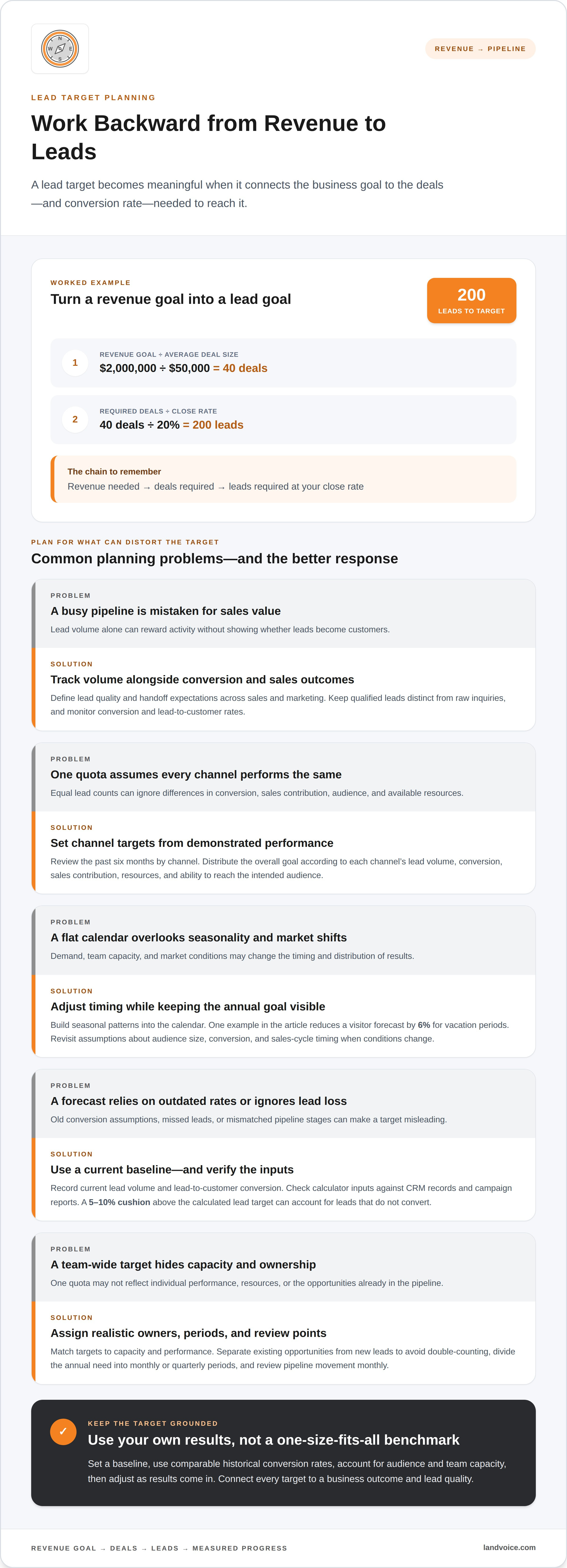
A lead target without a sales value behind it is just a number. When setting lead generation goals for the year, start with the revenue you need, calculate how many deals that requires, then use your close rate to work back to a realistic lead target. For example, a $2,000,000 revenue goal with a $50,000 average deal size calls for 40 deals. At a 20% close rate, that means targeting 200 leads.
A busy pipeline doesn’t always translate into revenue, and one team-wide quota can hide differences in capacity and performance. Set targets by connecting them to business outcomes, then make them specific to the people responsible for delivering them. This guide explains how to use past results and lead conversion rates to set measurable annual goals, break them into monthly and individual targets, and review progress without losing sight of lead quality. You’ll have a clearer plan for building a pipeline your team can act on, with goals each person can own.
Key Takeaways
- Start with your business revenue objective, then use historical performance and lead quality to shape a realistic pipeline target.
- Turn annual goals into clear actions, owners, and deadlines so each team member knows what to do next.
- Track lead volume alongside conversion and lead-to-sale rates to see whether activity is creating sales value.
- Set individual and sub-team targets around capacity, resources, and performance, then adjust them as results come in.
- Use lead sources that fit your prospecting plan to help your team build a focused pipeline and make more homeowner contacts.
How to set your lead generation goals?
Build annual lead targets from business outcomes, past performance, and the conditions shaping your market. When setting lead generation goals for the year, assign measurable channel targets that your team can review and adjust.
-
Align Goals With Business Objectives and Growth
Start with the business result you need, such as revenue growth, expansion into a new market, or more customers from a specific audience. Then map that result to required deals and the leads likely to create them. If the business aims for 5% revenue growth in the following quarter, determine how many additional customers or sales opportunities that objective requires.
Make sure sales and marketing agree on lead quality and handoff expectations. A lead-volume target should support the business objective, not reward activity for its own sake.
-
Set Goals by Marketing Channel
Set a separate target for each channel, based on its lead volume, conversion rate, and contribution to sales. Review the past six months of results by channel to identify which strategies bring leads that progress through the sales process. Distribute the overall target according to each channel’s demonstrated role, available resources, and ability to reach your intended audience.
Connect each channel’s expected lead volume with its conversion and sales outcomes. Don’t assume every channel should produce the same number of leads. Compare the quality and value of the leads each one brings in.
-
Adjust Targets for Seasonality and Market Changes
Build seasonal patterns into your calendar instead of treating every month as equal. Review when audience demand, team capacity, or market conditions typically shift, then adjust the timing and distribution of targets while keeping the annual objective visible. For example, a visitor forecast can be reduced by 6% to account for vacation periods.
When market conditions change, revisit assumptions about audience size, lead conversion, and sales-cycle timing. Adjust the affected channel or period, and record the reason for the change.
- Set a baseline before choosing a growth rate. Record current lead volume and the lead-to-customer conversion rate, then review which campaigns succeeded or fell short and why. Use those results to identify a realistic improvement opportunity. A 5-10% cushion above the calculated lead target can help account for leads that don’t convert.
- Match targets to conditions your team can influence. Consider audience size, niche market conditions, customer attributes, and available sales and marketing capacity. No single industry or company-size benchmark fits every business, so compare results with your own history and target audience. A disciplined approach to setting lead generation goals for the year also revisits assumptions when the market or available resources change.
Making specific plans for goal-related behaviors
Translate the annual target into repeatable actions, owners, and review points. A practical plan connects revenue expectations to the behaviors and systems that can produce qualified opportunities.
-
Set SMART Goals to Direct Systems
Write each goal using the SMART framework: Specific, Measurable, Achievable, Relevant/Realistic, and Time-bound. For example, “increase website-generated sales-qualified leads next year” becomes actionable when you define the target, responsible team, and deadline.
Then align systems and behaviors with that outcome. If website SQLs are a priority, assign marketing efforts to activities that influence them—such as partnering with a full-service agency like ThinkTank Creative to strengthen your digital marketing and web presence—and give sales a clear follow-up process. Avoid goals that describe activity without connecting it to a business result.
-
Calculate and Verify Lead Goals
Use a lead generation goal calculator to work backward from the revenue goal, expected deal value, and historical close rate. Divide the number of new customers required by the share of leads that typically become customers. Make sure the calculator uses the same definitions as your sales and marketing teams.
Check each input against CRM records and campaign reports before adopting the result. For example, distinguish qualified leads from raw inquiries. If the calculation uses mismatched stages, the target may look achievable while understating the work required.
-
Forecast Leads From Pipeline and Close Rates
Start with the deals already in your sales pipeline, then estimate the remaining customer or revenue gap. Use actual close rates for comparable lead sources and stages to work out how many additional leads could cover that gap. Keep existing opportunities separate from new leads to avoid counting the same potential sale twice.
For a monthly and quarterly plan, divide the annual need into periods that reflect your sales cycle. Review pipeline movement monthly and revise the next quarter’s forecast when conversion or deal progress changes.
-
Plan the Lead Generation Budget
Build the budget around planned lead volume and the full cost of acquiring customers. Include sales and marketing team costs, technology, and tools that support lead generation, not just digital advertising.
Review channel performance before allocating spend, and direct investment toward campaigns that contribute to pipeline and revenue. For paid search and ad campaigns, collaborating with marketing teams like Social: Managed can help maximize return on spend and drive qualified inquiries. Reserve budget for unexpected initiatives or market shifts. Connect planned spending to the leads and sales outcomes the plan requires.
- Turn the forecast into a behavior plan with named owners and deadlines. Assign weekly actions that feed into monthly targets, then review progress in regular team meetings. Common mistakes include counting every inquiry as qualified, relying on outdated conversion rates, and setting targets beyond available resources. These can distort forecasts and create unsustainable workloads.
Use each review to determine whether the issue is lead volume, conversion, follow-up, or capacity. Adjust the system or action plan accordingly, rather than raising targets without evidence. To connect your prospecting plan with a focused lead source, explore a lead-planning demo.
Setting measurable thresholds and deadlines
Set deadlines and define what counts as progress before launching a campaign. Measure lead quantity and quality together, so meeting a volume target doesn’t hide weak conversion.
-
Measure Lead Quantity and Quality
Track total leads alongside qualified leads and the share that becomes customers. For example, a team with a historical 10,000 leads per month could set a lower target of 5,000 total leads per month, plus 500 quality leads per month. That separates useful pipeline from volume alone.
Define lead quality by the likelihood of converting into a paying account. Compare conversion rates across channels and lead types, then investigate when high volume produces few sales. Don’t treat every form submission, email sign-up, or inquiry as equally valuable.
-
Track Progress Toward Goals
Assign each goal a KPI, reporting period, and deadline. A daily waterfall report can show progress toward a monthly lead goal, while CRM and analytics platforms help track customer behavior and campaign results. Review form submissions, email sign-ups, demo requests, conversion rates, and lead-to-sale ratios.
Compare actual results with the target during weekly or monthly reviews. If a campaign falls behind, identify whether the gap comes from lead volume, lead quality, or conversion. Then adjust the tactics, not the definition of success.
- Break annual goals into monthly milestones and give each milestone a due date. A goal to generate 10% more leads over the year needs scheduled checkpoints, not a single year-end review. Deadlines make it possible to spot a shortfall early and revise channel activity while there’s still time to influence results.
Make the metric precise by naming the lead stage, source, owner, and period. For instance, “qualified leads per month from Channel A” gives the team a clearer threshold than “more leads.” Use the same definitions in sales and marketing reports to measure progress consistently.
- Use conversion rates to test whether a target is achievable. An example site with 12,000 visitors per year and a 10% conversion rate generates 1,200 SQLs per year. At the same conversion rate, a target of 14,100 visitors corresponds to 1,410 SQLs per year. The relationship between traffic and SQLs makes assumptions visible.
Review actual performance against the target as the campaign runs. If traffic meets its target but SQLs lag, focus on conversion before increasing lead volume. If results exceed the threshold, record which channels and actions contributed.
- Use the same scorecard across channels, while keeping each channel’s results distinct. Track volume, qualified leads, conversion rates, and deadline status for every source. This shows whether the total target is being met through effective channels or through activity that adds little sales value.
At each scheduled review, document the result, the gap, and the next action. A clear record turns the monthly report into a decision tool and gives the next review a measurable point of comparison.
Calculating lead value from average sale price and close rate
Estimate the contribution of an average lead before setting acquisition targets. Use actual sales and lead-tracking data to connect campaigns with revenue.
- Calculate the average sale price from closed sales in the period you’re analyzing. For example, an average sale price of $1,000 gives you the starting value for each lead calculation. Keep the sales period and lead cohort aligned. Mixing older sales with recent leads can distort the estimate, especially when conversion rates or deal values have changed.
- Multiply the average sale price by the lead close rate to estimate value per lead. With a $1,000 average sale price and a 5% close rate, the calculation is $1,000 × 0.05, or $50 per lead. This is an expected average, not the value of every individual lead. It gives campaigns a consistent basis for comparing potential revenue.
- Use the estimated lead value to translate a revenue target into a lead target. Divide the additional revenue required by the expected value per lead. For example, an additional $10,000 revenue goal divided by $50 per lead requires 200 leads. This calculation connects sales objectives with lead volume, rather than choosing a volume target without a revenue rationale.
- Compare lead value across sources using the same calculation and stage definitions. Track leads, closed sales, average sale price, and close rate for each campaign or channel. A source with fewer leads but a stronger close rate may have greater expected value than a higher-volume source. Keep source attribution consistent so results aren’t credited to multiple campaigns.
- Refresh the calculation when sales outcomes shift. Recalculate average sale price and close rate from comparable records, then update lead value and related targets. Don’t assume an old rate still reflects current performance. Because a change in either input affects the result, review both before adjusting marketing efforts.
- Use lead value to guide decisions, not to automate them. A $50 average doesn’t mean every lead will generate that amount, and it doesn’t show whether each lead fits your ideal customer profile. Combine expected value with lead quality, pipeline progression, and conversion data to judge campaign performance. This prevents a spreadsheet estimate from replacing informed sales and marketing decisions.
- Document the formula and inputs alongside each forecast. Record the average sale price, close rate, reporting period, and lead source used. When you review tracking results later, the team can see why a target was set and identify which assumption needs updating. Consistent inputs make lead-value comparisons more useful across campaigns and planning cycles.
Calculate deals using average revenue per customer; baseline with leads and lead-to-customer conversion rate. Assess channel closing rates with past six months’ data. Match region monthly calculator goals to revenue per month; examples include maintaining a sick-leave rate below 5% and achieving an 80% satisfaction goal over the previous business year.
Setting individual and sub-team lead goals
Turn the shared business target into goals each person can act on. Individual goals work best when they reflect capacity, lead quality, and the sales team’s responsibilities.
- Divide the team target by responsibility, not headcount alone. For example, a listing-focused sub-team may own prospecting and qualification, while another handles follow-up and appointments. Define which lead stages each group controls before assigning targets. This prevents the same opportunity from being counted twice and makes ownership clear in reports.
- Set individual targets based on role, available time, territory, and past results. A new agent and an experienced agent may have different prospecting capacity, even with similar schedules. Compare performance using similar lead sources and responsibilities. Don’t treat a team-wide average as a fair individual quota when assignments or market coverage differ.
- Connect each target to actions and engagement measures the rep can influence. For example, define expected follow-up, recordkeeping, and appointment-setting behaviors alongside qualified lead outcomes. Activity measures show whether the process is happening; conversion measures show whether it’s working. Avoid rewarding activity alone when the goal is sales value.
- Match targets to the resources available to each person. Before finalizing quotas, review territory coverage, prospecting time, marketing support, and lead distribution. If one sub-team receives fewer opportunities or handles a longer follow-up process, adjust its target or invest in the support it needs. Unrealistic goals can fuel frustration and burnout; achievable targets can motivate consistent effort.
- Review individual and sub-team results together at scheduled check-ins. Compare progress by lead stage, source, and assigned owner, then identify whether a gap stems from lead supply, follow-up, or conversion. A team lead can coach the specific behavior causing a shortfall instead of lowering every quota. Record changes and reasons so later reviews have the right context.
- Keep the plan flexible without making accountability vague. If territory conditions, staffing, or lead distribution shift, document the change and revisit affected targets. Maintain clear ownership for each lead and next action. The principle is simple: assign goals to the people who can influence them, then support those goals with the time, tools, and processes they need.
Lead generation goals should reflect the team’s resources, budget, and capabilities. Before setting or revising a quota, consider what the team can sustainably support: the people available to prospect, the tools and marketing support within budget, and the skills needed to qualify and follow up leads. A goal that assumes capacity the team lacks can obscure whether the issue is execution or insufficient support.
Use this resource check when setting goals for individuals and sub-teams. If a target depends on additional tools, training, or marketing investment, make that dependency clear and decide whether the support is available before holding people to the outcome. When resources change, reassess whether the goal remains realistic. Aligning targets with supporting resources gives leads and reps a clearer basis for planning work, identifying gaps, and discussing adjustments.
Landvoice
Landvoice helps real estate professionals build a focused prospecting pipeline with seller lead sources that support their outreach goals. Match prospecting activity to the audiences and targets your team has defined with options including Expired Pro, FSBO Leads, FRBO Leads, and Pre-Foreclosure Leads. These sources can support homeowner outreach while you track lead quality and sales outcomes. When you’re ready to connect annual targets with practical pipeline opportunities, explore Landvoice’s lead generation tools.
Put Your Annual Targets Into Motion
When setting lead generation goals for the year, treat the plan as a decision framework, not a fixed promise. Give your team clear conditions for staying the course or changing direction. If lead quality weakens, investigate the source. If capacity tightens, revisit assignments before asking people to do more. This discipline keeps targets connected to the business as circumstances shift.
Choose a review rhythm your team can maintain, and use each meeting to make one clear decision: continue, adjust, or reallocate effort. Keep the reason for every change visible. Over time, this record helps you identify which choices support stronger pipeline performance and which need a different approach. The next step is to turn the plan into focused action, supported by the right lead sources.
Contact Landvoice to discuss lead generation
Start with the next action your team can own, and build momentum through deliberate execution.
Frequently Asked Questions
What is Goal Setting?
Goal setting means choosing a result and deciding how to work toward it. In lead generation, that means defining the business outcome, identifying indicators of progress, and assigning responsibility for the actions involved. For example, a team might connect a listing objective to qualified prospect conversations, then review those conversations in its CRM. Clear goals turn broad intentions into decisions people can act on.
Lead generation benchmarks by industry and company size
No single benchmark fits every industry or company size. Compare results with your own history and target audience, accounting for audience size, niche conditions, and available resources.
