



by Bruce Keith, on October 24, 2026
A For Sale by Owner seller’s doubts often come down to control, value, and fear of making the wrong move. The psychology of a for sale by owner seller reflects a desire to protect the home’s value, alongside uncertainty about pricing, buyer responses, and whether accepting help could lead to regret. Understanding those motives gives you a clearer way to approach the conversation.
It makes sense that sellers want to manage the process themselves. They may believe they know the property best, want to retain control, or feel skeptical of claims that aren’t backed by market evidence. A respectful, positive interaction matters too: sellers are more open to conversation when they feel heard rather than pressured.
This article explains what can shape an FSBO seller’s decisions and why evidence, fair dealing, and trust can ease hesitation. You’ll see how comparisons with similar properties can address pricing concerns, how listening reveals what matters most, and how fear of regret can affect choices. The goal is to help you recognize the thinking behind a seller’s doubts and respond with clarity, patience, and useful information.
Key Takeaways
- Separate a seller’s practical concerns from the emotions influencing their decision so your response addresses both.
- Use relevant property comparisons to make pricing conversations clearer and more grounded in evidence.
- Build trust through fair, transparent communication instead of pressure or artificial urgency.
- Ask thoughtful questions and listen closely to discover what the seller values and fears losing.
- Recognize that fear of regret can make change feel risky; help sellers weigh trade-offs without pushing them toward a decision.
Emotional and rational motivations in property decisions
Homeowners who sell without an agent often want control, a strong sale price, or a simpler process. Their decisions combine practical calculations with personal feelings about the home and the move ahead.
What motivates homeowners to sell by owner? Common reasons include managing the sale themselves, protecting their expected proceeds, and describing the property’s features directly to buyers. A seller may also have a personal deadline, such as relocating for work, that makes control over showings and negotiations feel valuable.
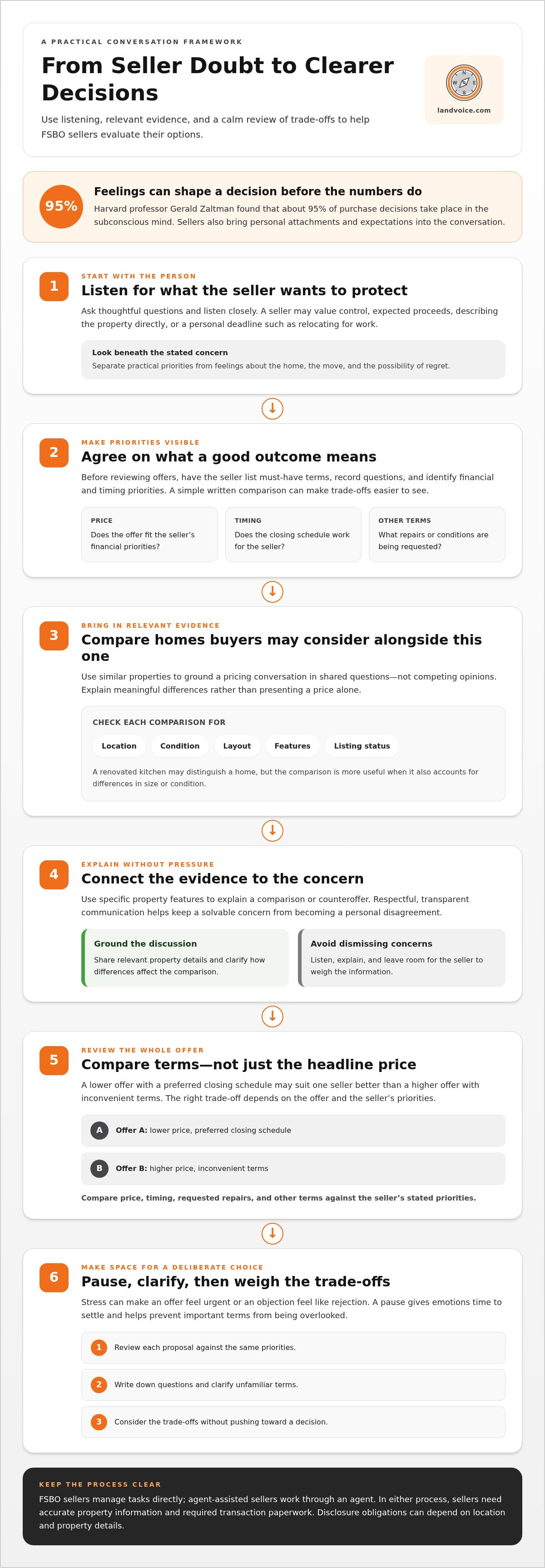
Emotion affects both sides of a home sale. Harvard professor Gerald Zaltman found that about 95% of purchase decisions take place in the subconscious mind. That finding helps explain why buyers may react to a home’s atmosphere before comparing its features. A bright kitchen, a quiet street, or a familiar layout can create a positive feeling, while visible repairs may trigger concern. Sellers bring their own attachments and expectations into the same interaction.
Rational Pricing and Negotiation Choices
Rational pricing and negotiation involve weighing market comparisons, property condition, and sale priorities before setting a price or responding to an offer. A seller’s personal attachment can distort what comparable homes suggest. FSBO sellers often consider nearby listings and recent sales, then weigh buyer feedback against their financial goals. Optimism, anchoring to an initial asking price, or overvaluing renovations can contribute to overpricing.
How does an FSBO seller typically price and negotiate a home sale? The seller can compare similar properties, account for differences in condition and features, then assess each offer against timing and financial priorities. Negotiation is about more than the sale price: closing timing, requested repairs, and other terms may affect the decision. For example, a lower offer with a preferred closing schedule may suit one seller better than a higher offer with inconvenient terms.
Emotion-focused negotiation starts by identifying what matters to the person across the table. A buyer may value a move-in-ready home, while the seller may care most about preserving the home’s perceived worth. Ask what drives an offer, then explain a counteroffer using specific property features to keep the discussion grounded. Respectful language matters: dismissing a buyer’s concern can turn a solvable issue into a personal disagreement.
Stress and Decision-Making
Stress can narrow a seller’s attention, making each offer feel urgent or each objection feel like rejection. This matters because rushed decisions can overlook terms beyond the sale price. To reduce pressure, sellers can set priorities before reviewing offers, compare each proposal against the same criteria, and pause to clarify unfamiliar terms. A written comparison makes trade-offs easier to see.
How can an FSBO seller reduce stress and make better decisions? Create a simple process: list must-have terms, record questions, and review each offer against those priorities. For instance, compare price, timing, and requested repairs in separate columns instead of reacting to one detail. This gives emotions time to settle and helps the seller make a deliberate choice.
Using comparisons and market data to address skepticism
Evidence can shift a pricing conversation from competing opinions to shared questions. For a skeptical seller, relevant comparisons and clear property details make the transaction easier to evaluate. Understanding the psychology of a for sale by owner seller also means recognizing that evidence works best when it addresses the concern behind the doubt.
How do FSBO sellers compare with sellers who use a real estate agent? Both can set an asking price, market the home, review offers, and negotiate terms. The difference is who manages those tasks: FSBO sellers handle them directly, while agent-assisted sellers work through an agent. That difference affects the process, but it doesn’t determine a property’s value on its own.
A useful comparison starts with homes buyers are likely to consider alongside the property. Look at location, condition, layout, features, and listing status, then explain meaningful differences rather than presenting a price alone. For example, a renovated kitchen may distinguish one home from a nearby property, but the comparison is more useful when it also accounts for differences in size or condition. This gives the seller information to assess rather than a conclusion they must simply accept.
How does an FSBO seller handle legal and disclosure responsibilities in the United States? Sellers need to provide accurate property information and complete the paperwork required for their transaction. Disclosure obligations can depend on location and property details, so sellers should treat applicable forms and known property issues as essential parts of the sale.
Market comparisons can also help sellers consider timing. If similar homes compete for the same buyers, current listing activity may inform how the seller presents the property and responds to offers. In a high-mortgage-rate market, some buyers may pay particular attention to the full cost of moving. A seller might consider a concession, such as addressing a repair request, to resolve a buyer’s concern. The right trade-off depends on the offer terms and the seller’s priorities.
Storytelling adds context that a data table cannot provide. A listing can connect features to everyday use: a breakfast nook becomes a place for quiet mornings, while a fenced yard gives buyers room to picture outdoor routines. Professional staging services, such as those provided by Raw at Home, complement this approach by visually styling spaces to help buyers see that potential firsthand. Specific, truthful details help buyers imagine a fit without concealing practical drawbacks. That kind of presentation can support a better conversation by giving buyers a clearer basis for questions.
What are the most common mistakes and risks for FSBO sellers? Common pitfalls include relying on an unsupported asking price, overlooking important paperwork, and responding to offers without comparing all the terms. Incomplete property details can also create confusion during the transaction. Sellers can reduce misunderstandings by keeping property descriptions, offer terms, and responses consistent.
To address skepticism, share the comparison behind a claim and invite a focused discussion. Separate observable facts, such as a home’s condition, from interpretations, such as whether a feature justifies a higher price. Understanding the psychology of a for sale by owner seller means considering what evidence might resolve a specific concern. That distinction keeps market insights useful for both parties.
Appealing to a seller’s sense of right and wrong
Fair dealing matters because selling a home involves trust, personal stakes, and consequential choices. A seller is more likely to engage when your conduct matches your claims. Be candid about your purpose, respect the homeowner’s decision, and offer information without disguising pressure as advice.
Start with honesty about the conversation. If you’re contacting someone about their FSBO property, say why you reached out and what you can contribute. Don’t imply you already have a buyer if you don’t, or suggest that a price or outcome is certain when it isn’t. For example, explain that you want to discuss the seller’s priorities and share relevant perspective, then let them decide whether to continue.
Fairness also means listening before presenting a solution. Ask what the seller believes would make a transaction worthwhile, then reflect their answer accurately. A homeowner may prioritize a particular closing date because of a planned move. Another may care most about avoiding repair disputes. A response that acknowledges those priorities shows you see a person with a specific situation, not simply a listing to pursue.
Reciprocity can make the exchange feel balanced, but it must be genuine. Offer something useful before asking for time or agreement. For instance, point out a relevant detail in the property’s public presentation or clearly explain a term the seller raised. Keep your contribution connected to their concern. A generic gift or unrelated pitch can feel like a tactic rather than a fair exchange.
Be precise with comparisons and claims. If you mention a nearby property, explain how its condition or features differ instead of using its asking price as proof. If you discuss buyer interest, distinguish what you know from what you’re inferring. This helps the seller make an informed choice and keeps the conversation from relying on selective details.
Ethical urgency requires the same discipline. A real deadline or competing offer may affect a seller’s decision, but invented scarcity undermines trust. If timing matters, explain the specific reason plainly. If it doesn’t, don’t manufacture a reason to rush. A seller who feels pressured may disengage, while a transparent conversation leaves room to consider the terms carefully.
Respect includes accepting “no” without arguing. If a homeowner declines a meeting, acknowledge the answer and avoid repeated messages that add no value. If they raise a concern, address it directly rather than redirecting to a prepared pitch. These small choices make your conduct consistent with the fair outcome you say you want.
Ultimately, appealing to someone’s sense of right and wrong isn’t about using morality to secure agreement. It’s about being fair throughout the process: tell the truth, honor stated priorities, explain your reasoning, and leave the decision with the seller. That approach gives the conversation a sound basis, even when both sides don’t reach an agreement.
Liking and positive seller interactions
A seller’s impression of you can shape whether the conversation continues. Buyers may enjoy buying but dislike feeling sold to. For an FSBO homeowner, an unexpected pitch can feel like a challenge to their position. Start with a natural exchange, not a rehearsed argument. A calm introduction gives the seller room to decide whether a conversation would be useful.
Listening is an active strategy, not a pause before your next pitch. Ask an open-ended question such as, “What matters most to you in the next step of selling?” Then let the seller finish and reflect their answer. If they say timing matters more than an ideal price, respond to that priority. This approach gathers practical insight and helps you understand the person behind the listing.
According to Nielsen’s Global Trust in Advertising report, 89% of consumers trust recommendations from people they know more than any other channel. That finding underscores the influence of trusted relationships, but it doesn’t mean a stranger should act like an old friend. Build rapport through attention and relevance. For example, acknowledge a specific feature the seller has described, rather than offering a generic compliment.
A sincere compliment can make an interaction warmer, especially when it recognizes the seller’s effort. You might mention that the listing clearly explains a recent improvement, then ask how buyers have responded to it. Keep the observation specific and true. Automatic-sounding flattery can weaken confidence, while a grounded comment opens a more logical discussion about the home.
Positive interaction also depends on pacing. If the seller gives a short answer, don’t respond with a long presentation. Ask one useful follow-up, such as whether they’ve received questions about the property’s layout. If they want details, explain them clearly. If they seem ready to end the conversation, respect that signal. This keeps the exchange collaborative rather than turning it into a contest for attention.
Pay attention to the seller’s words and behavior. A homeowner who repeatedly mentions control may want to lead the discussion. Someone focused on buyer feedback may welcome a practical comparison. Respond to the concern they actually raise, not an assumption about every FSBO seller. That flexibility helps you stay relevant without pretending every seller has the same motivation.
Confidence comes from being clear, not forceful. State your point, explain your reasoning, and leave space for the seller’s response. For instance, when discussing a buyer objection, separate the buyer’s concern from your interpretation of it. The seller can then consider the information without feeling pushed toward an answer. Strong interactions make room for honest questions and a more productive next conversation.
Loss aversion and fear of regret
Loss aversion makes a possible loss feel heavier than an equivalent gain. Daniel Kahneman’s work describes people as feeling the pain of loss two to two and a half times more than the joy of gaining the same thing. In real estate, this imbalance can make an FSBO seller focus more on what an offer might take away than on what accepting it could make possible.
Consider Kahneman’s simple example: losing $100 hurts more than the joy of finding $100. A homeowner may view a buyer’s offer below the asking price as a loss, even when the offer could support a move or another personal goal. The asking price then becomes an emotional reference point. Any lower number can feel like surrender, rather than one option in a larger decision.
Fear of regret can also make a seller’s decision harder. Accepting an offer may prompt worry that a higher one could arrive later. Rejecting it may raise concern that no other buyer will appear. Both imagined outcomes can influence behavior, even though neither is certain. A seller may delay, change terms, or hold firmly to a price to avoid feeling responsible for the wrong choice.
Make the decision easier to examine by separating known facts from imagined outcomes. A seller can compare an offer’s price and terms with their priorities, then write down the specific benefit of accepting and the practical cost of waiting. For example, if a move depends on closing by a certain date, timing belongs beside price in the comparison. This turns a vague fear of loss into distinct trade-offs.
Language matters during this conversation. Calling an offer a “loss” can intensify resistance, while describing its actual terms invites a more logical review. Rather than insisting that a seller accept quickly, clarify what the buyer proposed and ask which terms matter most. If the seller rejects the offer, calmly explore whether a counteroffer addresses the concern. The goal is a deliberate decision, not a reflexive defense of the initial position.
Sellers can also reduce regret by defining decision criteria before reviewing an offer. They might identify acceptable timing, important contingencies, and the priorities that would make a transaction worthwhile. Then they can assess each proposal against those criteria instead of judging it only against the asking price. This approach doesn’t remove emotion. It gives emotion a place alongside practical considerations.
For professionals, recognizing loss aversion can change the conversation. A firm response may reflect fear of giving something up, not a refusal to consider alternatives. Acknowledge the concern, clarify the trade-offs, and give the seller room to weigh them. This keeps the discussion focused on the homeowner’s goals and supports a confident choice without manufacturing urgency.
Landvoice: Expired Pro
Landvoice gives real estate professionals a practical next step when they’re ready to turn seller insights into focused outreach. Expired Pro supports prospecting around expired listings, while FSBO Leads are relevant when you want to contact homeowners selling independently. Choose the lead type that matches the conversation you’re prepared to have: understand the seller’s priorities, open respectfully, and offer useful information rather than pressure.
For agents building a pipeline across different seller situations, FRBO Leads and Pre-Foreclosure Leads offer other focused lead categories. Pair a relevant lead source with thoughtful, consistent communication. Visit Landvoice to explore your next step.
Turn Seller Understanding Into Your Next Conversation
Understanding the psychology of a For Sale by Owner seller gives you a stronger starting point, but the next conversation is where that understanding becomes useful. Treat each interaction as an opportunity to learn what the homeowner wants to protect, what would make a change worthwhile, and what information would help them decide. Then respond to the person in front of you, not to a script built on assumptions.
That approach takes preparation and consistent outreach. Keep your message relevant, your claims clear, and your follow-up respectful. A measured conversation can create room for trust without asking a seller to decide before they’re ready.
Contact Landvoice to discuss seller insights
Build your next conversation with purpose. Explore how Landvoice can support your outreach and keep moving toward stronger seller relationships.
Frequently Asked Questions
What is the seller’s psychology?
A seller’s psychology is the mix of goals, assumptions, and emotions that shape decisions about the home. A homeowner might see selling independently as a way to stay in control, while feeling uncertain about how buyers will judge the property. For example, a seller who values privacy may prefer fewer showings, even if broader access could attract more interested buyers. Their choices reflect personal priorities, not just price.
What are common fears and concerns of for-sale-by-owner sellers?
Common concerns include setting a price, attracting serious buyers, managing the workload, and making a poor decision under pressure. A seller may worry that a buyer’s repair request signals a larger problem, or that accepting an offer too soon could mean missing a better fit. These concerns often become clearer when you ask which part of the sale feels most uncertain, then address that specific issue rather than offering a general pitch.
What are the emotional challenges of selling a home without an agent?
Selling without an agent can mean carrying the practical workload while also managing personal reactions to buyer feedback. A blunt comment about dated décor, for instance, may feel like criticism of the seller’s taste rather than a buyer’s preference. The seller may also need to balance showings with work and family routines. Separating feedback from personal judgment can help preserve perspective during those conversations.
How do FSBO sellers handle buyer objections and negotiations?
FSBO sellers can handle objections by clarifying the buyer’s concern before deciding how to respond. If a buyer questions an appliance’s age, the seller can share the known details, then discuss whether the concern affects the offer or requested terms. For negotiation, compare the full proposal, including timing and contingencies, against the seller’s priorities. A calm, specific reply keeps one objection from taking over the entire discussion.
