



by Bruce Keith, on October 25, 2026
Without a solid foundation, a real estate career can become reactive: you may pursue goals that don’t fit, overlook important preparation, or struggle to build momentum. Building a sustainable real estate career starts with defining what success means to you, then aligning your education, licensing, and early experience with that goal.
It’s easy to focus on getting started quickly, but a clear direction helps you choose the work you pursue and the skills you develop. You don’t need to copy someone else’s version of success. You need a career plan that reflects your priorities and can adapt as they change.
This article explains how to define personal measures of success, choose relevant education and licensing, and gain practical early experience. Each decision can strengthen the next, helping you build a professional path with purpose rather than guesswork. Start with a solid foundation, then make your next move count.
Key Takeaways
- Define what career success means to you before choosing a path, so your goals guide the skills and opportunities you pursue.
- Match your education and licensing decisions to the real estate role you want to build toward.
- Explore internships, junior roles, and volunteer projects to gain practical experience and strengthen your early-career foundation.
- Understand why agent income can vary, and consider how your work habits and client pipeline shape financial stability.
- Build a deliberate approach to finding clients and nurturing referrals, then explore lead sources that fit your prospecting goals.
Defining personal measures of success
Building a sustainable real estate career starts with choosing measures that reflect your priorities, not someone else’s scoreboard. One investor may view 600 rental doors as success; another may aim to manage a fund with nine figures under management. Those examples show how differently professionals define progress. As an agent, decide whether your goal is steady income, flexible hours, repeat clients, a focused market niche, or leadership. Then choose measures that reveal whether your daily work is moving you toward that outcome.
Compare business models by deciding what matters most to you: autonomy, structure, or shared support. Independent agents have more control over their business systems, while teams may offer shared processes and collaboration. A brokerage provides an organizational setting and professional oversight. Before choosing, compare each model’s costs, support, expectations, and working arrangements with your goals.
Common financial and business pressures include irregular income, ongoing expenses, a thin client pipeline, and dependence on a single source of business. These can compound: a quiet period may reduce cash flow while marketing, transportation, and other work costs continue. Track business income and expenses separately, monitor where clients come from, and plan for slower periods. Don’t measure performance only by closed transactions.
Translate broad ambitions into a small set of indicators you can review regularly. For example, a new agent who wants repeat and referral business might track follow-up conversations, client feedback, and returning clients. An agent seeking greater schedule control might compare workdays and time spent on core business activities. Effective planning benchmarks include keeping cash reserves equal to 12 months of expenses and reinvesting 20-30% of cash flow as a growth allocation. Treat these as guidelines, then assess whether they fit your circumstances.
- Income quality: Review consistency, business expenses, and whether your client sources are becoming more balanced.
- Time: Decide whether you prefer working four days a week or six days a week, then measure how your actual schedule compares.
- Growth: Consider allocating 40-50% of work time to high-leverage work, 20-30% to maintenance and oversight, and 20-30% to renewal and input.
- Personal fit: Check whether your workload, client relationships, and chosen business model support the life you want.
Review these indicators regularly, such as at the end of each month, and adjust one business decision at a time. If finding clients takes longer than expected, identify which activities are creating conversations and which are using up your capacity. A clear scorecard turns “success” into practical choices you can revisit as your experience and priorities change.
Education and professional licensing
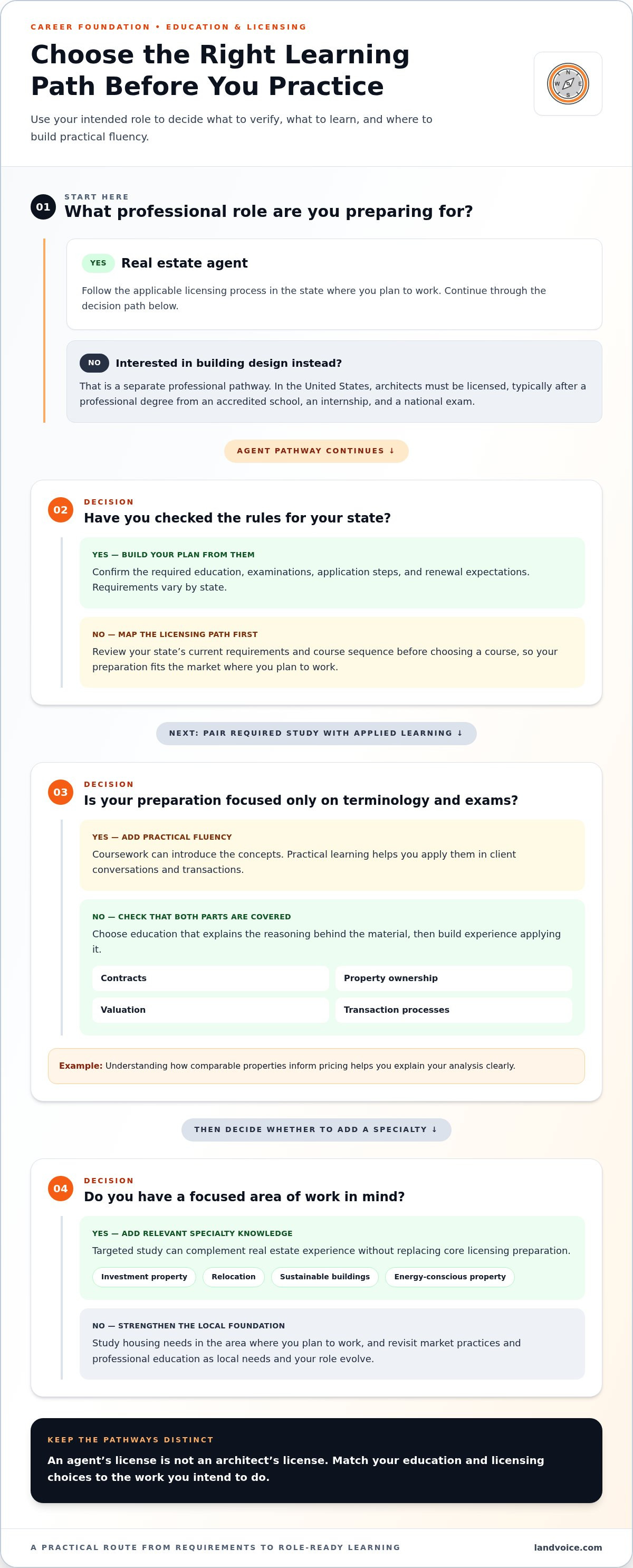
Education provides working knowledge for serving clients; licensing determines whether you can perform regulated real estate activities in your state. In the United States, requirements vary by state, so begin with the rules where you plan to work. Before choosing a course, review the required education, examinations, application steps, and renewal expectations. This helps you avoid training that doesn’t fit your intended market.
Distinguish licensing requirements from the skills that build trust. Coursework can introduce contracts, property ownership, valuation, and transaction processes. Practical learning helps you apply those concepts in client conversations and transactions. Choose education that explains the reasoning behind the material, not just terminology to memorize. For example, understanding how comparable properties inform pricing helps you explain your analysis clearly.
Education can also support a focused specialty. If you want to work with energy-conscious buyers, sellers, or investors, learn how building performance, operating costs, and compliance affect property conversations. For example, understanding how rental property owners track their portfolio cash flow and records with platforms like PropAlly allows you to communicate more credibly with investor clients. Professionals often combine disciplines by earning degrees in energy business, finance, or urban sustainability while gaining industry experience. This type of path illustrates how targeted study can complement real estate experience without replacing core licensing preparation.
Licensing rules, market conditions, and housing trends shape career prospects in different ways. Your state’s rules determine how to qualify and what your license permits, while local demand influences which property knowledge and client skills are useful. Study housing needs in the area where you plan to work, then choose continuing education that helps you respond to them.
Use a focused learning plan instead of collecting credentials without a clear purpose:
- Map the licensing path: Identify your state’s current requirements, course sequence, exam process, and renewal obligations.
- Build practical fluency: Study contracts, pricing analysis, disclosures, negotiation, and transaction communication.
- Choose a specialty: Add relevant knowledge in areas such as investment property, relocation, or sustainable buildings.
- Refresh your knowledge: Revisit market practices and professional education as your role and local housing needs evolve.
Keep the distinction clear: an agent’s license is not an architect’s license. In the United States, architects must be licensed, typically after completing a professional degree from an accredited school, an internship, and a national exam. If your goal shifts toward building design, that is a separate professional pathway. For an agent, relevant real estate education and the applicable state licensing process provide the foundation; continued learning keeps your expertise relevant as client questions change.
Internships and early-career experience
A license allows you to practice, but supervised work helps build judgment. An internship, junior team role, or volunteer project can show how property decisions unfold beyond coursework. Look for experience with real tasks, clear feedback, and contact with working professionals. For example, supporting a property team can introduce you to client communication, market research, listing preparation, and transaction coordination.
Prioritize the work you want to learn, not just the job title. A real estate internship might involve organizing property information, observing client meetings, researching neighborhoods, or helping coordinate open houses. Ask for a defined assignment, such as comparing nearby listings or summarizing housing trends. Review the result with a supervisor and note what you would improve next time.
A junior team role can teach you the rhythm of the business through repeated tasks. You might maintain client records, prepare materials for listing appointments, or track follow-up commitments. These duties build practical habits: accurate documentation, timely communication, and organized handoffs. Record the skills you use and questions that come up. This helps you identify training gaps and describe your experience clearly in future interviews.
If sustainable buildings interest you, contribute to a campus green building audit or certification working group. This can help you learn how a building is assessed, how evidence is organized, and how teams coordinate recommendations. Volunteer to lead a defined task, such as scheduling site observations or compiling notes. A clear deliverable makes your contribution concrete and gives collaborators a specific basis for recommending your work.
Make each placement a learning opportunity. Before you start, agree on the assignment, who will review it, and what a finished result should look like. Ask specific questions about the reasoning behind decisions. After researching a neighborhood, for example, ask how the team uses comparable properties to explain pricing. After a client meeting, consider which questions helped clarify the client’s priorities.
- Seek useful exposure: Target internships or junior roles connected to the work you want to pursue.
- Volunteer with purpose: Join a campus audit or certification group, then take ownership of a defined task.
- Request feedback: Bring a completed assignment to a supervisor and ask what would make it stronger.
- Capture your progress: Keep examples of research, coordination, and communication tasks for future applications.
Experience can also help you test whether a career path suits you. A property-focused internship may reveal whether you enjoy client-facing work, research, or operational coordination. A green building project may show whether you want to pursue sustainability-related expertise. Use what you learn to choose your next assignment deliberately. Each role should add a skill, a professional relationship, or a clearer sense of the work you want to do. When you are ready to pursue your next position, tools like Rezumi can help you optimize your resume to highlight that hands-on experience.
How much do real estate agents earn, and how variable is their income?
Real estate agents don’t receive one fixed salary. Income depends on completed transactions, compensation arrangements, and business expenses. A newly active agent may have periods without a closed transaction, while established agents may draw business from repeat clients and referrals. Earnings reflect both how much business you close and how consistently you create opportunities.
Start by separating gross income from take-home income. Gross income is what you earn from completed business before expenses and taxes. Business costs may include marketing, transportation, professional services, technology, and work-related fees. Track each category against actual income so a busy period doesn’t disguise the cost of operating. Compare revenue after expenses over time, not just from one month to the next.
Transaction timing is another source of variation. A client may pause a search and return later; a seller may need time to prepare a property. Such delays can shift when income arrives, even after substantial work. For example, an agent may spend weeks advising a prospective seller but receive transaction income only after a listing sells. A reliable tracking system helps connect current effort with eventual results.
Market conditions also shape opportunity. The number and type of properties available, buyer and seller activity, and client demand can influence how quickly conversations turn into completed transactions. Specializing in a particular area or client group may sharpen your market knowledge, but it can also concentrate your pipeline. Track where each opportunity comes from and whether your business depends too heavily on one source.
Use a simple financial review to understand your own pattern:
- Record completed business: Track each transaction and the income it produces.
- Log operating costs: Categorize marketing, travel, technology, and professional expenses.
- Monitor pipeline movement: Note when prospects become active clients and when transactions close.
- Compare business sources: Identify which relationships and activities lead to completed work.
This review gives you a more useful picture than a headline earnings estimate. It can show whether income changes reflect transaction timing, fewer opportunities, higher expenses, or shifts in the market. Use those patterns to adjust prospecting, costs, and workload. If conversations are active but closings are lagging, for example, focus on follow-up and pipeline management before increasing expenses. A sustainable career depends on understanding how revenue is earned, when it arrives, and what it takes to generate it.
How can new real estate agents find clients and build a referral network?
New agents need two connected systems: consistent prospecting and dependable relationship follow-up. Start with a defined audience, such as first-time sellers in a specific neighborhood or owners considering a move. A clear focus makes your conversations, local research, and educational content more relevant. It also helps people understand who you serve and when to introduce you.
Build visibility by sharing useful information about the area where you work. Post a concise market update, explain how to prepare for a listing conversation, or summarize common buyer questions about a property. Keep each piece specific and accurate. A short guide to local parks, transit, or housing styles can give residents a practical reason to remember you. Avoid claims you can’t support with local knowledge.
Make personal outreach a regular part of your work. Reconnect with people you know, attend community events, and follow up after meaningful conversations. Don’t treat every interaction as an immediate sales opportunity. Ask what the person is planning, listen for their needs, and offer a relevant next step. If a neighbor is considering a move, for example, offer to discuss the local selling process and answer their questions.
Referrals grow from trust and clear communication. Keep past clients and professional contacts informed at appropriate times, and make it easy for them to describe your work. A lender, contractor, or attorney may think of you when a client needs an agent, especially if you’ve handled previous introductions professionally. Thank people who refer business, update them on the outcome, and respect client privacy.
Use a simple contact-management routine to keep relationships on track. Record how you met, what matters to the person, and the next follow-up action. For instance, note that a local business owner wants market updates before deciding whether to sell. A timely, relevant check-in feels more personal than a generic message without context.
- Choose a focus: Define the neighborhood or client group you can serve with genuine knowledge.
- Share useful expertise: Create practical local information that answers real property questions.
- Follow up with purpose: Track conversations and reconnect with a relevant reason.
- Strengthen referral relationships: Communicate clearly with clients and professional contacts, then show appreciation for introductions.
Review your activity regularly. Note which conversations lead to meetings, which local resources attract engagement, and which relationships generate introductions. Then spend more time on activities that create meaningful client connections. A consistent system makes prospecting a repeatable part of your business, rather than an occasional push.
Landvoice: Expired Pro
Landvoice offers Expired Pro for agents building a prospecting routine around expired listings. It helps you identify potential seller conversations and focus outreach on homeowners whose listings have expired. Consider it when you’re ready to contact more homeowners and want a defined lead source to support your client pipeline.
If you want to reach other seller audiences, Landvoice also offers FSBO Leads, FRBO Leads, and Pre-Foreclosure Leads. Choose the source that fits your market focus and the conversations you’re prepared to have. These resources support prospecting; consistent follow-through and client service remain central to lasting professional relationships.
Visit Landvoice to explore Expired Pro and its lead options.
Build your next move with purpose
A lasting career isn’t built on one perfect decision. It develops as you make deliberate choices, learn from each client interaction, and adapt your approach to your goals. Building a sustainable real estate career means treating your plan as an ongoing process: choose a direction, put it into practice, and review what you learn.
As you strengthen your prospecting, choose lead sources that suit the clients you want to reach. Landvoice offers Expired Pro, FSBO Leads, and FRBO Leads for agents focused on seller opportunities. The right fit depends on your market focus and the conversations you want to develop. Let your goals guide the choice, then bring consistency and thoughtful follow-up to every contact.
Take the next step with intention. A focused conversation can help you explore how these options align with your business goals.
Your career is yours to shape. Keep learning, stay purposeful, and build momentum through strong professional decisions.
Frequently Asked Questions
What Happens When You Skip the Foundation?
Without a solid foundation, you may find yourself reacting to problems instead of making deliberate business choices. An agent who accepts every client request, for example, may struggle to make time for preparation, follow-up, and personal commitments. Without clear priorities, it’s also harder to decide which opportunities deserve attention. Set boundaries and define your ideal client experience early so each commitment supports the practice you want to build.
Why Is Patience a Competitive Advantage?
Patience helps you make sound decisions as client relationships and transactions develop. A prospective seller may need time to prepare a home or discuss a move with family. By staying helpful without applying pressure, you can remain a trusted resource during that pause. Patience also gives you time to review feedback, improve your communication, and avoid treating a temporary lull as a reason to abandon a thoughtful business plan.
What does a sustainable real estate career involve?
A sustainable real estate career combines professional standards with a workable approach to serving clients over time. Set clear expectations, keep accurate records, protect time for preparation, and make choices that fit your priorities. For example, you can build a practice around a specific client group while continuing to update your expertise. Sustainability isn’t a fixed level of activity; it’s a career structure you can maintain and adapt.
What skills and continuing education help agents build a long-term career?
Long-term agents benefit from clear writing, attentive listening, negotiation, time management, and the ability to explain complex information. Continuing education can sharpen these skills and help you respond to changes in client needs, transaction practices, and property concerns. An agent who regularly studies housing patterns, for example, can explain market context more clearly in client discussions. Choose learning that addresses a real gap in your work, then apply it in your next client interaction.
