



by Bruce Keith, on November 21, 2026
Your next step isn’t to close every deal yourself. Learning how to transition from solo agent to team leader means shifting from doing the work alone to guiding people, systems, and business growth. You may still work directly with clients, especially early on, but more and more of your success will depend on helping others do their best work.
You already know that building a real estate business takes consistent effort. The challenge is making room to lead without letting client service or new opportunities slip. That shift requires deliberate delegation, not simply adding people to your workload.
This article explains how to decide what to hand off, coach team members, communicate expectations, and plan beyond your next transaction. You’ll also learn how these leadership habits can help you grow from agent to team leader and, eventually, owner. The goal is a business that can move forward through a capable team, rather than one that depends on you doing everything.
Key Takeaways
- Track how you spend your work time before choosing what to delegate, then hand off tasks that free you to focus on higher-value work.
- Coach each team member around their strengths and goals, and give them ownership instead of micromanaging.
- Set clear expectations, listen to feedback, and communicate decisions consistently to build trust across the team.
- Protect time for strategic planning so your vision, growth priorities, and repeatable systems guide daily decisions.
- Build toward ownership by documenting workflows and creating a business that can keep moving without relying on your memory or constant involvement.
1. Auditing time and identifying tasks to delegate
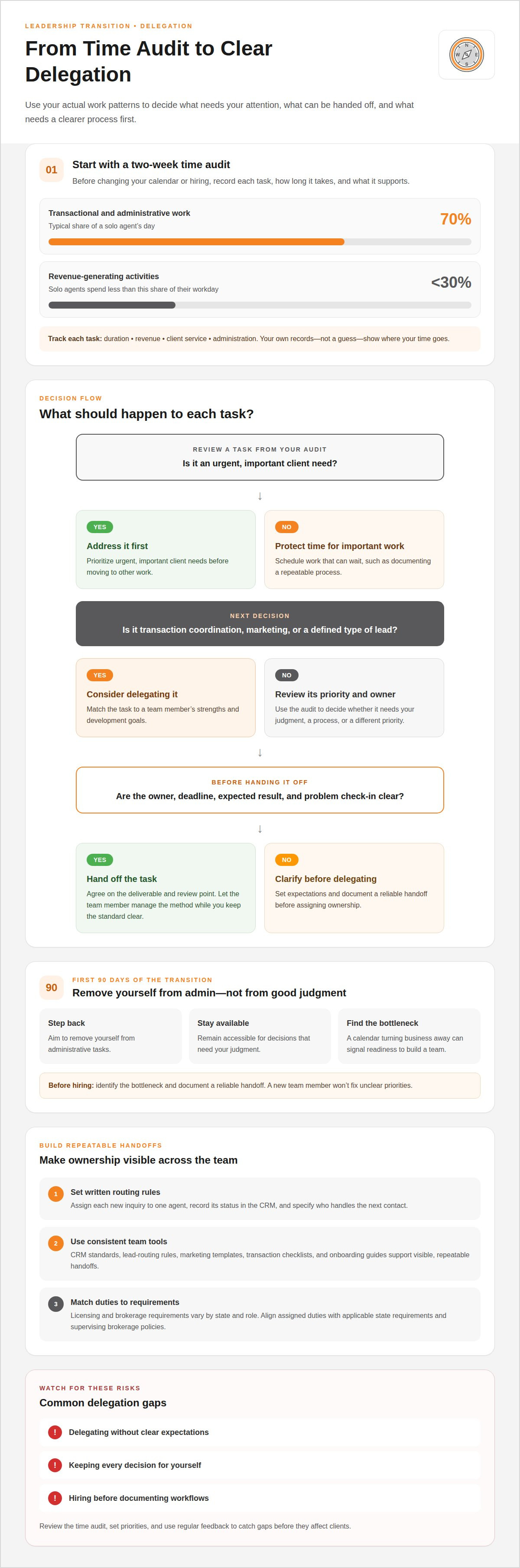
Start with a two-week time audit before changing your calendar or hiring. Record each task, its duration, and whether it supports revenue, client service, or administration. A typical solo agent’s transactional and administrative work takes up 70% of the day, while solo agents spend less than 30% of their workday on revenue-generating activities. Your own records show where your time actually goes. They also give you a practical starting point for how to transition from solo agent to team leader.
Next, sort tasks by urgency and importance. Address urgent, important client needs first, then protect time for important work that can wait, such as documenting a repeatable process. Transaction coordination, marketing tasks, and defined types of leads can be delegated. Match each task to a team member’s strengths and development goals. A clear handoff identifies the owner, deadline, expected result, and when to flag a problem.
Delegation means letting go of control over the method, not the standard. If you assign listing marketing, agree on the deliverable and review point, then let the person manage the steps. Give specific feedback after the work is complete. Rechecking every decision slows the team and weakens ownership. A workable plan for how to transition from solo agent to team leader gives each person room to act while keeping outcomes clear.
During the first 90 days of the transition, aim to remove yourself from administrative tasks while staying available for decisions that need your judgment. A calendar that is turning business away can signal readiness to build a team. Before hiring, identify the bottleneck and document a reliable handoff. A new team member won’t fix unclear priorities. Schedule time for client work, team support, and strategic decisions.
Assign leads and clients using written routing rules, clear ownership, and defined follow-up responsibilities. For example, direct each new inquiry to one agent, record its status in the CRM, and specify who handles the next contact. Consistent rules reduce duplicate outreach and support a collaborative team culture.
Teams need repeatable systems, including CRM standards, lead-routing rules, marketing templates, transaction checklists, and onboarding guides. These tools make handoffs visible and help the team navigate busy periods. In the United States, licensing and brokerage requirements vary by state and role. Match each person’s assigned duties to applicable state requirements and the supervising brokerage’s policies.
Common risks include delegating without clear expectations, keeping every decision for yourself, and hiring before documenting workflows. Review your time audit, set priorities, and use regular feedback to catch gaps before they affect clients.
2. Coaching and mentoring team members
Strong coaching turns individual skills into shared team capability. Start each agent’s development with a conversation about their strengths, goals, and current challenges. A newer agent might need practice structuring a client conversation, while an experienced colleague may want to develop negotiation skills. Ask what outcome they want, then agree on a practical next step. This approach makes development specific instead of treating every team member alike.
Recruit, train, and manage agents with clear role expectations, structured onboarding, and ongoing coaching. Define the responsibilities and qualities each role requires, then assess candidates for relevant skills and cultural fit. Once they join, explain team processes, model client communication, and schedule regular one-on-ones to discuss goals, obstacles, and progress.
Coach agents instead of taking over their work. When an agent brings you a difficult client situation, resist giving them the answer immediately. Ask what they have tried, what the client needs, and which options they see. Then help them weigh the choices and commit to a next step. If they draft a follow-up message, review their reasoning and offer focused feedback rather than rewriting every line yourself.
That distinction matters. Taking over may solve today’s problem, but coaching helps the agent handle a similar situation independently. Set the expected outcome and any boundaries first. Give the agent room to make decisions within them, then agree on a check-in point. Trust doesn’t mean disappearing. It means supporting ownership without monitoring every action.
Your example sets the team’s working standard. Show agents how you prepare for a client meeting, respond to feedback, and handle a mistake. If a transaction hits a snag, explain how you identify the issue, communicate with the people involved, and choose a solution. Recognize small wins as team progress, and give specific feedback close to the work, not only during formal reviews.
Leadership skills also take deliberate practice. Study coaching and management, learn from a mentor who has built a team, and ask agents what support helps them perform. One-on-ones create space to listen without rushing into advice. Regular team meetings can address shared challenges, clarify processes, and recognize progress. Use what you hear to keep refining your leadership.
For a practical way to connect prospecting activity with agent development, explore Landvoice’s prospecting resources as you shape your team’s workflow.
3. Communication, emotional intelligence, and decision-making
Clear communication gives a real estate team shared standards for decisions and client care. In regular team meetings, review current goals, surface challenges, and clarify who owns each next step. Emotional intelligence starts with listening for what is behind a concern. An agent missing follow-ups may need clearer priorities or support, not an immediate reprimand.
Make expectations specific. If a client issue needs escalation, explain when the agent should bring it to you and what information to include. Then listen without interrupting, confirm what you heard, and agree on a solution. This approach shows respect while keeping responsibility clear. It also helps you distinguish a skills gap from a process problem.
Discuss team value and commission splits transparently. Explain the responsibilities, support, and shared systems connected to each role, then document the agreed split and how lead ownership is handled. Don’t present a split as arbitrary. Invite questions and explain how the arrangement relates to the work and resources involved. Clear terms reduce misunderstandings and support trust.
Team operating costs also depend on the model you choose. Consider staffing, brokerage arrangements, marketing, software, transaction support, and how leads are sourced and distributed. These choices shape both expenses and the support agents receive. Build the budget around your actual workflow, then review whether each cost helps the team serve clients or develop its pipeline.
If you’re moving toward a leadership position, communicate your ambition to supervisors and key stakeholders. Share relevant achievements, describe the responsibilities you’re ready to take on, and ask for feedback on how to demonstrate readiness. Make your impact visible with clear updates on projects, results, and challenges. This gives decision-makers specific evidence of how you contribute beyond individual production.
Culture grows through consistent actions, not slogans. Use team meetings to recognize collective wins, explain decisions, and invite feedback on processes. Address conflict directly and privately. For example, if two agents disagree about a client handoff, hear each person’s account, restate the agreed ownership rule, and focus the discussion on the client’s next need.
Good decisions rarely require perfect information. Identify what is known, what remains uncertain, and who will be affected. When delay creates a bigger problem than choosing an imperfect option, decide, explain your reasoning, and stay open to new information. Consistency, fairness, and follow-through build credibility across the team.
4. Shifting from task execution to strategic planning
Your value changes when you shift your focus from personal production to team capacity. An agent measures progress through individual deals and client outcomes. A leader also asks whether team members can deliver those outcomes consistently. Set a clear direction for the business, then connect each role’s work to that direction. Team members should understand how a client handoff, follow-up, or training session supports the larger plan.
The steps into leadership are practical: define a business vision, identify the team’s priorities, assign ownership, and review progress against agreed measures. Choose a niche and team culture that fit your strengths and market. Then define success beyond your own production, such as improving client experience or helping agents build confidence. Keep the plan visible so daily decisions support the same objectives.
Strategic planning needs protected time. Set aside one day each week for CEO responsibilities and avoid client work during that time. Use the block to review performance, evaluate lead flow, plan training, and make resource decisions. A calendar invitation makes the commitment visible. If urgent client needs repeatedly take over, revisit how responsibilities are assigned rather than abandoning the planning block.
Build a stable pipeline before expanding the team’s capacity. Develop at least three distinct lead sources to provide opportunities for future team members. Review whether each source fits your market niche, follow-up process, and client service standards. This lets you plan distribution around the team’s capacity instead of reacting to whichever opportunity appears first. A strong strategy balances incoming opportunities with the people available to serve them.
Planning also means shifting from finding every deal yourself to distributing opportunities fairly. During months four through six, focus on moving from finding deals to distributing them. That change requires clear decisions about who receives each opportunity, what support they need, and how progress will be reviewed. Use team members’ strengths when assigning responsibility, while giving them room to develop in new areas. Your job as leader is to guide the flow, not reclaim every task.
Review the plan as the business changes. Compare actual team results with your goals, identify what is slowing progress, and adjust priorities. For example, if new agents need more guidance than expected, make training a strategic priority before adding more leads. Your decisions will be more effective when they respond to evidence from team performance, not only your instincts as an agent.
Measure leadership by the capacity you build in others. When a team member handles a client need well without your intervention, that shows stronger team performance. Keep improving the vision, priorities, and support that make those outcomes repeatable.
5. Growing from agent to team leader to owner
Leading a team is a new operating role, not a lighter version of selling. Expect your workload to change as you coach people, improve processes, and make decisions about growth. Early on, you may still work directly with clients. The goal is to learn how to multiply your work through others, then build a business that can deliver at ten times the scale without relying on your personal effort for every result.
Start by identifying what only you can do and what someone else can own. For many growing real estate businesses, administrative support is the first hire. Choose someone who can take draining operational work off your plate, rather than hiring a second version of yourself. Document your workflow as you hand it off. Clear processes for client communication or transaction timelines help a new hire deliver consistently and reveal where the system needs improvement.
Build the transition around capability, not headcount. For leaders looking to streamline operational tasks before adding headcount, GenAI consulting firms like Navo Inc. help integrate AI agents into daily workflows. A proposed 12-month transition can create a planning framework: streamline operations, document repeatable work, and strengthen lead flow before expanding agent capacity. Bring on a first licensed agent by month seven of the 12-month transition. That milestone only makes sense when the agent has a defined role, a way to receive and manage opportunities, and a process for getting support.
Ownership begins when the business can operate without your constant intervention. Aim to build a real estate business that can run for two weeks without you answering email. Treat this as a test of delegation and systems, not a reason to disappear. Track what stalls, clarify who makes each decision, and improve the process. If client updates, lead assignments, or transaction details all wait for you, the team still relies on your memory.
Keep learning as your responsibilities expand. Review your strengths and leadership gaps, then address them through mentorship, training, and deliberate practice. Protect the team when problems arise, but use each issue to strengthen the process rather than taking every task back. Measure your efforts by the team’s ability to serve clients, develop skills, and keep work moving. The shift from agent to owner becomes real when your systems and people can produce results together.
Leadership changes the shape of your workload rather than making it smaller. Evaluate your strengths and gaps, then plan how to address areas for growth. Establish repeatable processes for lead generation, client workflows, communication, CRM handoffs, transaction timelines, and accountability. Give team members consistent ways to carry work forward.
Document your workflows so others can follow them instead of depending on your memory or instinct. Clear systems help prevent details from slipping through the cracks as the team grows, while making responsibilities and handoffs easier to track.
Landvoice
Landvoice helps real estate professionals build a prospecting pipeline with Expired Pro, FSBO Leads, FRBO Leads, and Pre-Foreclosure Leads. As you move into leadership, a consistent flow of potential listing opportunities can support team planning and give agents a clearer focus for outreach. Choose lead sources that fit your market, define how your team will follow up, and assign clear ownership for each opportunity. These tools can support your growth strategy while you develop the people and processes that keep work moving. If you’re ready to explore how Landvoice may fit your team’s prospecting approach, contact Landvoice.
Make Your Next Move With Purpose
Leadership is not a title you wait to earn. It’s a business you build through deliberate choices, steady learning, and a willingness to let other people contribute. A clear plan for how to transition from solo agent to team leader starts with deciding what kind of business you want to lead, not simply how many agents you want to add.
Choose one leadership action to put into practice now. You might document a process, let a team member own a decision, or define what your next stage of growth should look like. Then observe what changes. Small, deliberate steps help turn ambition into a stronger operating model.
When your prospecting plan needs support as you grow, explore how Landvoice may fit your team’s approach.
Talk with Landvoice about your next step
You’ve already started thinking beyond your own production. Keep moving with intention, and build a team that can grow with you.
Frequently Asked Questions
Who is a Team Lead?
A real estate team lead guides a group toward shared business and client-service goals. The role involves coordinating work, helping agents solve problems, and clarifying responsibilities. A team lead may still work directly with clients, especially during a transition, but leadership means taking responsibility for how the group performs. The distinction is practical: an individual contributor owns their work, while a team lead also supports the team’s ability to deliver.
How should a real estate agent choose the first team members to hire?
Choose your first hire by identifying the business gap that most limits service or growth. For example, if client paperwork and follow-up repeatedly compete with listing appointments, prioritize someone whose skills address that operational need. Assess candidates for reliability, communication, and ability to work within established processes, as well as relevant experience. Define the role’s outcomes before hiring so you can evaluate whether the person’s strengths match the work and team culture.
What roles should a small real estate team have?
A small team can divide work among listing agents, buyer’s agents, a transaction coordinator, and administrative support. As activity grows, marketing specialists or inside sales and lead-follow-up agents may also fit. These are functional roles, not a mandatory staffing chart. One person may cover more than one function, provided responsibilities remain clear. For example, specify who manages listing preparation, client updates, transaction milestones, and new-inquiry follow-up.
How do real estate team leaders structure commissions, splits, and compensation?
Team leaders structure compensation around the work performed, lead source, support provided, and brokerage arrangements. Possible approaches include commission splits, salary for defined duties, or a combination, depending on the role and business model. Clarify how team-generated and agent-generated clients are treated, which expenses or services affect the arrangement, and when payment is earned. Put the terms in writing and align them with the supervising brokerage’s policies before work begins.
How much does it cost to start and run a real estate team?
Costs depend on the team model and may include staffing, brokerage arrangements, marketing, software, transaction support, and lead sourcing and distribution. Build the budget around your actual workflow and review whether each cost supports client service or pipeline development.
